
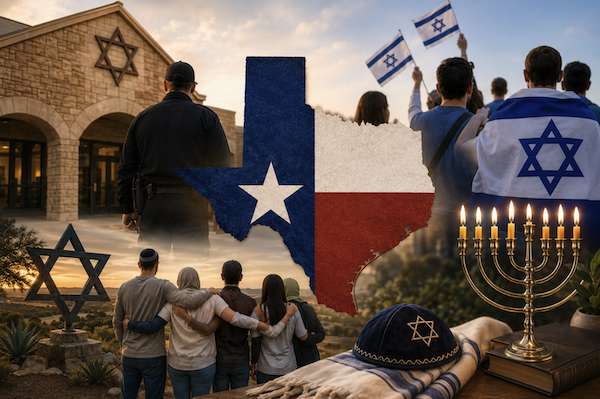
Jewish communities across Texas are navigating a tense moment marked by security concerns, political controversy and a renewed push to highlight Jewish history as part of the state’s broader story.
In Houston, safety concerns returned to the center of community life after Congregation Beth Israel and The Shlenker School closed temporarily in April following a reported threat. Authorities later said two young people had been arrested in connection with an alleged plot targeting the synagogue. The Jewish Federation of Greater Houston said at the time that other Jewish institutions in the area were not believed to be under direct threat, though law enforcement increased patrols around Jewish sites as a precaution.
The Houston case came during a period of heightened concern for Jewish communities nationally, with synagogues, schools and community centers across the country reviewing security practices amid a rise in antisemitic threats and incidents. In Texas, Jewish leaders have repeatedly emphasized that security is now a regular part of communal planning, especially around schools, worship services and public celebrations.
Another recent Houston-area case added to those concerns. A man was arrested after allegedly making violent anti-Muslim and antisemitic threats at the Ismaili Center Houston. The case was a reminder that religious communities often face overlapping threats, and that Jewish, Muslim and other faith groups sometimes share similar concerns about safety and public hostility.
Political tensions have also placed antisemitism in the Texas spotlight. A Democratic congressional candidate in Texas drew widespread condemnation after comments about “American Zionists” were criticized as antisemitic by leaders in her own party and others. The controversy underscored a broader challenge for both parties: how to debate Israel, Zionism and U.S. foreign policy without allowing political rhetoric to become bigotry against Jews.
At the same time, Jewish life in Texas is not defined only by threats or controversy. May is Jewish American Heritage Month, and Texas officials and educators have used the month to highlight Jewish contributions to the state’s history, culture, business, civic life and public service. The Texas Holocaust, Genocide, and Antisemitism Advisory Commission has continued promoting Holocaust and antisemitism education, including programs meant to help students understand the consequences of hatred and the importance of historical memory.
Those educational efforts come at a time when many Jewish organizations say young people need more direct exposure to Jewish history and Holocaust education. In recent months, Texas campuses and community institutions have hosted programs aimed at encouraging dialogue, reducing stereotypes and helping students understand how antisemitism can appear in both old and new forms.
North Texas has also seen signs of active Jewish community life. The Texas Jewish Post recently highlighted local programs including interfaith dialogue efforts, community events and the Bagel Run, a long-running Dallas-area Jewish community tradition that marked its 40th year. In Houston, the Jewish Herald-Voice reported on programs for young Jewish professionals, Yom Ha’Atzmaut events and local religious education.
The picture across Texas is therefore mixed. Jewish communities are investing in security and watching political rhetoric closely, but they are also continuing to gather, celebrate, educate and participate in public life. That contrast has become one of the defining features of Jewish life in Texas today: concern about safety on one hand, and a visible determination to remain active and connected on the other.
For many Texas Jews, the current moment is not simply about responding to antisemitism. It is also about making sure Jewish history, culture and community remain visible in a state where Jewish Texans have played a role for generations.
As Texas continues to grow and diversify, Jewish leaders say the broader challenge is not only protecting synagogues and schools, but building a civic culture where Jewish life is understood as part of the Texas story — not separate from it.