The question of whether Texas is close to becoming a Democratic-leaning state has returned to the center of state political conversation ahead of the 2026 election. A May 2 KUT report from the KUT Festival in Austin highlighted comments from Democratic state Sens. Sarah Eckhardt and Nathan Johnson, both statewide candidates, who argued that the political environment may be more favorable to Democrats this year. Their case rests on a mix of factors: a February special-election win in Tarrant County, early polling in the U.S. Senate race, higher Democratic primary turnout, and a full slate of Democratic candidates across the ballot.
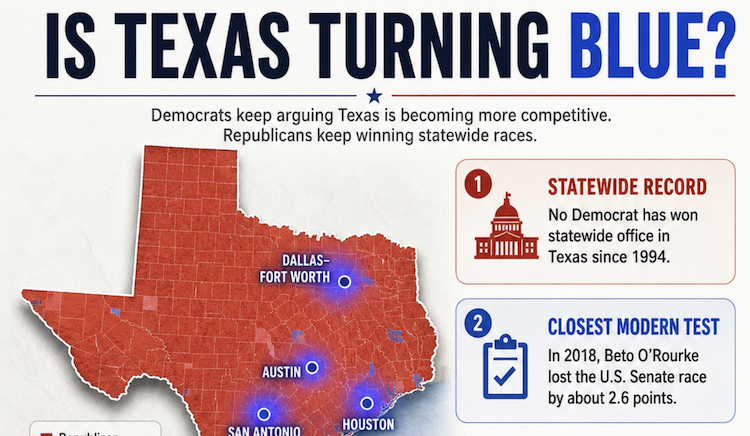
The argument is not new. KUT noted that every election season, Texas political observers debate whether Democrats can finally win a statewide race, something the party has not done since 1994. That year remains the dividing line in modern Texas politics: Democrats successfully held several statewide offices, but Ann Richards lost the governor’s race to George W. Bush, and Republicans have dominated statewide races since then. FOX 4 Dallas-Fort Worth, citing the Texas Secretary of State, the Associated Press and congressional records, reported in 2024 that no Democrat had won statewide office in Texas since 1994, no Democratic U.S. senator had represented Texas since 1993, and no Democratic presidential candidate had carried Texas since Jimmy Carter in 1976.
Democrats continue to say Texas could turn blue because there are real data points that support optimism, even if they have not yet translated into statewide victories. In 2018, Democrat Beto O’Rourke came within 2.56 percentage points of defeating Republican Sen. Ted Cruz, the closest modern Texas Senate race in decades. In 2020, Donald Trump carried Texas by 5.58 points, closer than many past Republican presidential wins in the state. More recently, KUT reported that Democrats pointed to Democrat Taylor Rehmet’s February 2026 special-election win in a Tarrant County district that Donald Trump had carried in 2024, and to polling showing Democratic U.S. Senate candidate James Talarico ahead of both Republican contenders in early matchups.
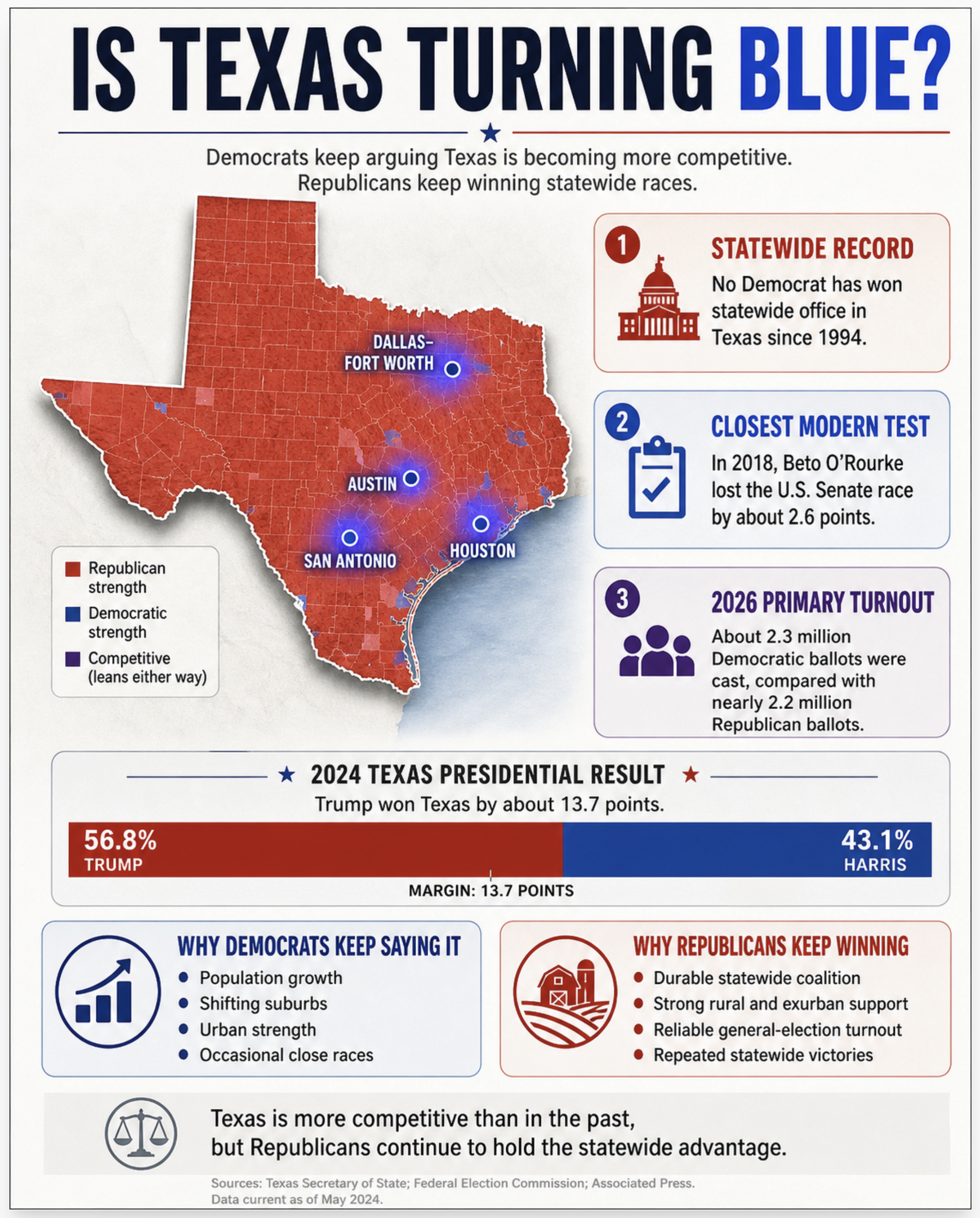
But the broader election record still shows Republicans repeatedly beating Democrats when the entire statewide electorate votes. In 2024, Trump won Texas by about 13.7 percentage points, a larger margin than in 2020 and 2016, according to the Texas Tribune’s election results. That same year, Democrats had hoped record voter registration and major urban-county turnout could narrow the gap, but turnout fell compared with 2020, especially in large counties where Democrats needed strong margins. The Texas Tribune reported that Texas had a record 18.6 million registered voters in 2024, but about 61% cast ballots, nearly six percentage points below 2020.
The 2026 cycle has given Democrats another reason to argue that the state is competitive. The Texas Tribune reported that nearly 4.5 million Texans voted in the March 2026 primaries, with about 2.3 million Democratic ballots and nearly 2.2 million Republican ballots. It was the first time since 2020 that Democratic primary turnout exceeded Republican turnout in Texas. Democratic leaders have used that number to argue that enthusiasm is rising, while Republicans have pointed out that primary turnout does not necessarily predict general-election outcomes, especially in a state where Republican candidates have continued to win statewide races.
The Democratic theory also depends on demographic and geographic change. Texas’ largest metro areas, including Houston, Dallas-Fort Worth, Austin and San Antonio, have become central to Democratic hopes, while some suburban counties have grown more competitive than they were a generation ago. At the same time, Republicans have maintained large advantages in rural Texas, smaller cities, exurban counties and many border-area communities where GOP candidates have improved in recent cycles. That pattern has allowed Republicans to survive Democratic gains in urban and suburban areas by running up large margins elsewhere.
For now, the verified facts support a cautious conclusion: Texas is more competitive than it was during some earlier periods of Republican dominance, but it has not yet become a Democratic state. Democrats keep raising the possibility because they can point to close races, population growth, shifting suburbs, high-profile candidates, and occasional special-election or polling successes. Republicans keep winning because they have built a durable statewide coalition, consistently turn out voters in general elections, and continue to win by enough votes outside the state’s Democratic urban strongholds. Until Democrats win a statewide race, the “Texas turning blue” argument remains a recurring political possibility, not an established political reality.