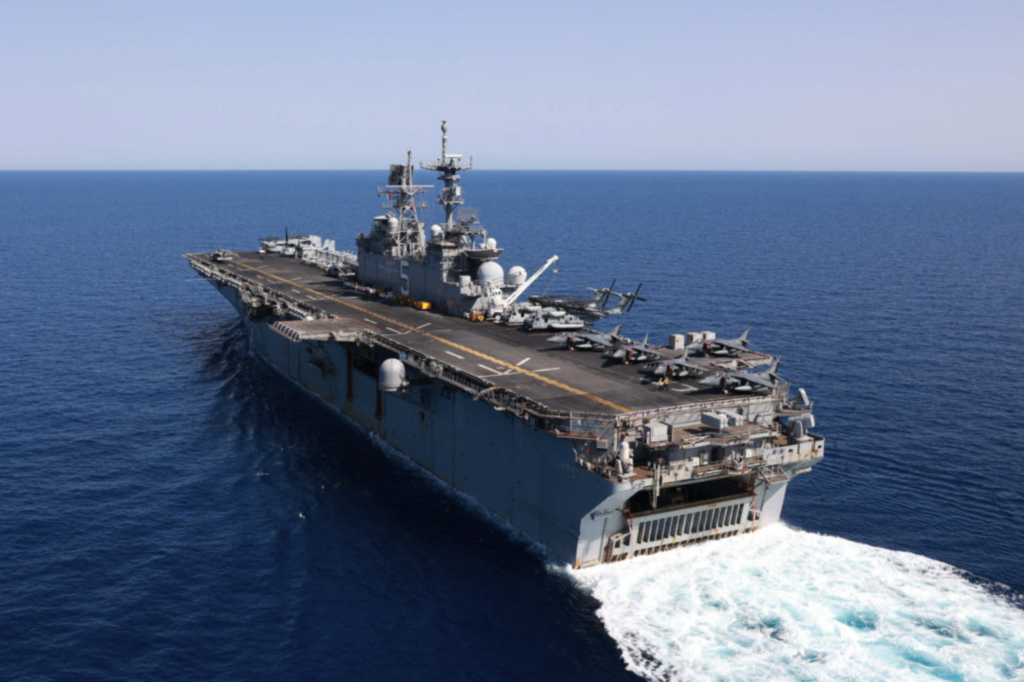
Iranian state-linked media claimed Monday that Iranian forces fired two missiles at a U.S. Navy vessel near the Strait of Hormuz and struck it, but U.S. Central Command denied the report and said no American Navy ships had been hit. The competing claims emerged during a tense day in the Persian Gulf, where the United States has been supporting a maritime effort known as “Project Freedom” and Iran has warned against foreign military activity near the strait.
The Iranian report was carried by Fars News Agency, which is aligned with Iran’s Revolutionary Guard Corps, and said two missiles hit a U.S. Navy frigate near Jask after the vessel allegedly ignored Iranian warnings. Reuters reported separately that Iran’s navy said it had prevented the entry of “enemy warships” into the Strait of Hormuz by issuing what state television described as a “swift and decisive warning.” Those Iranian claims have not been independently verified.
CENTCOM directly rejected the report. In a public statement posted to X, the command said, “No U.S. Navy ships have been struck,” and said U.S. forces were supporting Project Freedom while enforcing a naval blockade on Iranian ports. The Jerusalem Post reported that CENTCOM also said the missiles “didn’t even come close,” a further denial of the Iranian account.
The Associated Press reported that the U.S. military said two American-flagged merchant ships successfully transited the Strait of Hormuz under naval escort, while also denying Iranian claims that an American Navy vessel had been struck. Reuters reported that the United States has missile destroyers in the Gulf as part of the effort to help commercial shipping move through the critical waterway.
The disputed incident comes as traffic through the Strait of Hormuz remains under severe pressure from regional tensions. The strait is one of the world’s most important oil shipping routes, and Reuters reported that the latest confrontation has added to market concerns because roughly one-fifth of global oil shipments move through the waterway. MarketWatch reported that oil prices rose after the disputed Iranian claim, even as the U.S. denied any ship had been hit.
Open-source and social media accounts amplified the Iranian claim shortly after it appeared, but the available public evidence does not confirm that a U.S. warship was struck. Searches of social media feeds showed repeated reposts of the Fars-linked claim, along with reposts of CENTCOM’s denial, but no independently verified imagery, ship-identification data, casualty report, damage report, or official U.S. Navy acknowledgment supporting Iran’s version. The most reliable public record as of Monday remains the official U.S. denial and the absence of corroborating evidence from major wire services.
For now, the facts are limited: Iran-linked media claimed missiles hit a U.S. Navy vessel near Jask; Iran’s navy said it warned off enemy warships; U.S. Central Command said no American Navy ships were struck; and U.S.-supported maritime operations in and around the Strait of Hormuz are continuing. Until more evidence is released, the claim that Iran successfully hit a U.S. Navy ship remains unverified and disputed by the U.S. military.