

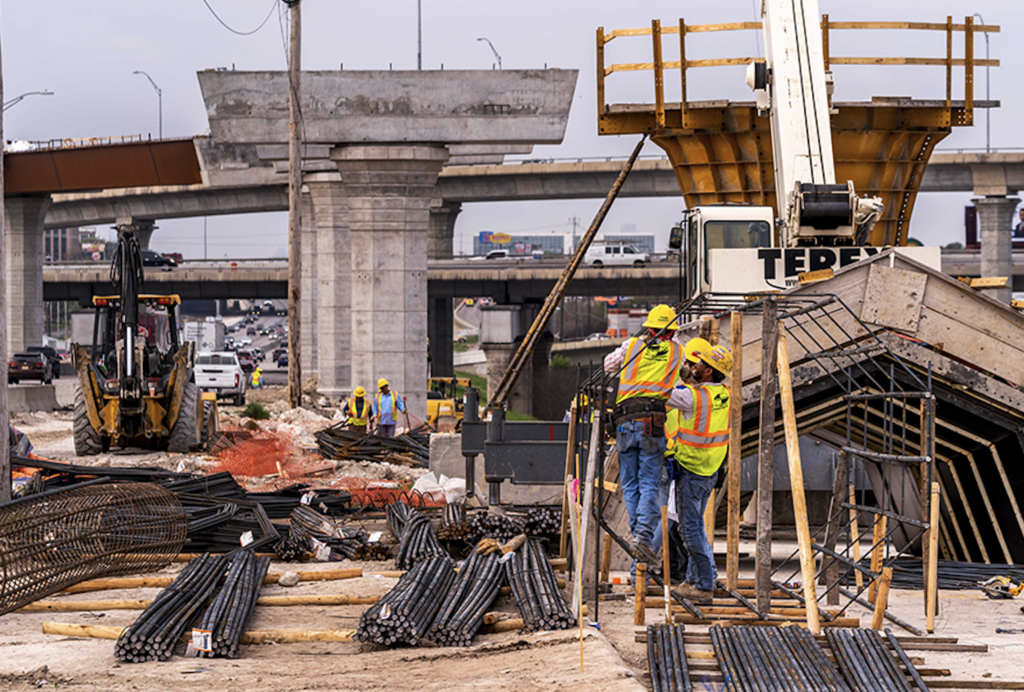
The rebuild of Interstate 45 through Houston is no longer just a transportation proposal sitting on a shelf. After years of planning, lawsuits, neighborhood opposition, federal review, and political debate, the North Houston Highway Improvement Project is now moving into construction. The Texas Department of Transportation says the project will modernize one of the region’s most important freeway corridors, improve safety, reduce congestion, and rebuild aging infrastructure between downtown Houston and Beltway 8 North. But for many Houstonians, the project also represents something more complicated: a multibillion-dollar bet that bigger and redesigned freeways remain the best answer to Houston’s mobility problems.
The project, commonly known as NHHIP, is estimated at roughly $13 billion and includes major changes to I-45, I-10, I-69/U.S. 59, and portions of SH 288 near downtown. One of the most significant changes is the planned relocation of I-45 away from the Pierce Elevated on the west and south sides of downtown. Under TxDOT’s plan, I-45 traffic would instead be routed around the north and east sides of downtown, running near I-10 and I-69. The Pierce Elevated, long seen as both a traffic artery and a physical barrier near downtown, would no longer function as part of I-45, though its final future remains unresolved.
TxDOT’s design also calls for reconstructed interchanges, straighter freeway curves, improved sight lines, new drainage infrastructure, and added non-tolled managed lanes. Those managed lanes are expected to serve carpools, buses, and other eligible vehicles, giving commuters and transit vehicles a more reliable route through the corridor. The agency has argued that the redesign will reduce weaving, improve traffic flow, and make the downtown freeway system safer and more efficient. Supporters see the project as a long-overdue correction to outdated freeway designs that were built for a smaller Houston.
Construction is expected to unfold over many years, with some work already underway and major phases continuing into the 2030s. Early work includes drainage improvements and reconstruction around parts of I-69 and SH 288 near downtown. Larger and more disruptive phases, including the full shift of I-45 around downtown, are expected later in the schedule, with current timelines pointing toward completion around 2038. That means Houston drivers, businesses, and nearby neighborhoods may face more than a decade of lane closures, detours, construction noise, and changing traffic patterns before the full project is finished.
The human cost of the project has remained one of its most controversial issues. TxDOT’s environmental documents projected the displacement of hundreds of residential units, businesses, and public or low-income housing units. The agency has said it is providing fair market value for acquired properties, relocation assistance, and additional housing support in affected communities. TxDOT has also pointed to affordable-housing commitments in neighborhoods such as Independence Heights, Near Northside, Greater Fifth Ward, and Greater Third Ward. Still, critics argue that financial assistance does not erase the disruption caused when homes, businesses, churches, and community institutions are removed or forced to relocate.
The central promise of NHHIP is that it will help traffic move more safely and more efficiently through one of the busiest urban freeway networks in Texas. In practical terms, TxDOT is betting that redesigned interchanges, better lane geometry, improved drainage, and managed lanes will reduce bottlenecks and make travel times more predictable. For commuters, freight traffic, emergency vehicles, and regional travelers, that could bring real benefits. But Houston’s history also raises a familiar question: whether expanding and rebuilding freeways ultimately relieves congestion or simply invites more driving over time.
What the project does not do is just as important as what it does. NHHIP is not a major public transit expansion project. It does not build a new METRORail line, does not significantly upgrade Houston’s rail network, and does not directly maintain or expand METRORail service. While TxDOT has included coordination with METRO and has described the managed lanes as usable by transit vehicles, the project remains overwhelmingly focused on freeway reconstruction. For a region struggling with congestion, population growth, air quality concerns, and limited transit coverage, that omission leaves a major policy question unresolved: Houston is spending billions to rebuild I-45, but it is not using this project to meaningfully expand the public transit system that could give more residents an alternative to driving.