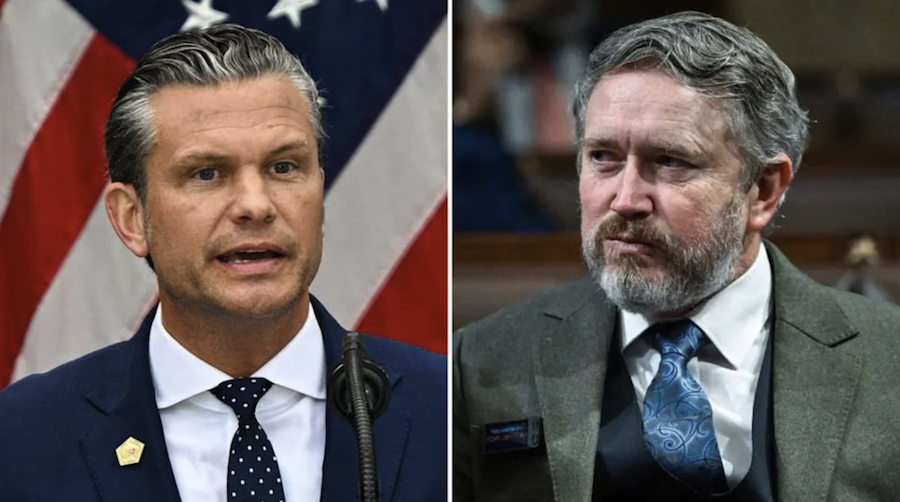
WASHINGTON, D.C. Defense Secretary Pete Hegseth is facing a new impeachment effort after Republican Rep. Thomas Massie of Kentucky introduced eight articles of impeachment against him Tuesday.
Massie introduced the measure as a privileged resolution. That means House rules require lawmakers to deal with it within two legislative days. Unless the House schedule changes, action is expected by Thursday, Sept. 17, before lawmakers leave Washington for an extended recess. Republican leaders could allow a vote on impeachment, move to table the resolution, or use another parliamentary move to dispose of it.
The impeachment effort comes from a Republican member of Congress, although Democrats have also raised many of the same concerns about Hegseth. Earlier this year, Democratic Rep. Yassamin Ansari of Arizona introduced a separate six-article impeachment resolution accusing Hegseth of misconduct involving the Iran conflict and his handling of the Pentagon.
Massie’s new 34-page resolution focuses heavily on the U.S. military campaign against Iran. The first several articles argue that Hegseth continued military operations without the authorization from Congress that Massie says is required under the War Powers Resolution of 1973.
“By engaging in hostilities in Iran for more than 90 days without congressional authorization, Secretary Hegseth is breaking the law and must be held accountable,” Massie said in a statement announcing the impeachment effort.
Massie argues that Congress never formally declared war on Iran or passed a specific law authorizing the continuing military campaign. His resolution also argues that the normal time limits under the War Powers Resolution have expired. The administration disputes that interpretation of presidential war powers.
The disagreement is not limited to impeachment. Late Tuesday night, the House voted 220 to 204 for a separate resolution directing President Donald Trump to remove U.S. forces from unauthorized hostilities with Iran. All 213 Democrats who voted supported the measure. Seven Republicans also voted for it.
That vote does not mean those members support impeaching Hegseth. It does show that a group of Republican lawmakers has joined Democrats in challenging the administration’s authority to continue the Iran operation without additional approval from Congress.
Massie’s impeachment resolution goes beyond the Iran war.
One article accuses Hegseth of weakening Pentagon programs designed to reduce civilian deaths during military operations. The resolution connects that issue to the deadly U.S. strike on the Shajareh Tayyebeh Elementary School in Minab, Iran. Massie’s resolution says more than 200 civilians were killed or injured and argues that Pentagon changes made under Hegseth weakened safeguards intended to prevent such mistakes. These are allegations contained in the impeachment resolution, not findings by a court.
Another article challenges U.S. military strikes against boats suspected of carrying drugs in the Caribbean and eastern Pacific. Massie argues that suspected drug traffickers should normally be handled through law enforcement unless Congress has authorized military force. The administration has defended those operations as part of a broader effort against organizations it considers threats to the United States.
Massie also accuses Hegseth of improperly using Pentagon authority against Sen. Mark Kelly of Arizona after Kelly publicly questioned the legality of certain military orders. The impeachment resolution says Hegseth’s actions threatened Kelly’s free speech rights and interfered with congressional oversight. Hegseth has argued in the past that retired military officers can remain subject to military rules in certain circumstances.
Another article challenges Hegseth’s role in the U.S. military operation that captured Venezuelan leader Nicolás Maduro. Massie argues that the operation amounted to military action against another country without proper congressional authorization.
The final article deals with U.S. military operations against the Houthis in Yemen. Massie argues that Hegseth helped direct the operation without the congressional authorization he believes the Constitution and War Powers Resolution required.
Hegseth has not released a detailed public response answering each of Massie’s eight impeachment articles. However, he has repeatedly defended the military policies that are now being used as grounds for impeachment.
During an official Pentagon briefing earlier this year, Hegseth described the Iran campaign as a major military success. He said Operation Epic Fury had produced a “historic and overwhelming victory on the battlefield” and argued that U.S. forces had badly damaged Iran’s military capabilities.
Hegseth has also defended the continuing U.S. military presence around Iran. During an Aug. 13 press appearance aboard the USS Gridley, he said the United States could maintain its blockade in the Strait of Hormuz “as long as we need to.” He said President Trump remained committed to preventing Iran from obtaining a nuclear weapon.
In another recent Pentagon appearance, Hegseth rejected concerns that the United States could not sustain its military operations. He said the Pentagon was making major new investments in weapons production and insisted the military remained capable of responding if Iran threatened U.S. forces or shipping.
The Trump administration is also defending Hegseth.
Attorney General Todd Blanche responded directly to the impeachment effort during a White House briefing Tuesday.
“Secretary Hegseth is doing a phenomenal job,” Blanche said. He added that Hegseth “follows the law” and said the Justice Department plays an active role in making sure administration actions comply with federal law. Blanche also disputed describing current operations against Iran as a “war.”
Pentagon Press Secretary Kingsley Wilson issued a separate defense of Hegseth, calling him a “transformative leader.” Wilson said the department is united behind Hegseth’s leadership and will continue focusing on U.S. service members and national security.
Massie argues that the question is not whether Hegseth’s military strategy has been successful. He says the central issue is whether the Defense secretary and president can continue major military operations without authorization from Congress.
“Doing this wasn’t predicated on whether it could succeed or not,” Massie told reporters after introducing the resolution. He said he wanted Congress to create a formal record of what he considers unlawful use of military power.
The latest congressional action shows that the debate over war powers is no longer limited to Democrats. Tuesday’s 220 to 204 vote on withdrawing U.S. forces from Iran included seven Republican votes, although most House Republicans opposed the measure.
What happens next could be decided quickly.
Because Massie used the House’s privileged resolution process, Republican leaders cannot simply leave the impeachment measure untouched while the House remains in session. They can seek to table it, which would effectively end the effort without voting directly on whether Hegseth should be impeached. They could also allow the House to vote on the articles themselves.
If the House approved articles of impeachment by a simple majority, Hegseth would be impeached but would not immediately be removed from office. The matter would then move to the Senate for a trial. A two-thirds Senate vote would be required to convict and remove him.
For now, Hegseth remains in office with the public support of the Trump administration. Massie’s action guarantees that House lawmakers will have to address the impeachment resolution before they leave Washington, putting another spotlight on the growing fight between Congress and the administration over who has the authority to decide when and how the United States uses military force overseas.