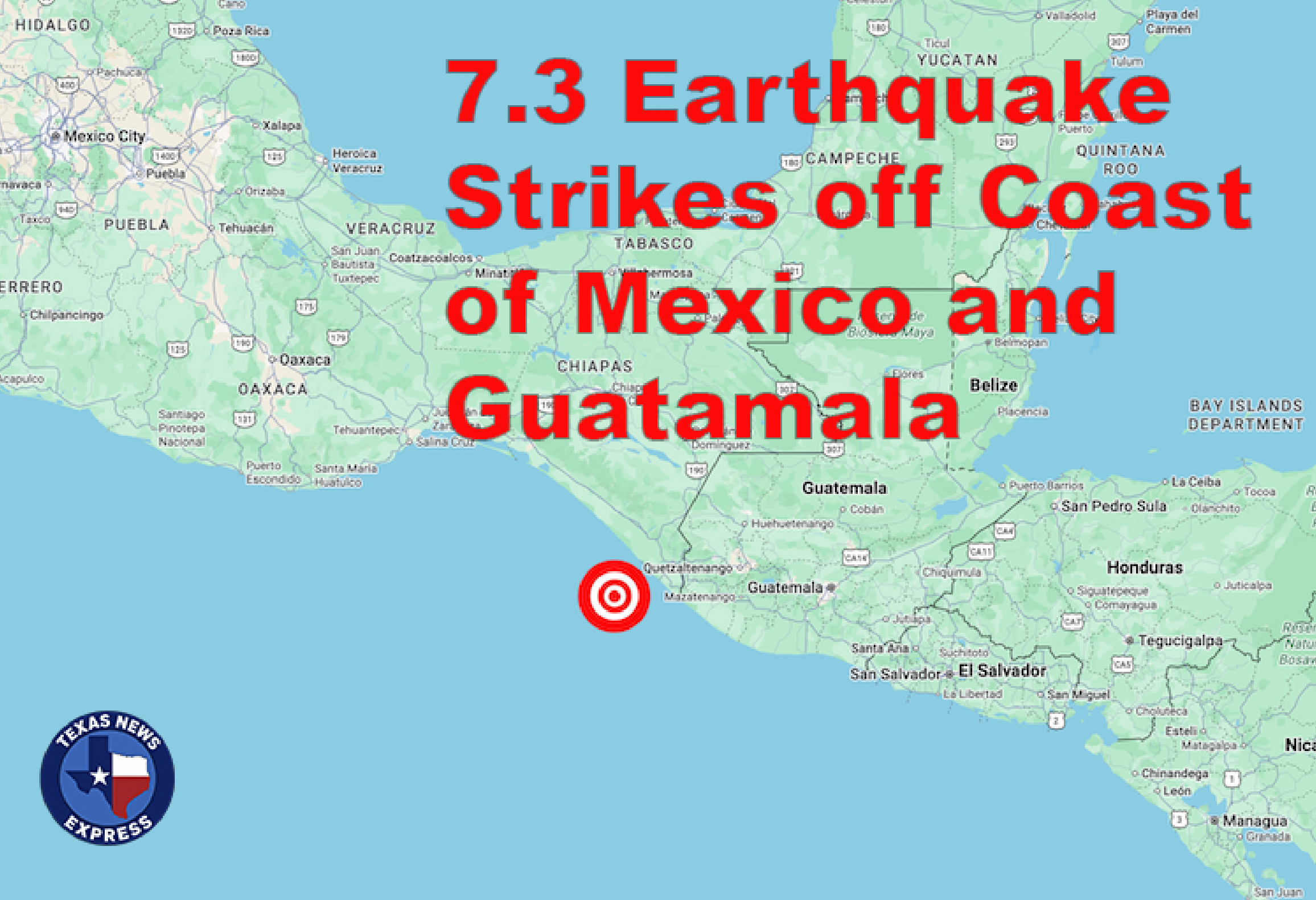
A powerful earthquake struck off the Pacific coast of southern Mexico near the Guatemala border Friday, shaking buildings across southern Mexico, Guatemala and El Salvador and prompting temporary tsunami concerns along nearby coastlines.
The U.S. Geological Survey reported the earthquake at magnitude 7.3, with an epicenter near the coast of Chiapas, Mexico. The quake was shallow, at roughly 15 kilometers deep, which can increase the intensity of shaking felt at the surface. Initial reports had placed the magnitude slightly higher before it was revised.
Authorities in Mexico and Guatemala said there were no immediate reports of major damage or deaths. Mexican President Claudia Sheinbaum said preliminary reports showed no damage in Chiapas or Tabasco, while Guatemalan President Bernardo Arévalo said no deaths had been reported.
The earthquake was felt widely. In Tapachula, near Mexico’s southern border, residents and workers evacuated buildings as the shaking intensified. In Guatemala City, people fled homes and offices during the morning commute. Reuters reported that shaking was also felt in El Salvador.
The quake was preceded by a smaller offshore tremor and followed by multiple aftershocks, including several in the magnitude 5 to 6 range. Officials urged residents in affected areas to remain alert for aftershocks and to follow civil protection guidance.
The tsunami threat was initially focused on nearby Pacific coastlines. The U.S. Tsunami Warning System said hazardous tsunami waves were possible along coasts within about 300 kilometers of the epicenter, with possible waves between 0.3 and 1 meter above tide level for parts of Mexico and Guatemala.
Mexico’s Navy later said it expected water levels to rise by no more than about half a meter in some coastal areas, but still advised people to stay away from beaches as a precaution. The Associated Press reported that the navy recommended avoiding beaches for six hours because of tsunami risk.
The latest bulletin from the U.S. Tsunami Warning Centers listed no tsunami warning, advisory, watch or threat in effect. That means the immediate tsunami danger had eased, although local officials continued monitoring coastal areas.
In Mexico City, the earthquake alert did not sound. Authorities said the initial seismic energy did not exceed the threshold needed to activate the warning system. El País reported that the alert also was not triggered because Chiapas lacks sensor coverage in parts of the region, and the quake was detected later by stations in Oaxaca after the energy had weakened below alert thresholds.
The southern Mexico and Guatemala region is seismically active because it lies near major tectonic plate boundaries along the Pacific coast. Earthquakes are common in this region, and large offshore quakes can sometimes generate tsunami concerns depending on the depth, movement and location of the rupture.
Emergency officials in Mexico, Guatemala and El Salvador continued inspections Friday. Authorities advised residents to avoid damaged structures, watch for landslides in mountainous areas and stay clear of beaches or low-lying coastal zones until local officials confirm conditions are safe.