A Boeing 747-8 once used by Qatar’s ruling family has arrived at Joint Base Andrews as the newest aircraft in the United States’ presidential fleet, giving President Donald Trump a larger and more modern Air Force One while Boeing continues work on two long-delayed permanent replacements.
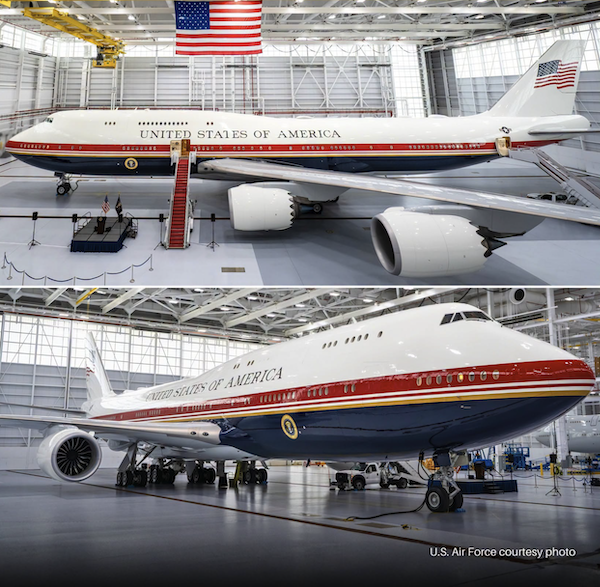
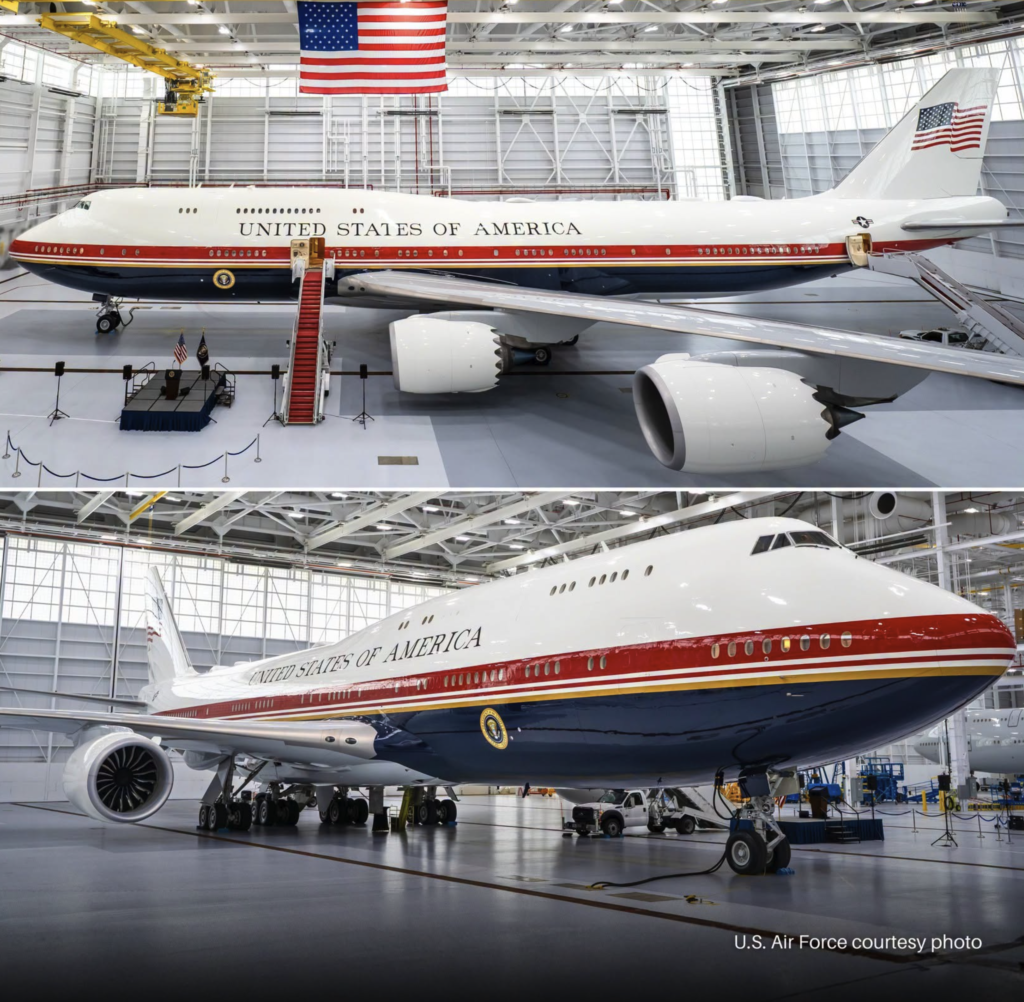
Trump unveiled the aircraft Friday at the Maryland base after touring its interior and addressing several hundred Air Force personnel inside a hangar. The converted jet carries a new red, white, dark blue and gold paint scheme, with a large American flag on the tail and the presidential seal near the forward boarding door.
The aircraft has been delivered to the Presidential Airlift Group, but it must complete commissioning flights and final operational checks before beginning routine presidential missions. Trump said he expects to use it for a NATO summit in Ankara, Turkey, and indicated that it could later carry him to the Asia-Pacific Economic Cooperation summit in China.
It is also scheduled to participate in a July 4 flyover over Washington during events marking the 250th anniversary of the United States.
Although it is commonly being described as the “new Air Force One,” Air Force One is technically the radio call sign assigned to any U.S. Air Force aircraft carrying the president. The converted Boeing is officially part of what the Air Force calls the VC-25B Bridge program because it is intended to fill the gap until Boeing delivers two purpose-built presidential aircraft.
How the United States Obtained the Plane
The aircraft was offered to the United States by Qatar in 2025 as the Trump administration became increasingly frustrated with delays affecting Boeing’s official Air Force One replacement program.
The Defense Department formally accepted the aircraft from Qatar, after which the Air Force contracted with L3Harris Technologies to modify it for presidential use.
The 747-8 had previously been configured as a luxury aircraft for Qatar’s government. The Air Force said much of its head-of-state interior was retained, while military and security systems were added or upgraded.
Converting a commercial or VIP aircraft into a presidential transport involves far more than installing offices and meeting rooms. The aircraft must provide secure communications, protection from electronic surveillance, defensive systems and the ability to support the president and senior advisers while traveling.
The Air Force said the conversion followed a disciplined engineering process that prioritized the aircraft’s essential security, communications and mission requirements.
Some modifications that would ordinarily be considered for a permanent presidential aircraft were reportedly reduced or omitted to accelerate delivery. The Bridge aircraft is therefore not expected to duplicate every capability planned for Boeing’s two permanent VC-25B aircraft.
The precise details of its defensive systems remain classified.
A Temporary Answer to Boeing’s Delays
The current primary presidential aircraft are two heavily modified Boeing 747-200Bs known as VC-25As. They entered service in 1990 and have carried presidents from George H.W. Bush through Trump.
Maintaining those aircraft has become more difficult as the commercial 747-200 fleet has largely disappeared and replacement components have become harder to obtain.
In 2018, Boeing received a fixed-price contract initially valued at approximately $3.9 billion to convert two newer 747-8 aircraft into the next generation of presidential transports. Those planes were once expected to be delivered in 2024.
The first permanent replacement is now expected in mid-2028, approximately four years behind the original schedule. The cost of the broader program has climbed beyond $5 billion, and Boeing has recorded billions of dollars in charges connected to the work.
The delays created the possibility that Trump would complete most or all of his current term before flying aboard the aircraft he helped redesign during his first presidency.
The Qatari aircraft was selected as a faster bridge solution. Unlike the permanent VC-25Bs, which are undergoing extensive structural and military modifications, the former Qatari jet already had an elaborate interior and could be adapted on a shorter schedule.
Trump said the older presidential 747 he used returning from Europe this week had completed its final planned presidential flight and would eventually be displayed in a museum. However, the Air Force is expected to retain access to both existing VC-25As and determine which aircraft to assign based on operational requirements.
Controversy Over the Qatari Gift
The aircraft has been controversial since the proposed transfer became public.
Democratic lawmakers, ethics specialists and some Republicans questioned whether accepting an aircraft worth hundreds of millions of dollars from a foreign government created a conflict of interest or violated constitutional restrictions on foreign gifts.
The Constitution’s Foreign Emoluments Clause prohibits federal officeholders from accepting gifts or benefits from foreign states without congressional consent. The administration argued that the aircraft was being transferred to the U.S. government and Defense Department—not personally to Trump—and that the arrangement complied with applicable law.
Critics responded that the plane’s intended use by Trump, followed by a proposed transfer to his presidential library, blurred the distinction between a government gift and a personal benefit.
Questions were also raised about Qatar’s diplomatic and business interests in the United States. Qatar hosts a major American military installation and has played a prominent role in Middle East diplomacy, while companies and investment entities connected to Qatar have conducted business with organizations tied to the Trump family.
Qatar denied that the aircraft was intended to purchase political influence. Its prime minister described the transfer as a normal gesture between allied governments.
Trump defended the decision, arguing that rejecting a valuable aircraft offered to the United States would waste an opportunity to modernize presidential transportation at a time when Boeing’s replacements remain years behind schedule.
The Plane Was Free, but the Conversion Was Not
Although Qatar provided the aircraft without a traditional purchase price, preparing it for presidential service required substantial government spending.
The Air Force previously said the modifications would cost less than $400 million. Other public estimates have placed the full conversion and related work higher, although the government has not released a complete itemized accounting.
The conversion required the removal or inspection of systems, installation of secure communications equipment, defensive modifications, extensive testing and a new exterior design.
Security specialists had warned that every part of a foreign-owned aircraft would need to be inspected for surveillance devices, compromised wiring or vulnerabilities. Air Force officials say the aircraft was thoroughly evaluated and modified to satisfy the core requirements for presidential use.
The project moved unusually quickly for a presidential aircraft program. L3Harris completed modification and flight testing before the jet was painted and transferred to Andrews for commissioning.
How the Air Force Plans to Use It
The aircraft will serve as a bridge presidential transport until the two Boeing-built VC-25Bs enter service.
It will be operated by the Presidential Airlift Group, part of the 89th Airlift Wing at Joint Base Andrews. The unit is responsible for transporting the president and maintaining the readiness, security and communications capabilities required for presidential travel.
The new aircraft is larger and more fuel-efficient than the aging 747-200-based VC-25A. Its cabin is also significantly more modern because it was originally built as a luxury head-of-state aircraft.
The Air Force is expected to use a mix of aircraft based on mission requirements. The converted 747 may handle prominent international and long-distance trips, while the current VC-25As could remain available as backups or for missions requiring capabilities not incorporated into the accelerated Bridge conversion.
Smaller Boeing C-32 aircraft—military versions of the 757—will continue to be used when airport size, mission conditions or other considerations make a 747 impractical.
The Air Force has also purchased two additional former commercial 747-8s to support the longer-term transition to the newer aircraft type. One is expected to be used for training pilots, crews and maintenance personnel, while the other will provide spare parts.
A New Look for Presidential Aircraft
The Bridge aircraft introduces a significant departure from the blue-and-white design associated with Air Force One since the Kennedy administration.
Its underside is dark blue, separated from the white upper fuselage by red and gold accents. The tail carries an oversized American flag.
Trump originally promoted a similar darker color scheme during his first term. President Joe Biden’s administration later rejected an earlier version because of engineering and heat concerns, but the Air Force subsequently approved a revised design.
Trump said the new colors would eventually appear on other executive aircraft, including the permanent VC-25Bs and Boeing 757s used by the vice president, Cabinet officials and other senior government leaders.
Supporters say the design gives the presidential fleet a stronger and more contemporary appearance. Critics view it as an unnecessary break from an internationally recognized symbol of the presidency.
What Happens After Trump Leaves Office?
The Bridge aircraft belongs to the U.S. government and will remain a government aircraft while it is operated by the Air Force.
When the proposal was first announced, the administration said the aircraft would eventually be transferred to the planned Trump presidential library after Trump leaves office. Trump has continued to describe the jet as a future library exhibit.
Such a transfer would likely occur only after the aircraft is removed from operational service, stripped of classified systems and declared excess to government needs. Sensitive communications, defensive equipment and other military technology could not remain aboard a publicly displayed aircraft.
The proposed library transfer remains one of the most disputed parts of the arrangement. Critics argue that an aircraft received from a foreign government and modified with substantial public funding should not later benefit an institution associated with Trump without clear safeguards and independent valuation.
Supporters say presidential aircraft are commonly displayed in museums or presidential libraries after retirement and that the plane would remain a historical government artifact rather than Trump’s personal aircraft.
The timing may ultimately depend on the delivery of Boeing’s permanent VC-25Bs. If those aircraft arrive in 2028 as currently scheduled, the Bridge jet could have a relatively brief career in frontline presidential service. It could then become a backup aircraft, remain in the executive transport fleet or be prepared for eventual museum display.
Those decisions will be made by the Air Force and federal government in office at the time.
For now, the converted Qatari jet represents both a practical response to an aging fleet and a highly unusual chapter in presidential aviation: a foreign government’s luxury aircraft, rebuilt at American expense, temporarily assuming one of the most recognizable roles in the world.