
The White House says the United States has plenty of weapons to keep fighting Iran. Critics say some of America’s most important missiles have been badly depleted. Public information suggests both claims contain part of the truth.
WASHINGTON — After months of fighting with Iran, a new debate is growing over a basic question: How much ammunition does the United States actually have left? President Donald Trump and Pentagon officials say the military has more than enough weapons to defend the country and continue operations. Outside analysts and some officials speaking privately to news organizations say stocks of several important missiles have fallen sharply. The problem is that the exact numbers are classified, so the public cannot independently check either side.
The government says America is ready
Trump has strongly rejected reports that the United States is running short. He said America has far more munitions than it needs and argued that U.S. defense companies are producing weapons at record levels. Pentagon spokesman Sean Parnell has made a similar argument, saying the military has what it needs to carry out missions ordered by the president and still has a deep range of military capabilities. U.S. Central Command has also been able to move weapons from American stockpiles around the world into the Middle East when needed.
That position is important because a military does not need every type of missile to remain at its prewar level to continue fighting. The United States has aircraft, bombs, drones, air-to-air missiles and many other weapons that can sometimes perform the same mission. CSIS, the Center for Strategic and International Studies, has also said the United States still has enough weapons for any likely military situation involving Iran. Its main concern is what happens if another major war begins at the same time, especially one involving China.
Critics say the numbers tell a different story
The strongest evidence supporting concerns about shortages came from Reuters in August. Three people familiar with U.S. inventory information said the Army had used most of its supply of two important long-range weapons, the older ATACMS missile and the newer Precision Strike Missile, or PrSM. Two sources said the United States had used “virtually all” of those weapons. Another source said the Navy had fired a little less than half of its worldwide supply of Tomahawk cruise missiles during the Iran war. Reuters said it could not independently confirm the exact Tomahawk number.
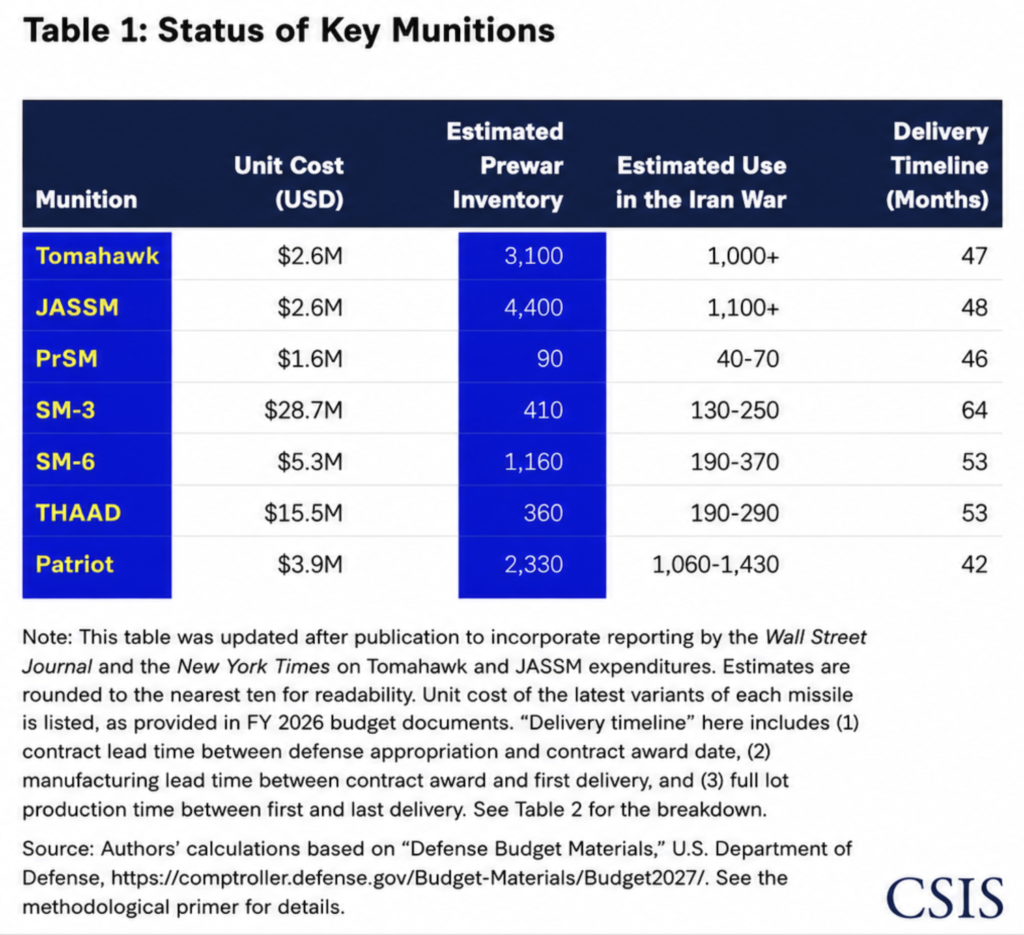
Those reports are similar to earlier public estimates. The Washington Post reported in March that more than 850 Tomahawks had already been fired during only the first four weeks of the war. CSIS estimated that the United States began the conflict with about 3,100 Tomahawks and later estimated that more than 1,000 had been used during the first major phase of fighting. A later Reuters report said the total use had climbed to just under half of the original worldwide supply.
Patriot and THAAD may be the bigger concern
Defensive missiles could be an even more serious problem because they protect U.S. troops and bases from Iranian ballistic missiles. CSIS estimated that America entered the war with about 2,330 Patriot interceptors. After renewed fighting this summer, the group estimated that only about 759 to 827 remained. That would represent a reduction of at least 65%.
THAAD interceptors, which are designed to destroy ballistic missiles at high altitude, have also been heavily used. The latest CSIS estimate cited by the Associated Press placed the remaining U.S. supply at about 234 to 278 interceptors, compared with roughly 452 before the war. CSIS estimated the stockpile was at least 38% smaller than before the conflict. These numbers are estimates rather than official Pentagon inventory figures.
The CSIS figures shown in earlier reports changed as more information became available. One earlier table estimated a smaller prewar THAAD inventory, for example. That is an important warning when reading any of these numbers. Analysts build their estimates from Pentagon budgets, weapons contracts, known deliveries, reports of missiles fired and information from government officials. New information can change the calculation.
What about JASSM?
The air-launched JASSM is another weapon that has been used heavily against Iran. CSIS estimated that the United States entered the war with about 4,400 JASSM missiles, while reporting from The New York Times placed use during the first major campaign at roughly 1,100 JASSM-ER missiles. That represents about one-quarter of the estimated prewar inventory, although there is no reliable public count showing exactly how many usable JASSMs remain today.
That distinction matters. Saying the United States has fired 1,100 JASSMs is not the same as saying it is about to run out. Missiles are continually being delivered, some older models may be upgraded, and not every missile in storage is necessarily available for every mission. However, JASSM is particularly valuable because aircraft can launch it from far away, reducing the danger to pilots when attacking heavily defended areas.
The strange case of the PrSM
The Precision Strike Missile shows how confusing the inventory debate can become. Aviation Week reported in April that an Army unit had exhausted its PrSM supply early in the Iran war. One day later, the Army disputed the report and said PrSM missiles still remained in the overall U.S. stockpile. Months later, Reuters reported that sources familiar with current inventories said the United States had now used “virtually all” of its PrSM and ATACMS weapons. Both stories can be true if the first report referred to a particular deployed unit while the later report dealt with the much larger national inventory after months of additional fighting.
Making replacements is not like ordering more online
Another reason critics are concerned is how slowly many advanced missiles have traditionally been produced. The CSIS data provided with this story showed five-year average production rates of only about 79 Tomahawks a year, 28 THAAD interceptors, 40 SM-3 Block IB interceptors and 96 SM-6 missiles. Manufacturing can also take several years from the time the government signs a contract until all the missiles arrive. CSIS concluded in May that rebuilding Tomahawk, Patriot and THAAD stocks to their earlier levels could take three years or longer under existing delivery schedules.
The government argues those historical production rates are exactly what it is now changing. The Pentagon has ordered defense companies to move much faster. Deputy Defense Secretary Steve Feinberg gave companies 21 days to propose ways to speed delivery of critical weapons and warned that years-long development cycles were no longer acceptable. The Pentagon says the effort is part of a wider rebuilding of the American defense industry that began before the Iran war.
There is real evidence that production is increasing. On Aug. 17, the military announced a $22.9 billion, seven-year Tomahawk agreement with RTX. Reuters reported that Raytheon currently produces about 60 Tomahawks a year but plans to increase capacity to more than 1,000 per year under the agreement. The Pentagon has also signed agreements aimed at tripling production capacity for PAC-3 Patriot components and quadrupling THAAD component production. New agreements with Boeing and RTX are intended to increase production of SM-3 missile-defense components as well.
Those contracts support the administration’s argument that America can rebuild. But they also support part of the critics’ argument: if stockpiles were completely comfortable, there would be less urgency to triple or quadruple production and place parts of the missile industry on what Pentagon officials themselves have called a wartime footing.
Running low is not the same as running out
One of the biggest problems with the public debate is the phrase “America is running out of missiles.” That makes it sound as if the entire military is nearly out of ammunition. There is no evidence that this is true.
CSIS has pointed out that the military still has large numbers of other weapons. For some targets, aircraft can use cheaper JDAM-guided bombs instead of multimillion-dollar cruise missiles. Air-to-air missiles can sometimes help defend against drones and cruise missiles. These alternatives may require aircraft to fly closer to danger, but they mean losing one type of missile does not leave the military unable to fight.
The more serious question is which missiles are running low and what else the United States may need them for. Tomahawks, JASSMs, Patriots, THAADs, SM-3s, SM-6s and long-range Army missiles would all be valuable in a major conflict involving China, Russia or North Korea. The concern among analysts is therefore less about whether America can keep fighting Iran today and more about whether it has enough high-end weapons to fight Iran while also remaining prepared for another crisis elsewhere.
So, who is telling the truth?
Based on the public evidence, the answer appears to be: both sides are describing different parts of the same problem.
The administration is correct that the United States still has an enormous military arsenal, alternative weapons and the ability to continue conducting combat operations. CSIS itself says America has enough weapons for likely scenarios involving Iran. The Pentagon is also moving weapons from other locations and rapidly increasing new production.
Critics are also supported by strong evidence when they say specific, high-value missile inventories have been badly reduced. Reuters reported that internal U.S. information was consistent with CSIS estimates showing major reductions in Patriot and THAAD stocks. Reuters also reported that nearly half the Tomahawk inventory and virtually all available ATACMS and PrSM weapons had been used. The Pentagon’s rush to expand production further shows that rebuilding missile stocks has become a major defense priority.
What nobody outside a small group inside the government can say with certainty is exactly how many missiles are sitting in American storage facilities today. Those numbers are classified for a reason: the United States does not want Iran, China, Russia or any other potential opponent knowing precisely when a particular weapon is becoming scarce.
So America is not out of weapons, and available evidence does not show that the military is incapable of continuing the fight against Iran. But the evidence also makes it difficult to dismiss concerns about depleted stocks as simply false. The United States has burned through significant portions of some of its most advanced weapons, and replacing them will take time even with factories now expanding.
The real debate may therefore be less about whether America can keep fighting today and more about a harder question:
How much of America’s arsenal should be used against Iran today if those same missiles may be needed for a much larger war tomorrow?