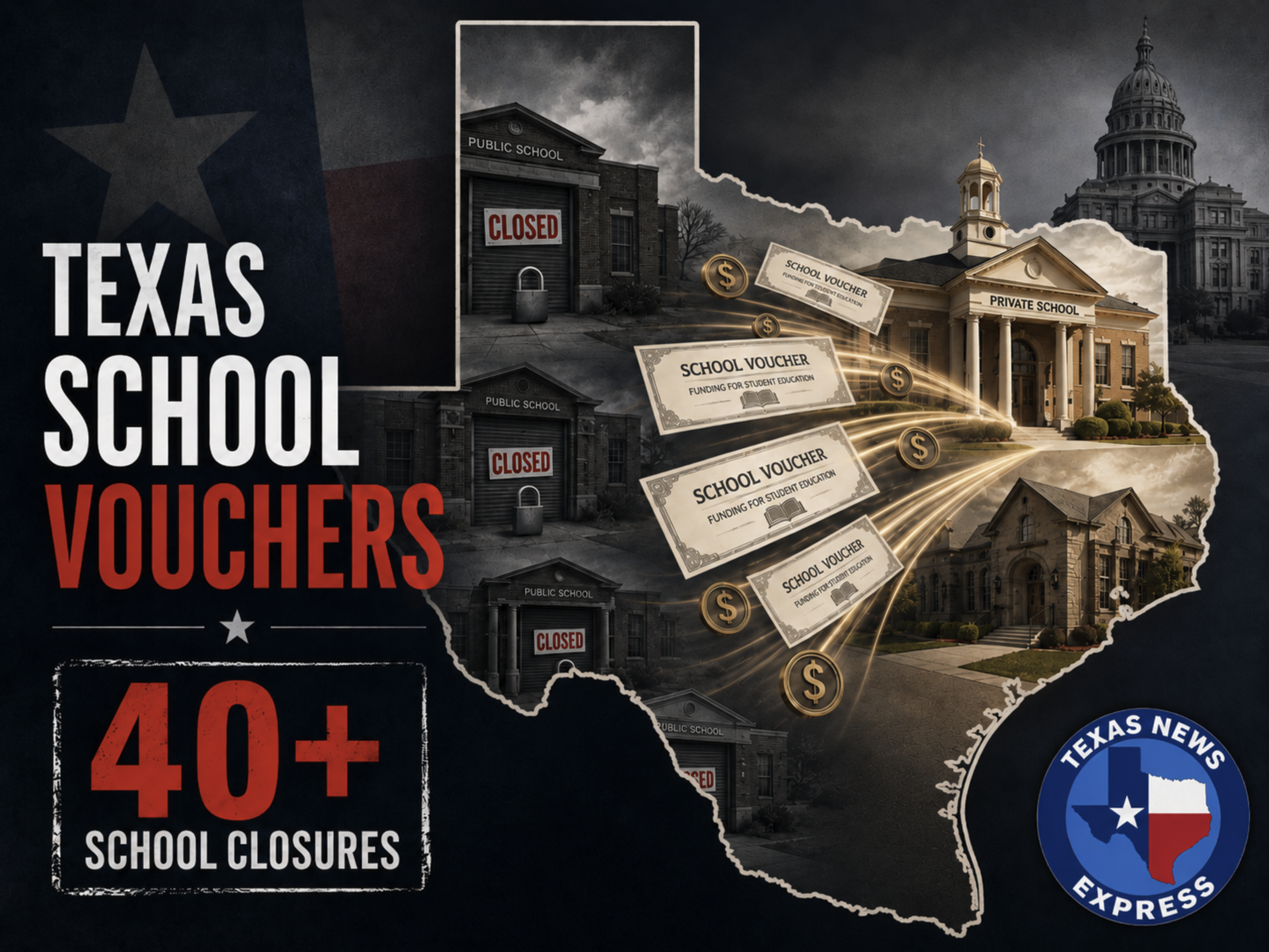
Texas is entering a new era of public education in which shrinking enrollment, budget shortfalls and the launch of a $1 billion private-school voucher program are converging. Dozens of public-school campuses have recently closed or are scheduled to close, raising a difficult question for state leaders: should Texas continue directing public money toward private education, or invest more aggressively in repairing and improving the schools that serve most Texas children?
There is no single official statewide count covering every traditional public school and charter campus that has closed, consolidated or been converted to another use. Confirmed announcements nevertheless show that the number is substantial. Houston-area districts alone closed or approved the closure of 26 campuses during the past year. Houston ISD accounted for 12 of those closures, Fort Bend ISD seven, while Aldine, Pasadena, Spring and Spring Branch also closed or consolidated schools. Aldine has now closed 11 campuses over two years.
The trend extends beyond Houston. Austin ISD approved the closure of 10 schools after reporting approximately 21,000 empty classroom seats and a loss of about 10,000 students over the previous decade. Fort Worth, San Antonio-area districts and charter operators have also reduced their footprints. KIPP Texas, for example, approved the closure of seven campuses—five in Austin and two in San Antonio—beginning in the 2026–27 school year.
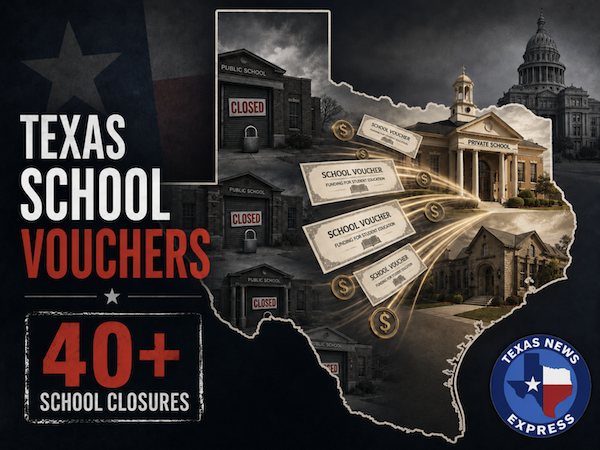
Taken together, the confirmed closures in just Houston, Austin and KIPP exceed 40 campuses, even before counting other district actions across North Texas, San Antonio and smaller communities. The true statewide number is higher, but comparisons can be complicated because some campuses are fully closed, while others are merged, relocated, converted into specialty programs or placed under outside management.
Why Schools Are Closing
The most immediate cause is declining enrollment. Texas public schools enrolled about 5.47 million students in 2025–26, down roughly 76,000 from the previous school year—the first significant non-pandemic statewide decline in decades. State projections suggest traditional public-school enrollment could fall by another 100,000 students by 2030.
The decline is not being driven by one factor. Texas has fewer school-age children in some established urban neighborhoods, while housing costs are pushing young families farther from central cities. Birth rates have fallen, and some districts have lost immigrant students amid changing migration patterns and enforcement fears. Charter schools, homeschooling and private education have also attracted students away from neighborhood districts. Meanwhile, fast-growing suburban districts in places such as Katy and portions of North Texas continue adding students, showing that the problem is uneven rather than statewide population collapse.
Texas funds districts largely according to attendance. When students leave, revenue falls faster than many operating costs. A district may lose 10% of its enrollment but still need to maintain the same building, roof, heating system, cafeteria, security staff and bus routes. Closing an under-enrolled campus can reduce utility, maintenance and staffing expenses, but the savings often come at a social cost. Neighborhood schools can function as community anchors, particularly in lower-income areas where families may have fewer transportation options.
Districts are also confronting the expiration of federal pandemic aid, rising insurance and utility costs, aging buildings, special-education obligations and pressure to raise employee pay. Austin officials estimated school consolidation could produce about $20 million in immediate savings, while Fort Bend acted partly in response to a $32 million deficit. Pasadena faced a roughly $50 million shortfall, and Spring Branch was dealing with a gap of about $24 million.
Will Private-School Vouchers Cause More Closures?
Texas’ new Education Freedom Accounts program begins serving families during the 2026–27 school year. Senate Bill 2 permits state-funded accounts for approved private-school tuition and other education expenses. Lawmakers capped spending at $1 billion for the first biennium, including administrative costs. Qualifying private-school students can generally receive $10,000 annually, with different amounts available in some circumstances for students with disabilities, homeschooling and other approved expenses.
Demand has been considerable. The state reported receiving more than 274,000 applications during the first application window, although an application does not necessarily mean that a student will receive funding, accept an award or leave a public school.
It would be inaccurate to blame the current wave of closures primarily on vouchers. Many district enrollment declines began years before the program was enacted, and most closure decisions were already developing before voucher money reached families. The program’s first-year effect on public-school enrollment is not yet known.
However, vouchers could intensify existing financial pressure if substantial numbers of students transfer from public schools to participating private schools. Because state funding follows students, even a modest additional decline could force districts already operating half-empty campuses to make further staffing and consolidation decisions. The effect may be greatest in metropolitan areas with a large supply of private schools; rural communities may have few or no participating private options.
There is also evidence that much of the initial voucher demand may come from students already outside the public system. In Midland, only 344 of 1,462 applicants living within the district’s boundaries had been enrolled in Midland ISD, according to district data. That suggests a large share of early state spending may subsidize families already using private schools or homeschooling rather than causing immediate departures from public classrooms.
Would the Money Be Better Spent on Public Schools?
Supporters of the voucher program argue that families should not be trapped in schools that are unsafe, academically weak or unable to meet a child’s needs. They say competition can pressure public systems to improve and that parents, rather than government agencies, are best positioned to choose an education for their children. Gov. Greg Abbott described the law as a way to give families greater educational freedom.
Critics argue that the state is creating a second publicly financed education system while the first continues closing campuses and struggling to recruit teachers. Private schools receiving voucher money are not required to provide every service offered by public districts, may select which students they admit and generally do not face the same accountability, transparency and special-education obligations as public schools.
The $1 billion allocated to vouchers is large enough to matter, but it should be viewed alongside the Legislature’s separate $8.5 billion public-school funding package enacted in 2025. That law increased money for teacher compensation, operational expenses, special education and other priorities. District leaders nevertheless say the package did not fully cover inflation, special-education costs, employee insurance, security mandates and years in which the basic allotment failed to keep pace with expenses.
Whether voucher money would produce greater public benefit inside traditional schools is ultimately a policy judgment. One billion dollars could finance teacher raises, counselors, building repairs, security improvements or tutoring. But simply adding money without changing how struggling schools are managed would not guarantee better outcomes. Some low-performing campuses have received additional funding or outside partnerships without producing sustained academic improvement.
What Experts Say Texas Schools Need
Education researchers and school leaders generally identify teacher quality and retention as the most important school-based factors affecting learning. Texas has expanded teacher incentive payments and adopted new compensation funding, but experts continue to call for higher base salaries, stronger preparation, paid mentoring for new teachers and improved working conditions. The state’s 2025 funding law also begins phasing out some uncertified teachers and rewards high-quality training, reflecting concern that rapid hiring of underprepared educators has weakened classroom quality.
Academic improvement also requires early literacy and mathematics intervention, longer-term tutoring and reliable measurement of whether programs work. Districts that wait until middle or high school to address reading gaps face far greater costs and lower chances of success. Turnaround efforts are more likely to work when strong principals and experienced teachers remain in place long enough to establish consistent instruction.
Experts also emphasize the importance of improving attendance. Texas schools lose both instructional time and state funding when students are chronically absent. Better transportation, family outreach, school-based health services and early intervention with frequently absent students can improve both enrollment stability and academic outcomes.
School safety reform increasingly extends beyond armed personnel and secured doors. Texas law now requires updated emergency plans, safety committees and revised drill procedures, but specialists also recommend interoperable communications, controlled campus access, rapid notification systems and regular coordination with local first responders.
Mental-health support is another recurring recommendation. Counselors, behavioral-threat assessment teams and access to treatment can help identify risks before they become emergencies while also improving attendance and student behavior. Texas has no dedicated school-finance allotment exclusively for student mental health, leaving districts to assemble services from limited or temporary funding sources.
Finally, experts say the state needs a more stable funding system. Districts cannot effectively plan staffing, safety improvements or building repairs when funding changes sharply with attendance, temporary grants or legislative cycles. Greater transparency is also needed when campuses are considered for closure, including public criteria, demographic impact studies, transportation planning and clear explanations of what will happen to the buildings.
A Choice About the Future of Public Education
School closures are sometimes financially necessary. Maintaining a nearly empty, deteriorating building can divert money from teachers and students at better-used campuses. Consolidation can create stronger academic programs if receiving schools are well staffed, safe and prepared for additional students.
But closures can also accelerate decline if families lose trust, students face longer travel times and communities conclude that the district is retreating from their neighborhoods. Closing a school is therefore not only a budget decision; it is a decision about which communities will continue to have a public institution within reach.
Texas’ voucher program will provide new options for some families, but it will not replace the public-school system. Public districts must accept students regardless of disability, academic history, family income or whether a private school considers them a good fit.
The central question is not simply whether Texas should support public schools or parental choice. It is whether the state can expand private options without destabilizing the system responsible for educating more than five million children. The answer will become clearer over the next several years as voucher participation, enrollment losses, campus closures and academic results can finally be measured rather than predicted.