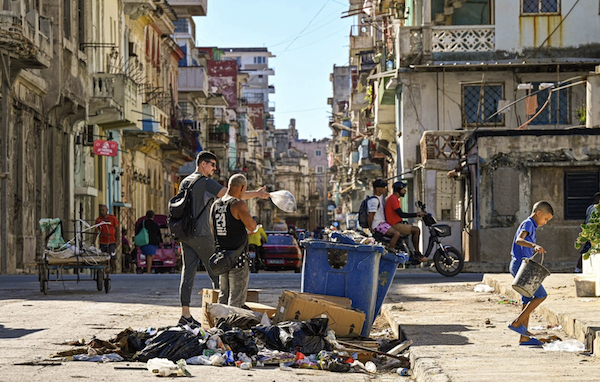
HAVANA — Cuba is facing one of its most severe energy crises in decades, with fuel shortages, rolling blackouts, public protests and new U.S. sanctions converging into a widening political and humanitarian emergency.
Cuba’s national electric grid suffered a major failure Thursday, cutting power to eastern provinces from Guantánamo to Ciego de Ávila, according to the Associated Press. The state-run Electric Union said crews were working to restore power, but did not provide a firm timetable. The collapse came as Havana and other parts of the island were already experiencing long daily outages.
Reuters reported that many Cubans are now enduring blackouts of 20 hours or more per day, while parts of Havana saw protests after residents went extended periods without electricity. Demonstrators in several neighborhoods blocked roads, banged pots and demanded that power be restored. Reuters reported that the protests were largely peaceful and were among the largest demonstrations in Havana since the current energy crisis worsened.

The Cuban government is facing collapse as the oil and electricity crisis create a humanitarian disaster. Most island residents have no way to cook, get to work or keep clean with power failures nationwide. Patients in hospitals and the elderly are in an even more complicated and desperate situation. The U.S. is trying to force the communist country’s president Miguel Diaz Canel to make changes to step aside.
The crisis is tied directly to Cuba’s lack of imported fuel. Cuban officials said oil delivered by a Russian tanker in late March had run out by early May. Reuters reported that Cuba has received no known oil shipments since that tanker delivered about 700,000 barrels, roughly enough for a couple of weeks for the island’s nearly 10 million people. Cuba produces only about 40% of the fuel it needs to run its economy, according to AP.
On Friday, Cuba nearly doubled gasoline and diesel prices, saying the new rates were needed to reflect the real cost of imports. Reuters reported that premium gasoline rose from $1.30 to $2.00 per liter, regular gasoline rose from $0.95 to $1.80, and diesel rose from $1.10 to $2.00. However, public filling stations in Havana remained largely closed, and many drivers said they had gone months with little or no fuel.
The shortages have also fueled a black market. Reuters reported that gasoline has been selling illegally for $8 to $10 per liter, far beyond the reach of most Cubans. Some private businesses have imported fuel at high cost, but that fuel is generally not available to the public.
The United States has increased pressure on Cuba through sanctions and threats aimed at restricting fuel access. Reuters reported that the blackouts worsened after President Donald Trump threatened tariffs on any country supplying Cuba with fuel, and that Venezuela and Mexico, previously major suppliers, have since cut off shipments.
The Trump administration has denied that there is a formal naval blockade around Cuba. Secretary of State Marco Rubio said on May 5 that there is “no oil blockade on Cuba per se,” according to a State Department transcript summary, while U.S. officials have framed the pressure campaign as an effort to force political and economic changes on the island.
The sanctions campaign expanded this month. On May 1, the U.S. Treasury Department announced Executive Order 14404, titled “Imposing Sanctions on Those Responsible for Repression in Cuba and for Threats to United States National Security and Foreign Policy.” OFAC later said the order authorizes sanctions against foreign persons involved in Cuba’s energy, defense, mining, financial services and security sectors, as well as people accused of supporting the Cuban government, serious human rights abuse or corruption.
OFAC clarified that operating in one of those sectors does not automatically mean a person or company is sanctioned, but it does expose foreign entities to sanctions risk if U.S. officials determine they meet the order’s criteria.
The U.S. has also offered humanitarian assistance. AP reported that the State Department reiterated this week that the U.S. would provide $100 million in humanitarian assistance and support for satellite internet if the Cuban government permits it. Cuban officials have long objected to U.S. sanctions and Cuba’s designation as a state sponsor of terrorism, while Washington says Havana cannot remain a safe haven for U.S. adversaries in the Western Hemisphere.
Tensions increased further after CIA Director John Ratcliffe met Cuban officials in Havana, including Raúl Castro’s grandson, according to AP. The meeting came as Cuba’s fuel reserves were depleted and as U.S.-Cuba relations remained under strain. AP also reported that the Justice Department is preparing to seek an indictment against former Cuban President Raúl Castro over his alleged role in the 1996 shootdown of planes operated by the exile group Brothers to the Rescue. Any indictment would still require approval by a grand jury.
For ordinary Cubans, the immediate problem is not diplomacy but daily survival. Long blackouts are spoiling food, disrupting work, limiting transportation and worsening conditions during hot weather. The government has restored power to some essential services after grid failures, but Cuba’s aging energy infrastructure, lack of fuel and limited access to outside financing leave the island with few short-term options.
The latest developments show Cuba caught between an internal economic collapse and an external U.S. pressure campaign designed to force political concessions. The result is an island where electricity, fuel and basic public patience are all running low.