The views expressed in this opinion article are those of the writer.
Zohran Mamdani is now the mayor of New York City. He won a lawful election and has every right to serve. His Muslim faith should be respected and protected under the same Constitution that protects Jews, Christians and every other religious group.
The issue is not his religion or background. The issue is whether his policies respect individual freedom, equal treatment, limited government and the free-market system that helped make New York one of the world’s greatest cities.

Netanyahu, Hamas and unequal attention
Mamdani repeatedly said Israeli Prime Minister Benjamin Netanyahu should be arrested if he came to New York. He called Netanyahu a war criminal and urged the federal government to cooperate with the International Criminal Court.
Mamdani has also said that anyone properly charged by the ICC should face justice. That broad statement would include Palestinian suspects. It would therefore be inaccurate to claim that he has completely rejected accountability for Palestinian leaders.
However, his public attention has been heavily focused on Netanyahu. He has not placed the same repeated and personal emphasis on Hamas leaders accused of organizing the October 7 terrorist attack, murdering civilians, taking hostages and committing sexual violence.
The ICC’s own charter states that it only has jurisdiction within countries that have signed up and agreed to the Rome Statute, which is the treaty that created the ICC. Yet The United States nor Israel (and neither is Russia) are members but somehow the ICC waives its own self-created limited jurisdiction and goes after non-participating countries. It has even issued an arrest warrant for Russian President Vladamir Putin. This is a dangerous precedent because if left to stand, the ICC can one day claim jurisdiction within the United States.
For many Jewish New Yorkers, the difference in emphasis matters. A mayor who speaks forcefully about arresting Israel’s elected prime minister should be equally forceful about Palestinian terrorist leaders who intentionally targeted civilians.
Mamdani’s administration has continued an official city office focused on fighting antisemitism. That deserves recognition. The real question is will he continue to fund it and empower it? But Jewish residents will judge his administration by more than the existence of an office. They will also judge his words, priorities and willingness to apply the same moral standards to Israel’s enemies.
Political theater is not the rule of law
Mamdani’s promise to arrest Netanyahu also raised a basic question about constitutional government.
A New York City mayor does not control American foreign policy. The United States is not a member of the ICC, and questions involving diplomatic immunity, federal law and foreign leaders are handled mainly by the federal government. Mamdani later acknowledged that the city could not simply carry out an arrest on its own.
This is why limited government matters. Public officials should not promise actions outside their lawful authority simply because those promises excite supporters.
The Constitution divides authority among federal, state and local governments. A mayor should concentrate on public safety, housing, sanitation, city services and the local economy—not pretend that City Hall can act as an international criminal court.
He must govern all New Yorkers
Mamdani won the election and has a real democratic mandate. But winning an election does not mean every resident agrees with him.
New York includes Democrats, Republicans and independents. It includes Jews, Muslims, Christians, Hindus and people of no religion. It includes renters, homeowners, police officers, union members, small-business owners, immigrants and major employers.
A mayor’s responsibility is not merely to reward the groups that elected him. It is to govern the entire city, including residents who strongly disagree with him.
That is especially important in a city with the largest Jewish population outside Israel. Jewish New Yorkers should not be treated as morally suspect because they support Israel’s right to exist or believe Israel has a right to defend itself.
At the same time, Muslim New Yorkers must be protected from hatred and discrimination. Equality means applying the same civil rights, public protection and moral standards to everyone.
The affordability promise was larger than his power
Mamdani built much of his political appeal around making life more affordable. That message connected with voters who are struggling with rent, groceries, transportation, health coverage and utility bills, in other words, the basics.
The problem is that a mayor has limited power over many of those prices.
City Hall does not control global food prices, fuel markets, interest rates, national inflation or most medical costs. New York State regulators review health-insurance rates. The Metropolitan Transportation Authority is governed by a state-created board, with the mayor recommending only some of its members. A mayor cannot simply order every major household expense to fall.
Voters were sold an affordability promise that suggested far more mayoral control than actually exists.
Mamdani’s proposed city-operated grocery program is one example. The plan calls for five stores supported by a $70 million city initiative, with the first not expected to open until 2029. Even successful stores of that size could serve only a small share of New York’s population and would not control food prices across the city.
Government can subsidize a product, freeze a regulated price or shift a cost onto taxpayers. It cannot make the true cost disappear.
Someone always pays, the real question is if that “someone” can afford to pay.
New programs could become new taxes
The greatest danger is that Mamdani will respond to costs he cannot control by raising taxes and creating expensive new programs.
New York City’s comptroller reported that the administration’s preliminary budget depended partly on a proposed 9.5% property-tax increase, greater state assistance and savings that had not yet been fully identified. The comptroller projected multibillion-dollar budget gaps in later years.
Property taxes do not affect only wealthy building owners. Landlords may pass part of the cost to tenants. Stores may face higher rents. Businesses may raise prices. Homeowners may have less money to spend or invest.
Large government programs can also produce waste, fraud and poor results when they lack strong oversight. That does not mean every public program fails. It means every program should have clear goals, public audits, spending limits and measurable results.
Compassion should be judged by whether people are actually helped—not by how much money the government announces it will spend.
Taxing the wealthy is not free money
Mamdani and his allies have argued that wealthy residents and corporations should pay more to support public programs.
It is reasonable to debate whether tax rates should change. But it is misleading to treat high earners as a permanent source of unlimited money.
High-income households are more able than working families to move, change where income is reported or delay taxable transactions. New York depends heavily on revenue from a relatively small number of high earners, making the city vulnerable when financial markets fall or taxpayers leave.
There are examples supporting the conservative warning. After Maryland adopted a millionaire tax, the number of millionaire tax returns fell sharply and expected revenue did not appear. However, that happened during the Great Recession, making it difficult to separate migration from falling incomes and investment losses.
Research from New Jersey has found much smaller migration effects, and New York City’s comptroller has estimated that some proposed taxes on high earners could still produce additional revenue after accounting for behavioral changes.
The evidence is therefore mixed. It would be wrong to say every tax increase on wealthy people has failed. However, California finds itself in a tough position. As they raise taxes and fees to make up for budget shortfalls, more wealthy and middle class residents move out of California, resulting in even lower tax revenues, which is the opposite affect politicians had hopes for when they raised taxes. New York looks to follow that same mistep.
The stronger argument is that elected officials should not build permanent programs around uncertain revenue. Tax policy should consider how people and businesses will respond, not assume they will remain in place and continue paying whatever government demands.
New York must compete with Florida, Texas, New Jersey, Connecticut and other places for residents, investment and jobs.
Housing prices are mainly a supply problem
New York’s housing crisis is not difficult to understand. Too many people are competing for too few available homes.
The city’s rental vacancy rate recently fell to about 1.4%, its lowest level since 1968. When supply is extremely limited and demand remains high, prices rise.
Rent freezes may give temporary relief to some current tenants, but they do not create new apartments. Research on San Francisco’s rent-control expansion found that affected landlords reduced rental housing supply, contributing to higher citywide rents over time. New York is not identical to San Francisco, but the results offer an important warning.
A 2023 study found many landlord’s simply refused to put all of their empty apartments on the market. Some because the cost to renovate the apartment to make it comply with new regulations would exceed what they could get for the unit and others because keeping supply limited maximizes what they get on the units they do rent out. Add to that rent control and rent freezes and you only incentivize landlord to keep even more apartment off the market, thereby increasing the cost of housing even more.
To Mamdani’s credit, his housing plan calls for building 200,000 affordable homes, preserving another 200,000 and allowing more development near public transportation. Those supply-focused parts of his plan move in the right direction. But Mamdami has no way to pay for these affordable homes and has advocated for new regulations and costs that make developers stay away because they are unable to build and still make any amount of profit.
The city should go further by allowing more housing, approving projects faster and simplifying zoning rules. It should permit taller buildings in appropriate areas, legalize more small apartments and reduce delays that add years and millions of dollars to construction. The city shold also reduce regulation when possible as long as it doesn’t create dangerous living situations.
New York cannot regulate its way out of a housing shortage. It must build its way out.
Regulations keep ordinary people from working
New York often claims to support working people while maintaining rules that make it difficult for ordinary people to start businesses.
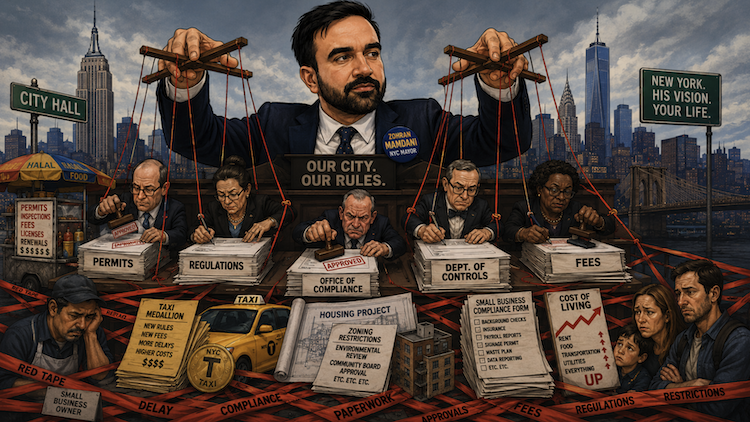
Street vendors are a clear example. For years, the city kept the number of available food-vending permits far below demand. That shortage pushed some workers into an unofficial secondary market and kept others outside the legal economy. Although recent reforms are expanding permits, the history shows what happens when government turns permission to work into a scarce privilege.
The taxi industry provides another example. A person who wants to own and operate a yellow taxi must obtain a medallion, while drivers also face licensing, testing, fingerprinting, training and other costs. Medallion prices are far below their former peak but can still reach tens or hundreds of thousands of dollars.
These barriers protect people who already hold licenses and permits, but they can keep newcomers from entering the market. It has also kept gig works such as Uber and Lyft drivers from effectively competing for business due to limits and regulations when where and when they can operate, essentially making the yellow taxi’s a city controlled monopoly.
A qualified person who is willing to work should not need political connections, a rare permit or a large amount of money merely to sell food or drive passengers safely.
Mamdani has announced more than 50 changes intended to remove outdated permits and reduce paperwork for small businesses. That is one part of his agenda conservatives should welcome. The same approach should be expanded throughout city government.
Jobs are better than dependency
New York needs a political environment that encourages employers to hire, investors to build and entrepreneurs to take risks.
A strong economy helps people become earners and taxpayers. It reduces long-term dependence on public assistance while giving families greater control over their own futures.
Government has an important role. It should protect public safety, enforce contracts, maintain infrastructure and provide a basic safety net for people who truly need help.
But government should not attempt to control every price, operate every business or replace private decision-making.
The goal should be to help people rise, not manage their poverty indefinitely.
Freedom, free markets and equality
New York does not need government control disguised as affordability.
It needs more housing, more employers, more competition and fewer unnecessary barriers. It needs equal protection for Jewish, Muslim and Christian residents. It needs leaders who respect constitutional limits and apply the same moral standards to allies and enemies.
Mayor Mamdani has an opportunity to govern differently from the ideological image he built during his campaign. His support for housing construction and small-business deregulation deserves fair consideration.
But his administration should be watched closely when it promises price controls, large new programs, higher taxes or symbolic foreign-policy actions outside the mayor’s authority.
New York became great because people from around the world came there to work, build, trade, worship and pursue opportunity.
The answer to the city’s problems is not less freedom.
It is freedom, free markets and equality under the law.
In conclusion
I’m not trying to say that New York City needs to be exactly like Texas. But there is a reason people are leaving New York and people are moving to Texas and it largely centers around affordability in housing, taxes and general lifestyle. You can either put your head in the sand and hope the problem somehow fixes itself, or you can recognize that reality and work to make it a better place for all. I do wish Mamdami a successful mayoralship and I do truly hope he is able to serve the needs of New Yorkers, but with the policies he advocates, I’m afraid the only people he will be serving are government employees as his administration grows larger to enact and enforce a wide spread of new regulations.