

Federal health officials say shredded iceberg lettuce served at some Taco Bell restaurants has been linked to a multistate outbreak of cyclosporiasis, a parasitic intestinal illness that can cause prolonged diarrhea and other gastrointestinal symptoms.
The Centers for Disease Control and Prevention said the outbreak is linked to shredded iceberg lettuce served at Taco Bell locations in Indiana, Kentucky, Michigan, Ohio and West Virginia. As of the CDC’s latest update, 1,644 people infected with Cyclospora who reported exposure to Taco Bell had been identified across those five states. Ninety-four people have been hospitalized, and no deaths have been reported.
The Food and Drug Administration’s traceback investigation identified a single supplier of shredded iceberg lettuce from Mexico used by Taco Bell locations where customers ate before becoming ill. The FDA and Taco Bell have not publicly named the supplier. However, the Associated Press and other news organizations reported, citing officials or sources familiar with the investigation, that Taylor Farms of Salinas, California, had been identified as a supplier under review.
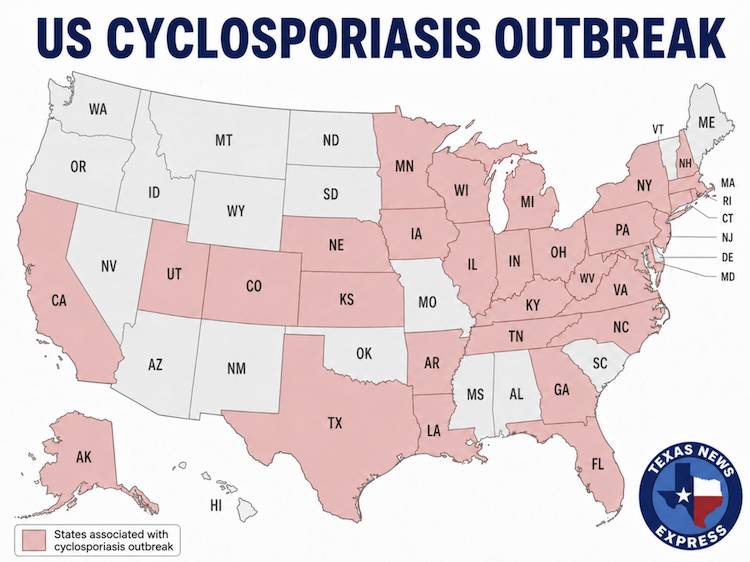
According to the CDC, the cyclosporiasis outbreak has been found in these states as of July 17, 2026.
Taco Bell said it had voluntarily removed potentially affected lettuce from select restaurants as a precaution after discussions with public health officials. The company also said the affected ingredient from that supplier was being removed from its supply chain nationwide and would be replaced quickly in select states.
The CDC is advising consumers not to eat shredded iceberg lettuce from Mexico served at Taco Bell locations in Indiana, Kentucky, Michigan, Ohio and West Virginia. Federal officials said not all Taco Bell restaurants in those states received lettuce from the same supplier, and the FDA is still investigating whether potentially contaminated lettuce may have gone to other restaurants, retailers or distribution channels.
Cyclospora cayetanensis is a microscopic parasite that spreads when people consume food or water contaminated with feces. The illness, called cyclosporiasis, often causes watery diarrhea, stomach cramps, nausea, fatigue, appetite loss and weight loss. Symptoms usually begin about a week after exposure but can appear anywhere from two days to more than two weeks later.
The illness is not usually life-threatening, but symptoms can last for weeks or return after improving. The CDC says people with symptoms should contact a health care provider. Testing can be difficult because routine stool tests may miss Cyclospora unless the provider specifically requests testing for the parasite. Cyclosporiasis is commonly treated with antibiotics, along with rest and fluids.
Michigan has been the hardest-hit state in the broader outbreak. Before the federal traceback announcement, Michigan health officials said early findings pointed to lettuce or salad greens as a possible source, though they said at the time that no specific produce type, grower or supplier had been identified. State officials reported 2,640 cases as of July 13 and said Michigan typically records only about 40 to 50 cyclosporiasis cases in a year.
Michigan officials said more than 1,000 interviews had been completed with people who tested positive. They also recommended extra caution with lettuce and salad greens, including buying whole heads of lettuce when possible, discarding outer layers, washing inner leaves under clean running water and cooking greens when possible. The state warned that washing alone may not fully remove Cyclospora.
The FDA said it is working with the identified supplier to determine whether potentially contaminated shredded iceberg lettuce remains on the market. The agency and state partners are collecting product samples for testing and analysis. Federal officials also said they have increased screening at the border for products implicated in the outbreak.
The investigation remains active. The CDC said the actual number of sick people is likely higher than the confirmed total because some people recover without medical care or are not tested for Cyclospora. The agency is also investigating other cyclosporiasis illnesses nationally that may not be related to the Taco Bell-linked outbreak.
The outbreak highlights the challenge of tracing illnesses connected to fresh produce, which often passes through complex supply chains before reaching restaurants and grocery stores. Leafy greens are frequently eaten raw, and contamination may occur before harvest, during processing or through distribution.
For now, federal guidance is focused on shredded iceberg lettuce from Mexico served at Taco Bell locations in the five affected states. Consumers who recently ate at those restaurants and develop prolonged watery diarrhea, nausea, cramps or fatigue should contact a health care provider and mention possible Cyclospora exposure.