
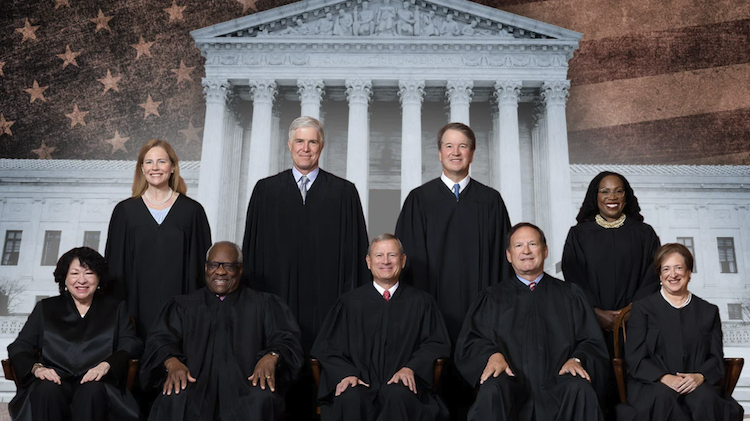
WASHINGTON – The Trump administration has asked the U.S. Supreme Court to allow new federal restrictions made by President Trump via an Executive Order on mail-in voting to take effect while a legal challenge continues.
The Justice Department filed an emergency request Monday asking the justices to temporarily lift a lower court order. That ruling currently blocks President Donald Trump’s executive order in 23 states and the District of Columbia. The restrictions could affect voting procedures before the Nov. 3 midterm elections, which will determine control of Congress.
Historically, elections and voting is ran by each state independently. The 10th Amendment of the U.S. Constitution says, “The powers not delegated to the United States by the Constitution… are reserved to the States respectively, or to the people.” This means that unless a power or authority is granted to Congress in the Constitution, it is a states rights issue, leaving the states free to make their own rules. Article 1, Section 4 says; “The Times, Places and Manner of holding Elections for senators and Representatives, shall be prescribed in each State by the Legislature thereof; but Congress may at any time by Law make or alter such Regulations, except as to the Places of Chusing Senators. Most interpret this to mean that each state decides their own election rules.
The Supreme Court has not decided whether the executive order is legal. For now, the administration is asking the court to let federal agencies move forward while the larger lawsuit works its way through the courts. The justices ordered the states challenging the policy to respond by Aug. 3.

What the executive order would do
Trump issued the executive order in March. It directs federal agencies to create lists of confirmed U.S. citizens who are eligible to vote in each state. The lists would be built using citizenship, naturalization and other federal government records.
The order would also require the U.S. Postal Service to deliver mail ballots only to voters included on state-approved mail-ballot lists. It directs the Justice Department to give priority to investigations involving state or local election officials who provide federal ballots to people the government considers ineligible.
Trump and his supporters say the changes would help prevent noncitizens from voting and improve confidence in elections. Noncitizen voting is already illegal, and available evidence shows that it is rare.
States argue the president exceeded his power
Democratic officials from 23 states and the District of Columbia sued to stop the order. California, Massachusetts, Nevada and Washington are among the states leading the case.
The states argue that the Constitution gives state governments and Congress—not the president—the main authority to set rules for federal elections. They also say federal citizenship databases may contain outdated or incomplete information that could wrongly leave eligible voters off the lists.
The states have warned that changing voting systems only months before an election could create confusion, increase costs and prevent some eligible voters from receiving ballots.
Twelve Republican state attorneys general have joined the case in support of the Trump administration’s policy.
Federal courts block the order
In June, U.S. District Judge Indira Talwani in Massachusetts blocked major parts of the executive order. She ruled that the president did not have the legal power to direct states to use federal voter lists or to give the Postal Service control over mail-ballot eligibility.
Talwani also found that the states had shown they could face real harm. That harm could include added expenses, election disruptions and possible federal investigations of election workers.
The administration appealed, but a divided panel of the 1st U.S. Circuit Court of Appeals refused to lift Talwani’s order. The judges said election deadlines were approaching quickly and that states had little choice but to begin preparing for the possible changes.
A different federal judge in Washington reached another result in a separate lawsuit earlier this year. That judge declined to immediately block the executive order because federal agencies had not yet completed rules that would directly affect voters. The judge did not decide whether the executive order itself was legal.
Administration says the lawsuit came too early
The Justice Department argues that the states filed their lawsuit before federal agencies had decided exactly how—or whether—to carry out every part of the order.
Government attorneys say the lower court should not have assumed that future agency rules would be unlawful before those rules were completed. They also argue that the states do not yet have the legal standing needed to sue.
The states disagree. They say election officials must prepare months in advance and cannot wait until the final weeks before voting begins to learn which rules will apply.
What happens next
The Supreme Court could allow the executive order to take effect temporarily, keep it blocked or issue a narrower ruling affecting only certain parts of the policy.
Any emergency decision would not necessarily settle the full legal case. The larger dispute over presidential power, state control of elections and federal mail-ballot rules could continue in lower courts and later return to the Supreme Court.
Until the justices act, the lower court order remains in place for the states involved in the lawsuit.