
A growing number of cybersecurity experts, technology companies and government agencies are warning about a future threat known as “Q-Day” — the point when quantum computers become powerful enough to break much of the encryption that protects modern digital life.
The concern is not that ordinary computers are about to collapse tomorrow. The concern is that governments, banks, hospitals, utilities, defense contractors and private companies may be running out of time to replace vulnerable encryption systems before quantum computing reaches that threshold.
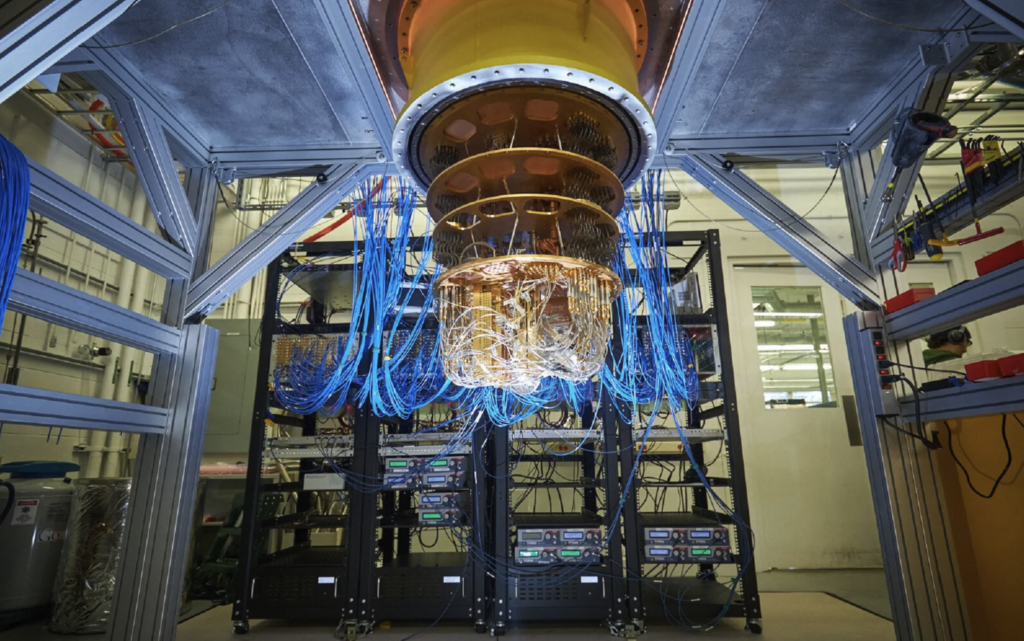
Google’s Sycamore quantum computer processor, part of the tech giant’s efforts into quantum computing and solving the qubits problem.
Google recently warned that the threat from quantum computers could arrive sooner than many organizations previously expected. In a March 2026 security post, Google said quantum computers will pose a significant threat to current cryptographic standards, especially encryption and digital signatures. The company also said the threat is already relevant because of “store-now, decrypt-later” attacks, where hackers or governments steal encrypted data today and hold it until future quantum computers can decrypt it.
Q-Day refers to the day when a cryptographically relevant quantum computer becomes capable of defeating widely used public-key encryption systems. Those systems include forms of RSA and elliptic-curve cryptography, which are used to protect websites, banking systems, software updates, email, cloud services, cryptocurrency wallets, government communications and countless business systems.
The reason quantum computers are different is that they do not process information the same way traditional computers do. Powerful quantum machines could use mathematical techniques, including Shor’s algorithm, to solve certain problems far faster than ordinary computers. That matters because much of today’s public-key encryption depends on math problems that are practically impossible for classical computers to solve in a reasonable amount of time.
The threat is serious enough that the U.S. government has already begun pushing agencies and industries toward post-quantum cryptography, or encryption designed to resist both classical and quantum attacks.
In August 2024, the National Institute of Standards and Technology released the first three finalized post-quantum encryption standards. NIST said the standards are intended to help protect electronic information from future quantum computers and encouraged system administrators to begin transitioning as soon as possible.
CISA, the Cybersecurity and Infrastructure Security Agency, has also issued guidance to help organizations identify products and technologies that will need upgrades to post-quantum cryptography. Its 2026 guidance focuses on hardware and software categories that rely on encryption, including systems used in enterprise networks, cloud services, identity management, internet connections and operational technology.
The financial sector is paying close attention. A Europol-backed financial cybersecurity group warned banks in 2025 that they should prepare now for quantum risk, noting that attackers may already be collecting sensitive encrypted data to decrypt later. The same report said major institutions should identify vulnerable cryptographic systems and plan migration strategies before quantum computers reach that capability.
The challenge is scale. Encryption is embedded almost everywhere: browsers, phones, payment systems, routers, industrial control systems, medical devices, cloud platforms, corporate VPNs, government databases and software-signing systems. Replacing it is not like updating a single password. It can require years of inventory work, testing, vendor coordination and system upgrades.

That is why experts say the most urgent work is not panic, but preparation.
The first step for most organizations is creating a cryptographic inventory — a map of where encryption is used, what algorithms are in place, what data must remain confidential for years, and which systems depend on RSA or elliptic-curve cryptography. After that, companies can prioritize the systems that protect long-term sensitive data, critical infrastructure, financial transactions and software-update chains.
The risk is especially high for information that must remain secret for many years. Medical records, intelligence files, legal records, defense data, trade secrets and financial records could still be valuable long after they are stolen. That is why “store-now, decrypt-later” attacks are considered a present-day threat even before Q-Day arrives.
There is still disagreement over exactly when Q-Day will happen. Some researchers believe a quantum computer capable of breaking major encryption systems remains many years away. Others say recent progress in quantum hardware, error correction and algorithm design could shorten the timeline. The Guardian reported in March that Google warned quantum computers could potentially crack current encryption systems as early as 2029, although other experts still place the threat in the 2030s or later.
For ordinary consumers, the immediate takeaway is not to stop using online banking or encrypted websites. Current encryption still works against conventional hackers. The bigger issue is whether the companies, governments and service providers that hold sensitive data are preparing early enough.
For businesses, the warning is more direct: waiting until Q-Day arrives may be too late. Systems that take years to modernize could become vulnerable if migration starts only after a major breakthrough is announced.
Cybersecurity agencies are not saying the internet will suddenly shut down. They are saying the digital trust system that supports banking, communications, software updates and government services needs to be upgraded before quantum computers become powerful enough to attack it.
Q-Day may still be years away. But the cybersecurity race has already started.