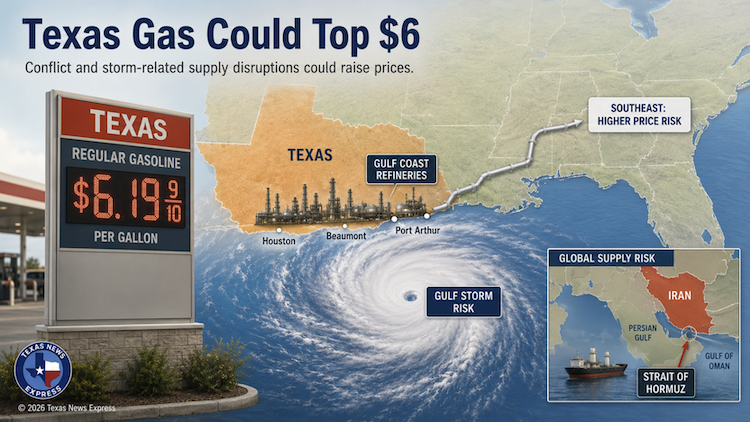
Gasoline prices in Texas could climb above $6 per gallon if the ongoing conflict involving Iran continues to disrupt global oil markets and a major hurricane strikes the Texas Gulf Coast, where some of the nation’s largest refinery complexes are located.
That outcome is not a certainty. But energy analysts, federal data and recent market conditions show that a combination of geopolitical conflict, hurricane damage, refinery outages or pipeline disruptions could create the kind of supply shock that pushes fuel prices far beyond the records Texas drivers have seen before.

As of May 17, 2026, AAA listed the Texas average for regular gasoline at $3.975 per gallon, while the national average stood at $4.513. Texas’ highest recorded statewide average for regular gasoline was $4.695, set on June 15, 2022.
But the current market is already under pressure. AAA reported earlier this month that the national average had risen sharply, reaching $4.55 per gallon after back-to-back weekly increases of 25 cents. Reuters reported that oil prices rose after President Trump said the Iran ceasefire was “on life support,” with Brent crude closing at $104.21 and West Texas Intermediate at $98.07 on May 10.
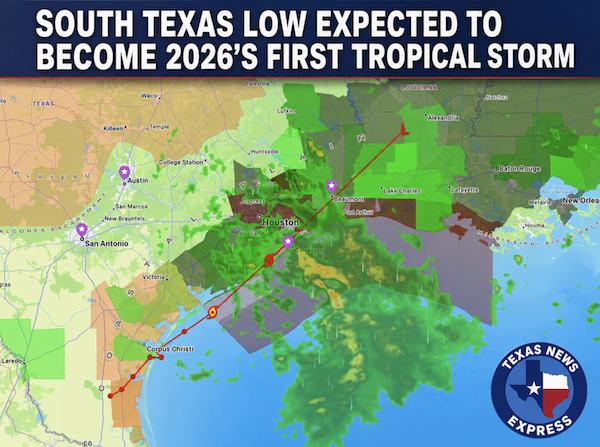
The biggest risk for Texas drivers is a two-part crisis: continued instability in the Middle East combined with a major Gulf Coast hurricane.
The Strait of Hormuz remains one of the world’s most important oil transit routes. Any prolonged disruption there can increase crude oil prices globally, even for the United States, which produces large amounts of oil domestically. Gasoline prices are tied not only to local supply but also to world oil markets, refinery capacity, shipping costs and investor expectations.
At the same time, Texas is home to a large share of the U.S. refining system. The Gulf Coast is the nation’s most important refining region, and EIA data shows the Texas Gulf Coast and broader Gulf Coast refining network are central to U.S. gasoline, diesel and jet fuel production.
That concentration creates strength in normal times, but vulnerability during storms.
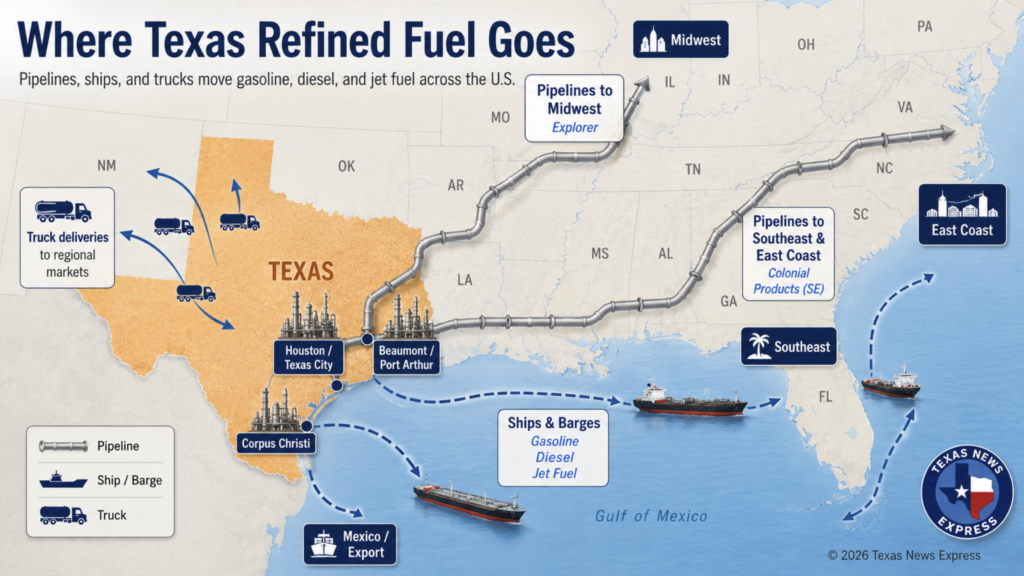
A map that shows where refined oil products such as gasoline, diesel, jet fuel are sent in the U.S. Texas ships about 20% of its total output to foreign countries including Mexico, Europe, and east Asia.
The Energy Information Administration has repeatedly warned that hurricanes can disrupt Gulf Coast oil production, refinery operations, ports, pipelines and fuel distribution. In a 2023 hurricane-impact analysis, the EIA modeled a high-impact case involving a 15% reduction in Gulf Coast refining capacity, equal to about 8% of total U.S. refining capacity, for one month. The agency said that level of disruption would be roughly equivalent to shutting down all New Orleans-area refineries for a month or sharply cutting Houston-Galveston refinery operations.
History shows the risk is real. After Hurricane Harvey struck Texas in 2017, Gulf Coast refinery inputs fell by 3.2 million barrels per day, or 34%, in one week — the largest drop since Hurricanes Gustav and Ike in 2008. The EIA said Harvey caused major disruptions to crude oil and petroleum product supply chains and increased petroleum product prices.
A similar storm today could hit an already stressed market. If Iran-related tensions keep crude prices high and a hurricane forces shutdowns at refineries in Houston, Beaumont, Port Arthur, Corpus Christi or along the Louisiana Gulf Coast, Texas prices could move quickly from the $4 range into the $5 range — and in a severe case, above $6 per gallon.
The impact would not stop at Texas.
Much of the Southeast and East Coast depends on refined fuel moving from the Gulf Coast through major pipelines. The EIA says Gulf Coast and East Coast fuel markets are linked primarily by the 2.5 million-barrel-per-day Colonial Pipeline and the 720,000-barrel-per-day Products Pipeline, formerly known as the Plantation Pipeline. The Colonial system often runs near capacity, meaning there is limited room to quickly replace lost supply.
Reuters reported last year that Colonial’s main gasoline line, which moves fuel from Houston to Greensboro, North Carolina, transports about 1.5 million barrels of gasoline per day. In a major Gulf Coast refinery shutdown, hurricane disruption, pipeline leak or refinery breakdown, states across the Southeast could face tight supply, price spikes and localized shortages.
In that kind of severe supply shock, gasoline prices across the Southeast could exceed $7 per gallon, especially if panic buying, pipeline allocation limits or delayed refinery restarts compound the problem. Other regions, including the West Coast and Northeast, could see even higher prices because of different fuel specifications, transportation limits and heavier dependence on imported or regionally specific fuel supplies.
The federal government has already been using the Strategic Petroleum Reserve to ease pressure on markets. The EIA reported that the reserve was created to reduce the effects of unexpected oil supply disruptions and has an authorized capacity of 714 million barrels across four Gulf Coast storage sites. But recent drawdowns have lowered the cushion. EIA data showed the SPR falling from 392.7 million barrels on May 1 to 384.095 million barrels on May 8, 2026.
That does not mean the reserve is empty. It still contains hundreds of millions of barrels. But a lower reserve gives policymakers less flexibility if the country faces multiple disruptions at the same time: war-related oil-market stress, hurricane damage, refinery outages, pipeline problems or a major surge in summer driving demand.
Energy markets are especially sensitive because gasoline is not simply a crude oil problem. Crude must be produced, transported, refined, blended, stored and delivered to gas stations. A breakdown at any major point — a refinery fire, a pipeline leak, a port closure, a power outage, a hurricane evacuation or a military escalation near oil-shipping routes — can raise prices.
For Texas, the bottom line is this: $6 gasoline is not the expected normal price, but it is no longer an unimaginable scenario. It would likely require a major combination of events, especially continued Iran-related oil disruption and a serious Gulf Coast hurricane or refinery failure.
For drivers, businesses and policymakers, the warning is clear. Texas may sit near the heart of America’s energy system, but that also means the state is exposed when that system is hit by war, weather or infrastructure failure.