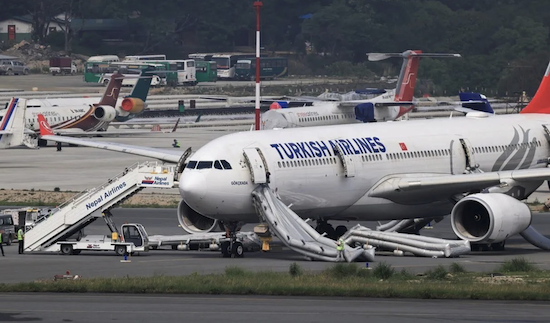
A Turkish Airlines Airbus A330 arriving from Istanbul was evacuated at Nepal’s main airport Monday after smoke and fire were reported from the aircraft’s landing gear while it was taxiing at Tribhuvan International Airport in Kathmandu. All 277 passengers and 11 crew members were safely evacuated, and officials said no injuries were reported.
The aircraft had landed in Kathmandu after a scheduled flight from Istanbul when smoke was seen coming from the landing gear area. Nepalese aviation officials said the fire involved the aircraft’s right rear tire and was quickly extinguished by emergency crews. The incident forced the temporary closure of the airport, which has a single runway, while responders handled the aircraft and safety checks were completed.
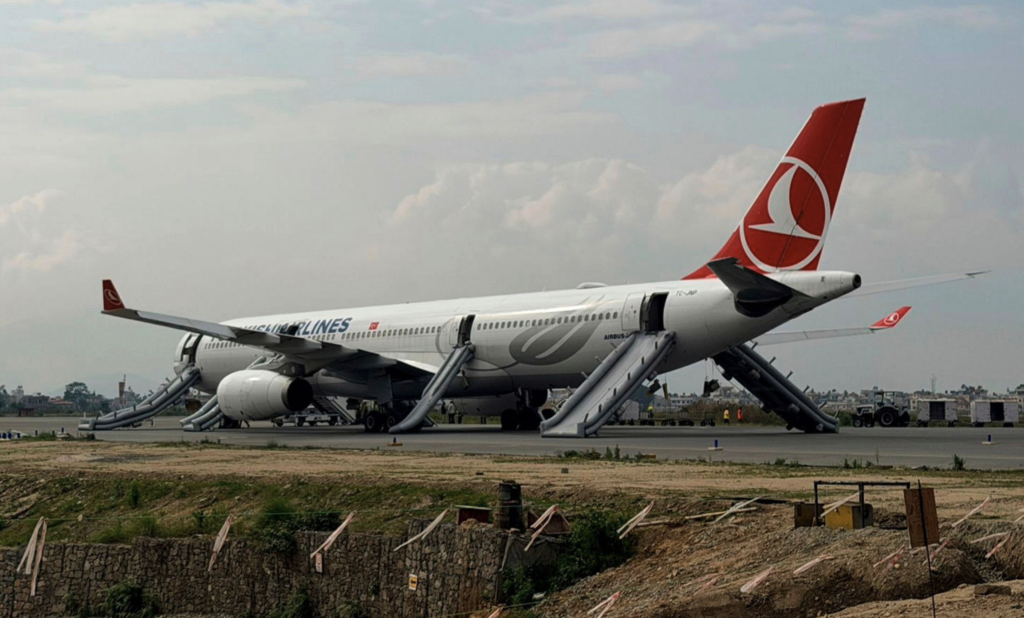
Passengers were evacuated using emergency slides after the crew initiated a precautionary emergency evacuation. Images from the scene showed the wide-body aircraft stopped on the airport surface after landing, with emergency response activity around the aircraft. According to the Associated Press, the airport reopened within about two hours after the aircraft was moved to a secure location.
Turkish Airlines said the aircraft landed normally before smoke was observed from the landing gear while taxiing. Yahya Üstün, the airline’s senior vice president for communications, said initial assessments indicated the smoke may have been caused by a technical malfunction in a hydraulic pipe. The airline said technical inspections had been started and that an additional flight was being arranged for the return leg.
The flight was identified in Turkish and regional reporting as Turkish Airlines flight TK726, operated by an Airbus A330 registered TC-JNP. The aircraft was flying the Istanbul-to-Kathmandu route, a long international service into one of the more operationally demanding airports in South Asia because of the surrounding terrain and limited runway infrastructure.
There was no immediate indication that the incident was related to pilot error or runway conditions. The early explanation from Turkish Airlines points to a technical issue in the hydraulic system, but aviation investigations generally require inspection of the aircraft, maintenance records and flight data before a final cause is determined. For now, the most important confirmed fact is that the evacuation was completed without injuries.
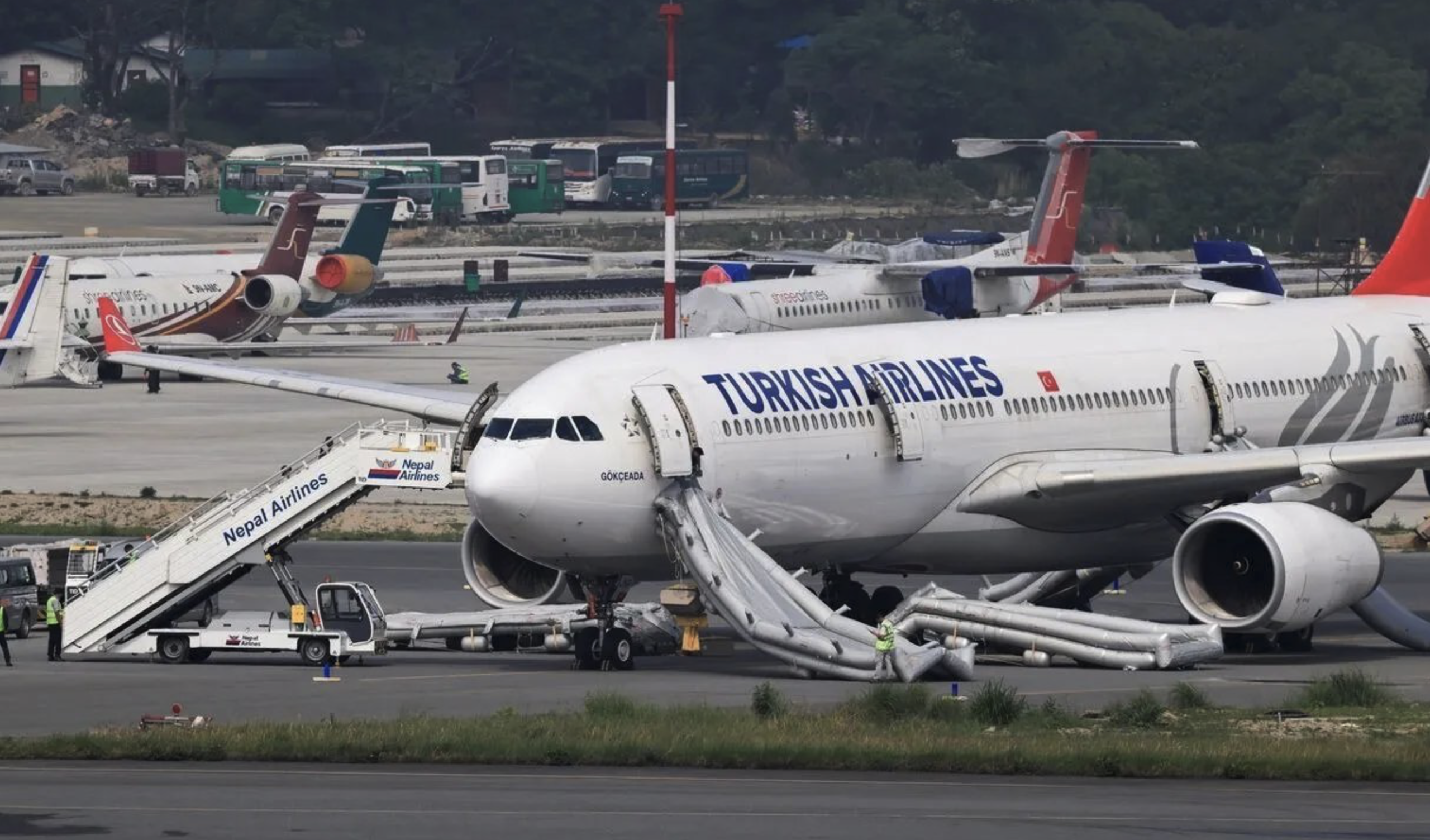
The incident briefly disrupted operations at Tribhuvan International Airport, Nepal’s busiest airport and the primary international gateway for the country. Because the airport operates with a single main runway, even a non-fatal aircraft emergency can temporarily halt arrivals and departures until the aircraft is cleared and the runway environment is inspected.
Nepal has a difficult aviation environment because of mountainous terrain, rapidly changing weather and airports located in challenging geography. However, this Turkish Airlines incident occurred after landing during taxiing, not during approach into terrain. That distinction matters: while Nepal’s aviation safety history often draws attention after any airport incident, the currently reported facts point to a mechanical or technical malfunction in the landing gear area rather than a terrain-related accident.
The evacuation also shows how quickly a routine arrival can become an emergency. Landing gear fires can be especially concerning because they may involve overheated brakes, tires, hydraulic fluid or other components close to fuel and structural systems. In this case, airport crews extinguished the fire quickly, the passengers and crew got off safely, and the aircraft was secured for inspection.
Turkish Airlines and Nepalese aviation authorities are expected to review the aircraft before determining the next steps. Until the technical inspection is complete, the reported hydraulic pipe malfunction should be treated as an initial assessment, not a final finding. For passengers, however, the outcome was the best possible result in a frightening situation: a full aircraft evacuation, a temporary airport closure, and no reported injuries.