
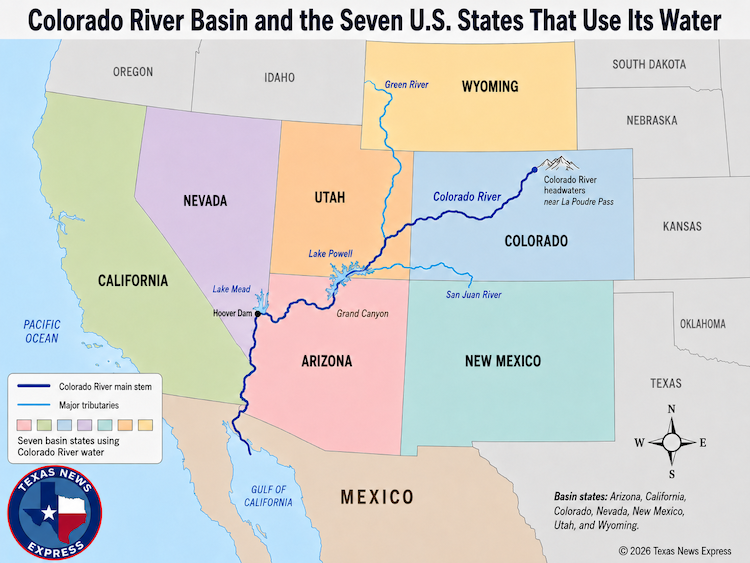
The Colorado River crisis is no longer a distant climate story. It is now a fight over how millions of people, farms, cities, power plants and desert economies survive when the water system they built their lives around can no longer provide what it once did. Arizona, California and Nevada have now proposed a temporary plan to save up to 1 million acre-feet of Colorado River water through 2028, adding to previous cuts by the Lower Basin states and Mexico for a total proposed savings of 3.2 million acre-feet. The goal is simple but urgent: keep Lake Mead and Lake Powell from falling into deeper crisis while the West argues over a longer-term deal.
The problem is not only drought. It is drought layered on top of overuse, population growth, old water agreements, hotter temperatures and a century of desert development based on wetter assumptions. The Colorado River supplies water to roughly 40 million people across seven U.S. states, two Mexican states and tribal communities. It also supports farms, cities, industry, recreation, wildlife habitat and hydropower. That means every acre-foot saved by one user is an acre-foot someone else may have expected to receive.
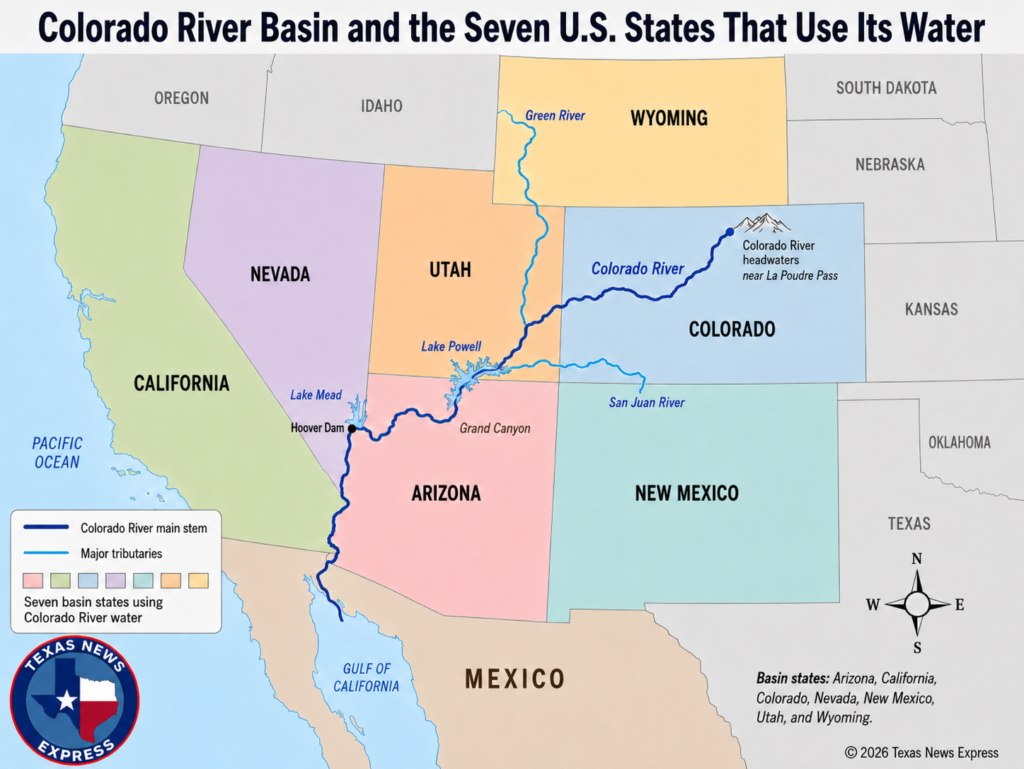
The latest emergency is centered on Lake Powell and Lake Mead, the two giant reservoirs that act as the Colorado River’s savings account. Federal officials have warned that Lake Powell could fall below the 3,490-foot minimum power pool level without intervention, threatening hydropower production at Glen Canyon Dam. To avoid that, the Bureau of Reclamation has moved to release water from Flaming Gorge Reservoir upstream while reducing releases from Lake Powell toward Lake Mead. That may help Powell in the short term, but it also pushes pain elsewhere, including lower water levels and possible power impacts downstream.
This is where water scarcity becomes more than an environmental issue. It becomes a political and economic conflict. Arizona leaders say their state is being asked to accept some of the deepest cuts, even as farmers, tribes, homeowners, technology companies and mining operations rely on the Central Arizona Project canal system. Arizona officials have warned that protecting Colorado River water is tied not just to local growth but to food supply, industry and long-term economic stability.
The conflict is also geographic. The Lower Basin states of Arizona, California and Nevada are proposing major reductions, while Upper Basin states including Colorado, Wyoming, Utah and New Mexico have argued for a different approach and have suggested mediation may be needed. AP reported that negotiations among the states have largely broken down, and Colorado’s lead negotiator said the Lower Basin plan is a first step but does not do enough to protect Lake Powell. The Upper Basin states also want the Lower Basin to commit to avoiding litigation, something AP reported is unlikely.
Agriculture is at the center of the debate because it uses the largest share of Colorado River water. The Bureau of Reclamation says agricultural uses depend on about 70% of Colorado River water, while several other water-use analyses put agriculture’s share even higher depending on what is counted. That does not mean farmers are villains. Western farms grow winter vegetables, hay, livestock feed and other products that feed the country. But it does mean that any serious water solution has to include farming practices: fallowing some fields, changing crop choices, improving irrigation efficiency, rethinking thirsty crops in arid regions and compensating growers when they conserve water for the system.
Cities also have to change. Desert cities cannot keep treating green lawns, ornamental landscaping, overwatered medians and inefficient outdoor irrigation as normal. Indoor household use is important, but in many desert communities, the biggest residential waste is outside: grass that does not need to be there, sprinklers running in heat and wind, leaks that go unfixed, and developments designed as if they were built in a wetter climate. Cities in the Southwest have already shown that conservation can work, but the next stage will require stricter landscaping rules, water pricing that discourages waste, leak detection, water reuse and building codes that make low-water living the default rather than the exception.
Commercial and industrial users also face pressure. Hotels, golf courses, warehouses, data centers, manufacturing sites and large developments all depend on reliable water. In desert regions, “economic development” can no longer mean approving every project first and asking about water later. Communities will have to ask harder questions: Does this project bring enough public value to justify its water demand? Can it operate with recycled water? Can landscaping be replaced with desert-adapted design? Does the local utility have a real long-term supply, or only a paper promise?
The West has been here before, but the margin for error is smaller now. Newsweek and other outlets have described the Flaming Gorge release as a lifeline for Lake Powell, but lifelines are not solutions. Moving water from one stressed reservoir to another may buy time, but it does not create new water. The same is true of temporary cuts. They may slow the decline, but they do not solve the underlying imbalance between what the river produces and what people expect it to deliver.
The hard truth is that desert living has to become more honest. The Colorado River can still support farms, cities and industry, but not if every user assumes someone else will sacrifice first. The future will require less waste at home, different crop and irrigation choices in agriculture, smarter commercial development, and water rules that reflect the climate the West actually has, not the wetter past it wishes would return. Without that shift, the coming conflict may not be about whether to conserve water. It may be about who gets cut off first.