Texas has always been big, but over the last decade it has become something else: one of the country’s most powerful migration magnets. The state’s population reached about 31.7 million in July 2025, after adding roughly 391,000 residents from 2024 to 2025 alone, according to newly released Census Bureau data summarized by the Texas Demographic Center and TxDOT.
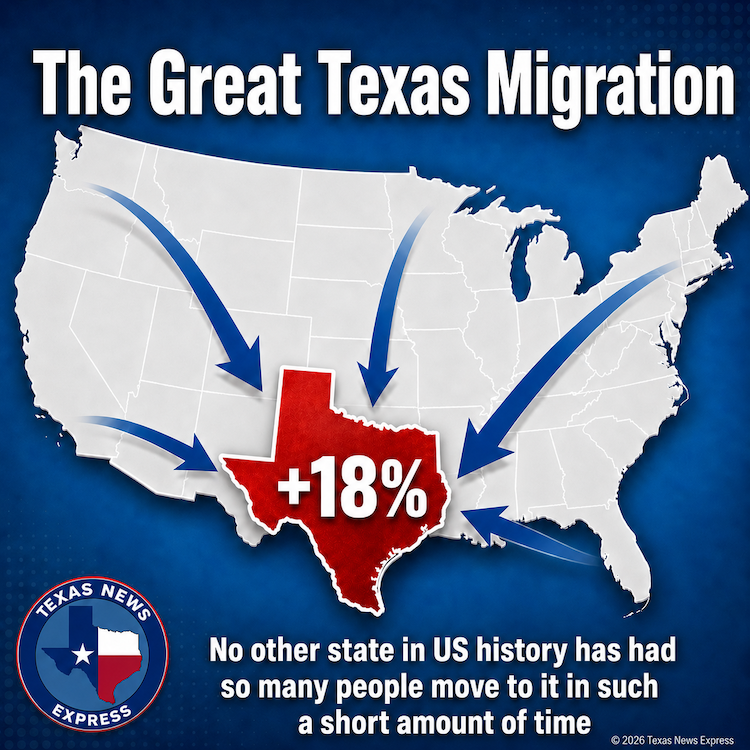
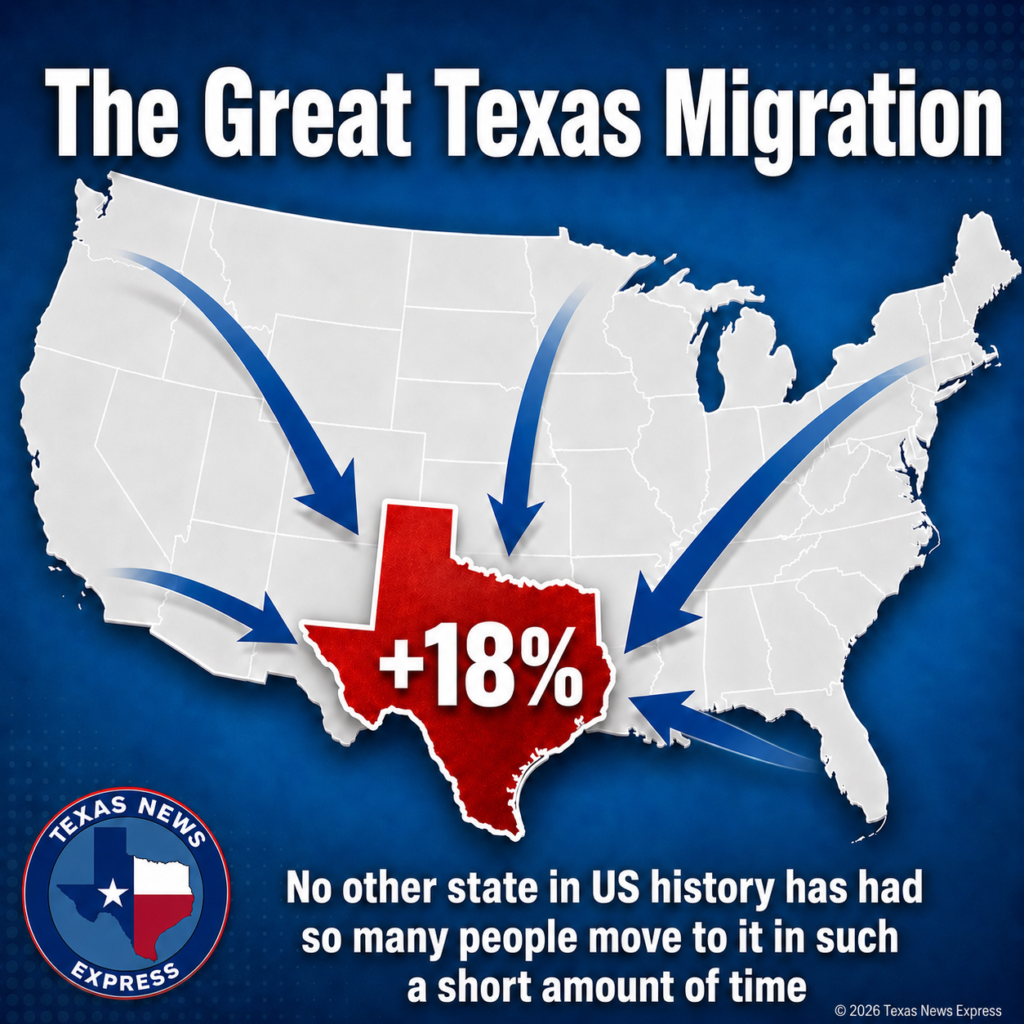
Over the last decade, the broader story is even larger. Based on the data used for this analysis, Texas has grown by about 5 million people, or roughly 18 percent, when accounting for people moving in, people moving out, births and deaths. That distinction matters. The migration numbers do not simply mean 5 million people moved to Texas and stayed. They represent a population boom shaped by domestic migration, international migration and natural population growth.
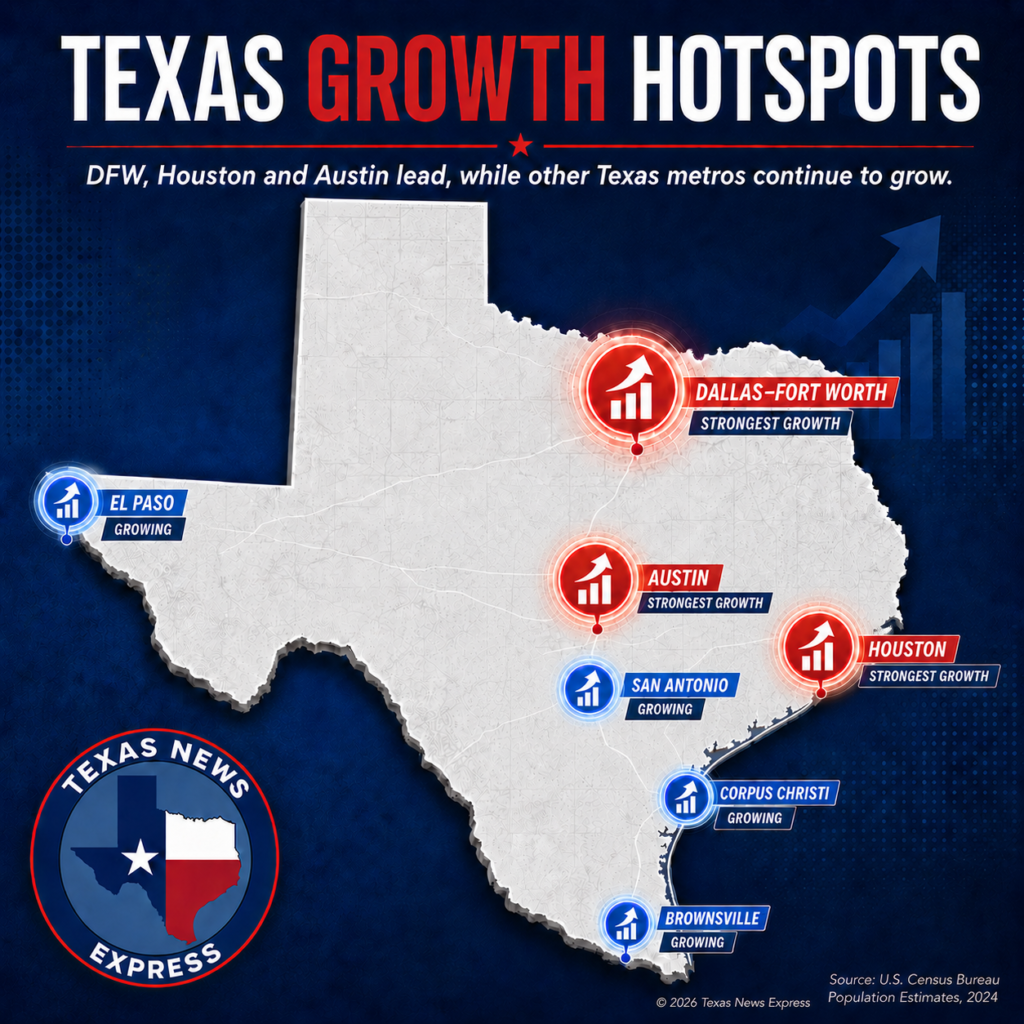
The working title almost writes itself: The Great Texas Migration. It is a migration fueled by jobs, housing, taxes, culture, business expansion and the pull of several large metro areas at once. Unlike states dominated by one giant city, Texas has multiple engines: Dallas-Fort Worth, Houston, San Antonio and Austin. Each has its own economy, personality and growth pattern, but together they have helped make Texas one of the most attractive destinations in the country.
For Angie Gordon, the move was not about chasing an abstract statistic. It was about a better life for her family. Gordon moved from the Chicago area to Frisco with her husband and three children two years ago after a higher-paying job opportunity opened in North Texas. She said the family quickly realized that the move gave them something they had been struggling to find in Illinois: more income, more space and more room to breathe.
“We’re earning more money here, and the housing cost is lower than Chicago,” Gordon said. “You get more house for the same amount of money.” For a family with three children, that difference matters. It can mean another bedroom, a better backyard, a neighborhood that feels like a better fit, or simply the feeling that the family’s paycheck stretches further. Gordon said the family has no regrets so far. They love Texas, they enjoy what they describe as more freedoms than they felt in Illinois, and they have been pleasantly surprised by how kind people have been. Her one complaint is a very Texas one: the traffic. “It’s worse than Chicago,” she said.
One of the clearest reasons people move to Texas is economic. Texas has no corporate or personal income tax, and the Governor’s economic development office promotes the state as having a business-friendly tax and regulatory structure, lower operating costs and one of the country’s largest economies. For families and companies leaving higher-cost states, that combination can be powerful, especially when paired with large job markets and housing that, while more expensive than it used to be, is still often cheaper than California, New York, Illinois and parts of the West Coast and Northeast.
Brian Nowak’s story is more of a leap of faith. He and his family of six moved from Southern California to the Houston area without jobs waiting for them. Nowak said they had reached a point where California’s high cost of living, tax burden and confusing regulations made it feel impossible to get ahead. He said the family felt like they were paying more and more but not getting enough back for what they paid.
So they used their savings and moved to Texas. It was risky, but the risk paid off. Within two months, Brian found a job in healthcare administration that paid more than he had earned in California. His wife, Maria, started a business that now employs eight people. For the first time in years, the family said they are able to put money back into savings instead of constantly watching it disappear. Both Brian and Maria said they feel safer in Texas and feel like the move gave their family a fresh start.
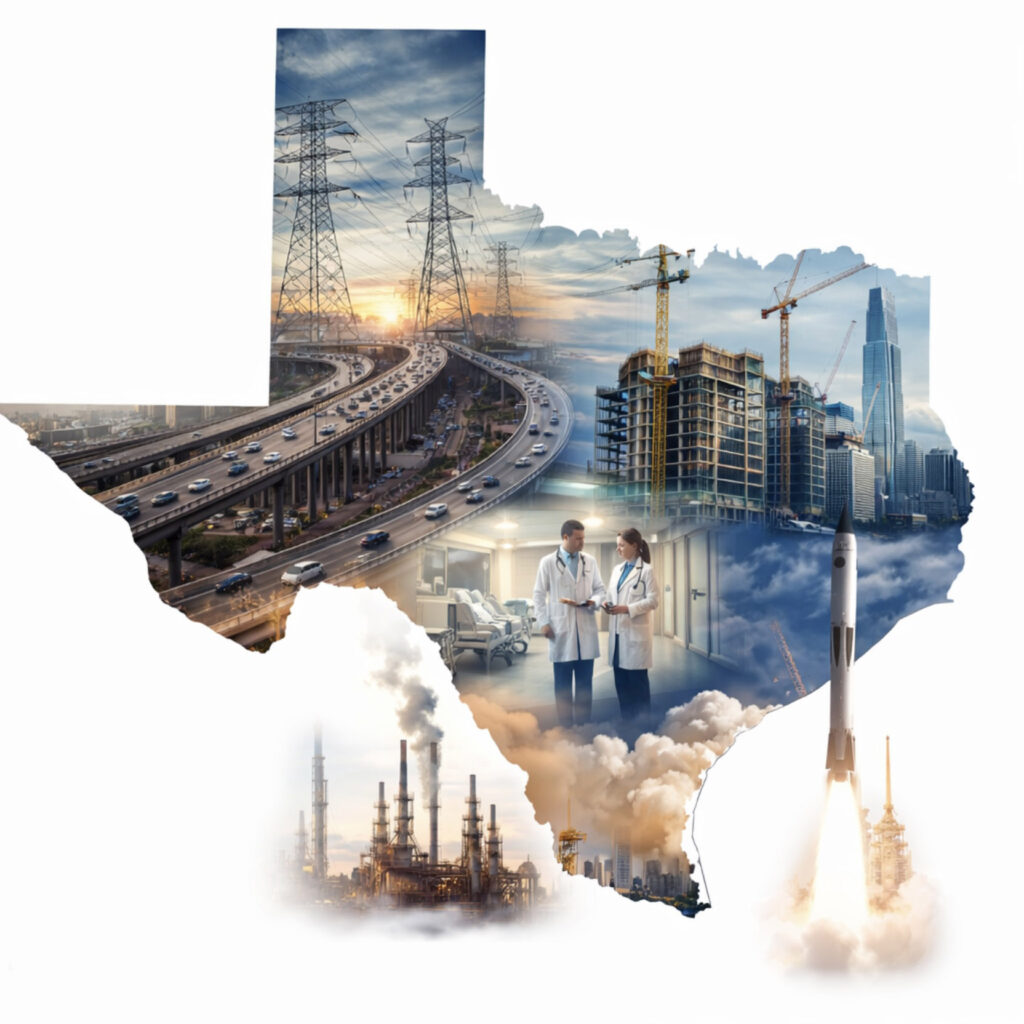
The state’s economy is also not just oil rigs and ranch land. Texas is now the eighth largest economies in the world if it were its own country, and the Governor’s office describes the state economy as powered by Fortune 500 companies, publicly traded companies, millions of small businesses and a large skilled workforce. Energy remains central, but it has evolved. Texas still leads in oil and natural gas, yet it also leads every other state in wind energy production. Solar, battery storage and grid technology are also becoming increasingly important as the state’s population and electricity demand continue to rise.
That energy story helped shape the future of Sung-ho Kim, an immigrant from South Korea who came to Texas for college. Kim attended the University of Texas at Austin and said he fell in love with the state while he was a student. After graduation, he was offered a job with a consulting firm in Austin, where he advised ERCOT and the state on energy forecasts and logistics. The work gave him more than a paycheck. He said it gave him the inside knowledge, technical skill and professional connections to eventually start his own business.
Kim has since left that company and now advises energy companies across the United States. His story reflects another side of the Texas migration: international talent that arrives for education, stays for opportunity and then builds companies that reach far beyond Texas. For Kim, Texas was not just a destination. It became the place where education, energy and entrepreneurship met.
Aerospace and space are another part of the draw. Houston’s Johnson Space Center remains central to NASA’s human spaceflight identity, and the Houston area continues to benefit from a long aerospace supply chain built around engineering, mission support, medicine, energy technology and federal contracting. Healthcare is just as important. The Texas Medical Center in Houston describes itself as the largest medical complex in the world, with more than 10 million patient encounters per year and more than 120,000 employees.
Transportation and logistics are also major drivers. Dallas-Fort Worth International Airport is American Airlines’ largest hub, while Houston’s George Bush Intercontinental Airport remains a major United Airlines hub. Freight rail networks operated by Union Pacific, BNSF and the newer Canadian Pacific Kansas City system help tie Texas to Mexico, the Midwest, the Gulf Coast and global shipping. With major airports, seaports, highways, rail corridors and border trade routes, Texas is positioned as one of the country’s most important logistics platforms.
Manufacturing is another reason Texas keeps pulling in people. General Motors operates its Arlington Assembly plant in North Texas, where it builds full-size SUVs including the Chevrolet Tahoe, Chevrolet Suburban, GMC Yukon and Cadillac Escalade. That is one example inside a much larger manufacturing base that includes semiconductors, chemicals, aviation components, vehicles, food processing, machinery and energy equipment.
Finance is becoming a bigger part of the Texas story too. The Texas Stock Exchange, headquartered in Dallas, received SEC approval and has said it plans to launch trading, exchange-traded products and corporate listings in 2026. TXSE’s member launch guide says the exchange is targeting trading to begin between July 2 and July 17, 2026, although that timing remains tied to operational readiness and market preparations.
Culture is part of the migration story as well. Texas is no longer just selling jobs and cheaper square footage. It is selling major-city life. Houston has one of the strongest performing arts scenes in the country, and its Theater District promotes the city as one of the few U.S. cities with permanent professional resident companies across the major performing arts disciplines. The state is also trying to grow film, television, animation, video game and visual production through incentive programs designed to attract more creative-industry jobs.
The people coming to Texas are not all coming from one place. According to the migration data provided for this analysis, the largest category over the last decade was people coming from foreign countries, totaling 2,674,219 people. That means roughly 34 percent of everyone who moved to Texas during the period came from another country.
Among domestic sources, California led the list, with 655,868 people moving to Texas over the decade. Florida followed with 433,861. New York sent 239,980, Illinois sent 199,826, Pennsylvania sent 195,687, Colorado sent 195,381, Georgia sent 165,588, Virginia sent 152,966, Washington sent 135,464, North Carolina sent 133,271, Missouri sent 128,639, Arizona sent 114,775 and Ohio sent 114,367. Oklahoma also ranked in the top group, although the exact number was not included in the provided data. Altogether, the listed origins totaled 5,539,892 people.
Driver license and moving-truck data offer another imperfect but useful window into the trend. Texas DPS tells new residents they can drive on a valid, unexpired out-of-state license for up to 90 days after moving to Texas, after which they must apply for a Texas license. U-Haul’s one-way rental reports have also frequently placed Texas cities and Texas markets near the top of national growth rankings. Those sources should not be treated as a complete population count, but they do help confirm the direction of the trend: people and businesses keep choosing Texas.
The migration has brought obvious benefits: a larger workforce, more consumers, more business formation, more tax revenue and greater national influence. But it also creates pressure. Roads, schools, housing, water systems, power infrastructure and local governments all have to absorb growth that often arrives faster than planning documents expected. The same forces that make Texas attractive can create the next round of challenges: traffic congestion, rising home prices, strained public services and infrastructure that must stretch across enormous metro regions.
A 2025 urban planning and engineering paper published by the Texas Urban Planning Agency warned that the Texas Triangle — the region anchored by Dallas-Fort Worth, Houston, Austin and San Antonio — is already home to more than 22.5 million people and could grow to roughly 31 million by 2040. The report described the Triangle as the state’s economic and demographic powerhouse, but also warned that rapid growth is placing increasing strain on transportation, freight movement, air quality, road maintenance and long-term development planning.
The paper estimated that more than 175,000 people travel daily between the major Texas Triangle metros, including 70,600 daily travelers between Houston and Dallas-Fort Worth alone. Freight movement is also growing fast. According to the report, about 9,000 semi-trucks and large box trucks traveled daily between Houston and DFW in 2024, and that number is projected to more than double by 2050. I-45 alone could require $7.2 billion in repairs through 2050, not counting expansion or modernization costs.
Those figures show why Texas’ growth challenge is more complicated than building more subdivisions and widening more roads. The same corridors that move new residents, commuters and families also move freight, energy equipment, food, medical supplies and consumer goods. As population and commerce grow together, the state faces a long-term infrastructure test involving highways, rail, airports, local transit, water systems, power demand and land-use planning.
The report also pointed to environmental and safety concerns, citing 122 ozone action days and 69 poor air quality days in the region in 2024, along with 1,376 freeway crash deaths within the Texas Triangle in 2023. The issue is not that growth is bad. Growth is one of Texas’ greatest strengths. But unmanaged growth can become expensive, dangerous and inefficient if transportation, housing, utilities and public services do not keep pace.
That is the real story of the Great Texas Migration. It is not just that people are moving to Texas. It is that Texas has become a national pressure valve, a business relocation target, an international migration destination, an energy and logistics hub, and a cultural competitor all at the same time. For Angie Gordon, it meant a better job and more house. For Brian and Maria Nowak, it meant a second chance. For Sung-ho Kim, it meant education, opportunity and the launch of a business. For Texas, it means the future is arriving fast.
The question now is not whether Texas will keep growing. The question is whether the state can build fast enough, plan wisely enough and invest carefully enough to keep the Texas advantage from being overwhelmed by its own success.