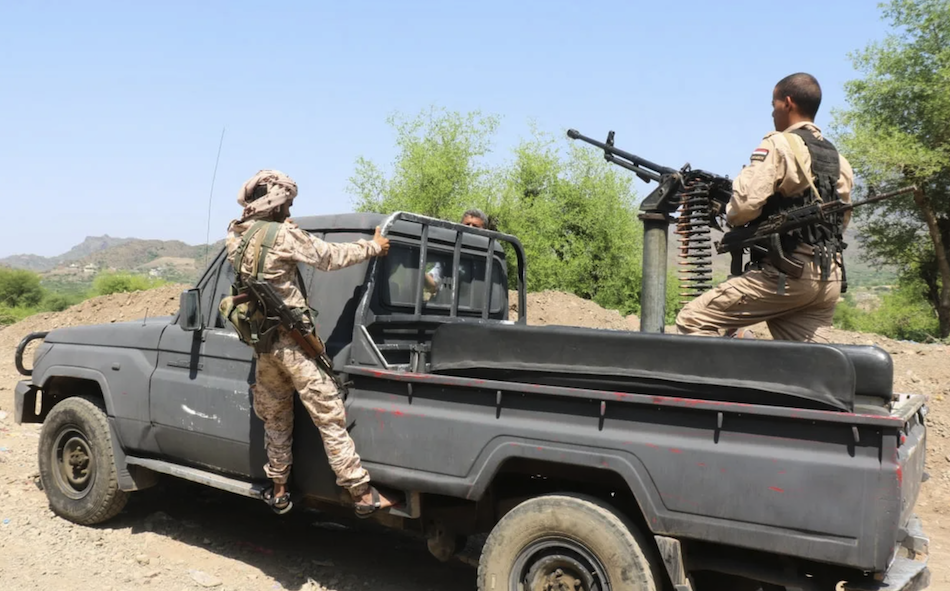
ADEN, Yemen – Yemen’s internationally recognized government has launched one of its largest military operations in years against the Houthi movement, opening new fronts as fighting intensifies near the Red Sea and around the key city of Taiz.
The Saudi-backed government announced the offensive Sunday after Houthi forces made major gains across western Yemen during September. Rashad al-Alimi, head of Yemen’s Presidential Leadership Council, said government forces would continue operations in an effort to recover territory controlled by the Houthis. Reuters
By Monday, government forces said they had made a rapid advance along the Red Sea coast near the Bab el-Mandeb Strait. Military officials said their forces captured important positions in the Dhubab district, including an airstrip near the entrance to the strait.
Government officials later said their forces reached the outskirts of Mokha and retook the city after Houthi fighters withdrew toward higher ground.
The Houthis rejected those claims and said reports of major government gains were not accurate. Reuters said it could not independently verify the full extent of the government advance. Reuters
The fighting around Bab el-Mandeb is especially important because the narrow waterway connects the Red Sea with the Gulf of Aden. Ships traveling between Europe and Asia regularly pass through the area.
Houthi forces captured much of Yemen’s Red Sea coastline during a major offensive in September, including Mokha and positions near the strait. Their advance raised concerns that the group could increase attacks on commercial shipping.
Even if government forces regain control of the coastline, military experts say the Houthis could still threaten ships with missiles or drones launched from positions farther inland. Reuters
Saudi Arabia is providing major air support for the government offensive. Saudi-led coalition officials said about 100 fighter jets were supporting Yemeni government forces and that hundreds of Houthi targets had been attacked.
The coalition said the strikes were intended to protect government troops and help secure the Bab el-Mandeb area. Those military claims have not been independently confirmed. AP News
The United States is also providing assistance to Saudi Arabia. U.S. and regional officials told The Associated Press that American support has included intelligence sharing and help identifying targets. The officials said the United States has also assisted with planning, but American forces are not reported to be directly fighting on the ground. AP News
While government forces appear to be making progress near the coast, the Houthis have made gains farther inland around Taiz.
Military sources told Reuters that Houthi forces captured sections of an important mountain road leading toward Taiz. Some government sources said the advances have left government troops in the city largely surrounded, although another government source disputed claims that the main road had been completely cut. Reuters
The Houthis also captured the town of Turbah, located along a major road connecting Taiz with Aden. Aden serves as the temporary headquarters of Yemen’s internationally recognized government.
Control of the road is important because government forces use it to move personnel and supplies toward Taiz. The city has been one of the main front lines of Yemen’s civil war for years. AP News
Government forces have responded with heavy air attacks in the province. On Friday, a Yemeni military spokesperson said aircraft carried out 20 strikes against Houthi positions and equipment in Taiz within several hours. Reuters
The latest fighting follows months of rising tension between the Houthis and Saudi Arabia.
The Houthis, formally known as Ansar Allah, control Yemen’s capital, Sanaa, and much of the country’s northwest. The movement has received military support from Iran.
The current escalation began this summer after several years of relative calm following a United Nations-backed truce in 2022. The Houthis have since launched missile and drone attacks toward Saudi Arabia, while Saudi forces have carried out strikes against Houthi-controlled areas. Reuters
The Houthis argue that they are defending Yemen and resisting foreign military involvement. Yemen’s internationally recognized government says the Houthis took power by force and must give up territory they captured beginning in 2014.
The conflict began when Houthi fighters seized Sanaa and later forced the government from the capital. Saudi Arabia entered the war in 2015 in support of the government.
The latest offensive is also showing some of the divisions within the forces fighting the Houthis. Yemen’s anti-Houthi forces include several armed groups that do not always share the same political goals.
Some have close ties to Saudi Arabia, while other factions have historically received support from the United Arab Emirates. They remain united in opposing the Houthis, but disagreements over the future of southern Yemen have caused tensions among them in the past. AP News
The renewed fighting is worsening Yemen’s already serious humanitarian crisis.
The United Nations migration agency said Monday that about 184,000 people have been displaced since the latest round of fighting began. Many families have fled combat areas with few belongings and limited access to food or clean water. Reuters
The World Food Programme said last week that nearly three-quarters of households in government-controlled areas it can reach do not have enough food. The agency said fighting has made it increasingly difficult to deliver aid around Taiz and other front-line areas. Reuters
Food prices have also risen as transportation routes have been disrupted. Yemen imports most of the food consumed by its population, leaving the country especially vulnerable when ports or major roads are blocked.
The government has described the new campaign as an effort to reverse recent Houthi gains and eventually restore government control over Sanaa. The Houthis have shown no indication that they intend to surrender and continue to fight on several fronts.
For now, the battlefield remains divided. Government forces appear to have regained ground along parts of the Red Sea coast, while Houthi forces are increasing pressure around Taiz. With major fighting continuing in both areas, control of southwestern Yemen remains unsettled.