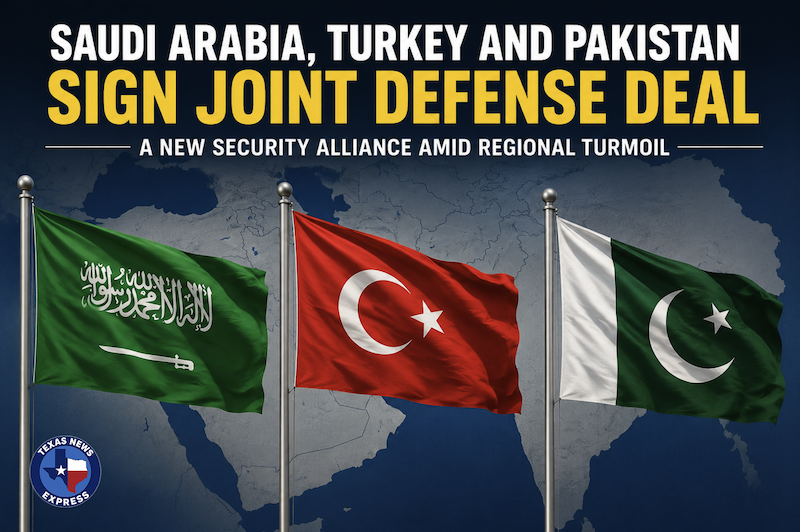
Saudi Arabia, Turkey and Pakistan have signed a new mutual defense agreement that could reshape security in the Middle East. The agreement, known as the Mecca Joint Defense Agreement, states that an armed attack against one of the three countries will be treated as an attack against all three. Leaders from the three nations signed the pact in Mecca on Thursday as tensions remain high following months of conflict involving Iran, Israel and the United States.

Officials from all three countries described the agreement as defensive and said it is not aimed at any specific nation. However, the timing comes after months of regional instability that included Iranian missile attacks, Houthi strikes, disruptions to Gulf shipping and military operations involving Israel and the United States. Analysts say the agreement reflects growing concerns among regional powers about future security threats and a desire to strengthen cooperation without relying solely on the United States.
The three countries each bring different strengths to the partnership. Saudi Arabia is one of the world’s largest oil exporters and has significant financial resources. Turkey has NATO’s second-largest military and a rapidly growing defense industry that produces drones, armored vehicles and other military equipment. Pakistan is the world’s only Muslim-majority country with nuclear weapons and maintains one of the region’s largest armed forces. Together, the three nations represent a significant military and economic bloc.
The new agreement builds on years of growing military cooperation. Saudi Arabia and Pakistan signed a bilateral mutual defense pact in 2025, and Reuters previously reported that Pakistan deployed approximately 8,000 troops, fighter aircraft and air defense systems to Saudi Arabia earlier this year after Iranian attacks on the kingdom. Those deployments demonstrated that military cooperation between Riyadh and Islamabad had already expanded before the new three-country agreement was signed.
While the agreement contains a collective defense clause, many details have not been released publicly. It remains unclear exactly what military actions each country would be required to take if another member were attacked. Defense analysts note that mutual defense agreements often allow governments flexibility in determining how they provide assistance, which can range from intelligence sharing and logistics support to direct military operations.
One of the biggest questions raised by the agreement is what would happen if Pakistan became directly involved in a future conflict. Pakistan possesses an estimated nuclear arsenal of more than 170 warheads and maintains ballistic missiles capable of delivering nuclear weapons. There is no indication that the new agreement changes Pakistan’s nuclear policy or creates a shared nuclear umbrella for the other members. Officials from the three countries specifically said the pact is not intended to advance nuclear ambitions.
If Pakistan were drawn into a conventional military conflict under the agreement, the consequences could be significant. Pakistan could contribute air defense systems, fighter aircraft, naval forces, intelligence capabilities and ground troops to help defend an ally. Such involvement would likely increase pressure on Iran and could complicate military planning across the region. It could also lead other countries, including the United States and Gulf allies, to reassess their own security strategies. These possibilities remain analytical scenarios rather than announced plans.
Experts also caution that any conflict involving a nuclear-armed nation carries greater risks, even if nuclear weapons are never used. Military planners generally seek to prevent direct fighting between nuclear powers because the possibility of escalation can make crises much more dangerous. There is no evidence that any of the countries involved are preparing for nuclear conflict, and the agreement itself emphasizes collective defense rather than offensive military action.
For now, the Mecca Joint Defence Agreement represents one of the most important new security partnerships in the Middle East in recent years. Whether it becomes a largely symbolic political statement or develops into a military alliance with regular joint operations will depend on future events. As regional tensions continue, governments around the world will be watching closely to see how the three countries interpret and implement their new commitment to defend one another.