
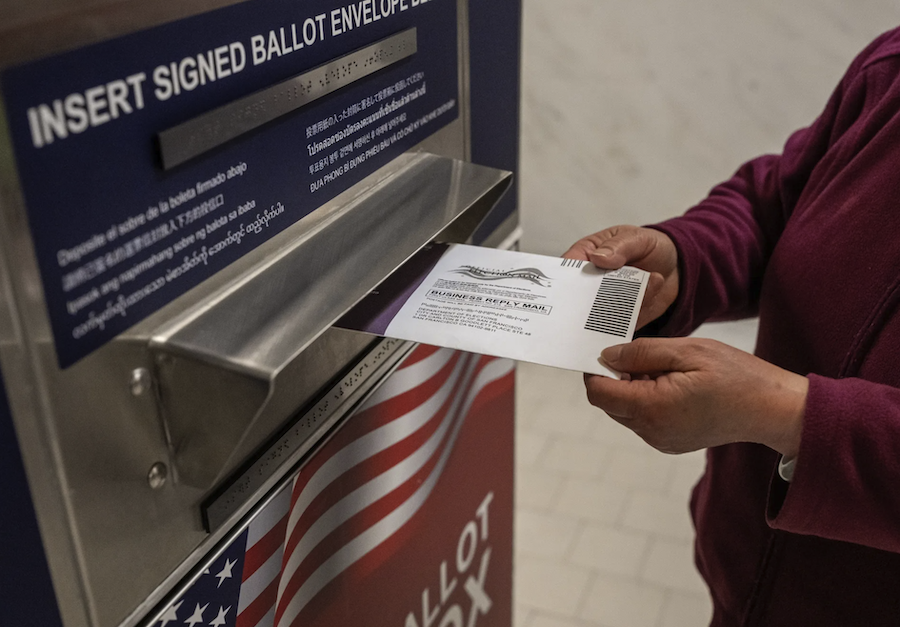
WASHINGTON, D.C. The U.S. Supreme Court has rejected the Trump administration’s request to immediately put new U.S. Postal Service rules for mail ballots into effect before the November 2026 midterm elections.
The decision leaves a lower court order in place that blocks key parts of the Postal Service plan while the legal fight continues. The Supreme Court said the federal government was unlikely to succeed on the merits of its challenge to the lower court’s injunction and that the circumstances did not support emergency relief. Justice Brett Kavanaugh wrote separately in support of the result. Justices Samuel Alito and Clarence Thomas dissented.
The ruling is important, but it is not a final decision on every legal question surrounding President Donald Trump’s plan. The case came to the Supreme Court as an emergency request to temporarily lift a lower court order. The larger lawsuit over the Postal Service’s authority and the president’s role in election administration can continue.
Trump issued an executive order in March directing the Postal Service to develop new rules for federal election mail. The administration said the changes were designed to improve election security, make ballots easier to track and help enforce federal laws against election fraud.
Under the plan, states using the Postal Service for mail ballots would have been required to meet new federal standards. Ballot envelopes would use unique Intelligent Mail barcodes, and state election officials would provide information about voters receiving mail ballots through a new Postal Service system. The administration argued that the system would create a more reliable record of ballot mail moving through the postal network.
The White House said the goal was to make sure mail ballots were sent only to eligible voters and to create a system that could be checked later if questions arose. The administration also argued that the Postal Service already has authority over the handling and security of mail and should be able to set standards for election mail moving through its network.
Postmaster General David Steiner defended the Postal Service’s involvement in September. He said USPS is part of the executive branch and had acted to address concerns about election integrity and the enforcement of federal law. The Postal Service also said its proposed system could improve the efficiency and tracking of election mail.
The administration’s opponents saw the issue very differently.
A coalition led by California and joined by more than 20 other states argued that the federal government was attempting to take control of an area traditionally handled by state and local election officials. The states said the Constitution gives states the main responsibility for running elections, subject to laws passed by Congress, and that the president and Postal Service could not create major new election requirements on their own.
The states were also concerned about how quickly the changes were being introduced.
The Postal Service issued its final rule in late August, only a short time before election officials would begin preparing and sending large numbers of ballots. States argued they could be forced to redesign ballot envelopes, change computer systems and place millions of voters into a new Postal Service database with little time for testing.
Another major concern involved what would happen when information did not match.
Under the Postal Service rule, USPS could refuse to handle certain ballot mail if election officials did not meet the new requirements. Opponents argued that even eligible voters could be affected by mistakes, missing information or technical problems with the new system.
The states also argued that the change could be especially difficult in places where voting by mail is widely used. Their Supreme Court filing said problems could affect voters in states that conduct elections largely by mail, as well as elderly, rural and disabled voters who often depend heavily on mailed ballots.
California Attorney General Rob Bonta called the Postal Service rule an unlawful federal intrusion into state elections. His office argued that states would have to make expensive and complicated changes close to an election and that mistakes could prevent legally eligible voters from having their ballots handled normally.
The Trump administration argued that those concerns were overstated and that the federal government has a legitimate interest in protecting federal elections and preventing illegal voting. Trump has repeatedly criticized mail voting and has argued that stronger controls are needed to prevent fraud.
Election officials and voting-rights groups have disputed claims that widespread fraud is common in mail voting. Reuters reported that nearly one-third of voters used mail ballots in the 2024 election and that election officials continue to say there is no evidence of widespread mail-ballot fraud that would have changed national election results.
The Supreme Court had considered an earlier part of the same dispute in August. At that time, the justices allowed parts of Trump’s executive order to move forward because the legal challenge had been brought before the Postal Service finished writing its actual rule. The Court specifically left open the possibility that states could challenge the final Postal Service regulation after it was issued.
That is what happened.
After USPS released its final rule, the states returned to court. A federal judge blocked major parts of the rule, and the First U.S. Circuit Court of Appeals declined to remove that block. The Trump administration then asked the Supreme Court to intervene.
On Sept. 14, the Supreme Court declined to do so.
The immediate effect is that the new Postal Service requirements cannot be enforced while the lower court order remains in place. The administration therefore cannot use the disputed USPS rule during the November election unless another court decision changes the situation.
The ruling also has a wider legal importance. It signals that a majority of the Supreme Court was not persuaded that the administration had shown a strong enough legal case to justify changing the rules shortly before a national election.
Justice Alito disagreed. In his dissent, joined by Justice Thomas, he argued that the federal government had met the legal requirements for a stay and questioned whether the states had a proper legal path to challenge the Postal Service rule.
The dispute is ultimately about more than mail.
Trump and his administration say the federal government has a responsibility to help protect federal elections and prevent ballots from going to people who are not legally eligible to vote. The states challenging the administration say election security is important but argue that a president cannot use the Postal Service to create a new national election system without authorization from Congress.
For now, the Supreme Court has left the lower court’s block in place. The broader case over the president’s authority, the Postal Service’s power and the role of states in federal elections is likely to continue after the November election.