
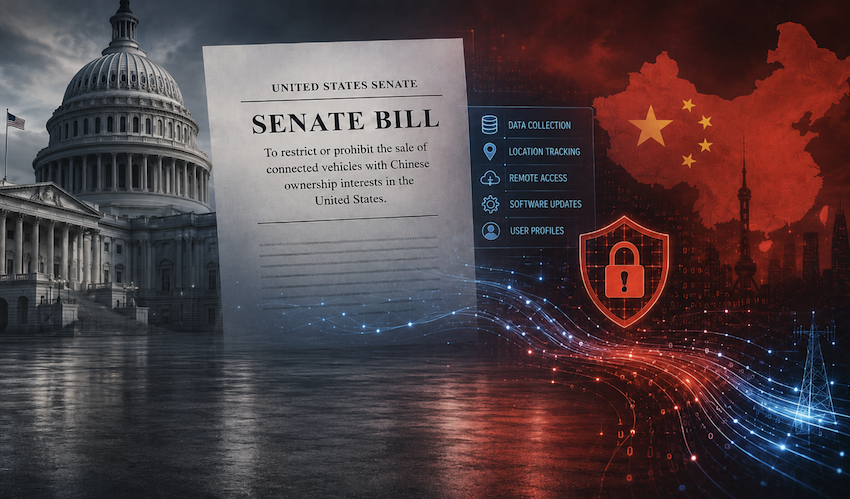
The bipartisan proposal targets connected vehicles linked to China, but it has not become law and could still be changed.
WASHINGTON – Mercedes-Benz could face limits on selling new vehicles in the United States under a bill approved by the Senate Commerce Committee. The proposal is aimed at connected vehicles made or controlled by companies linked to China and other foreign rivals. However, the measure is not yet law, and it would not immediately ban Mercedes-Benz from the country.
The bipartisan Connected Vehicle Security Act of 2026 was introduced by Republican Sen. Bernie Moreno of Ohio and Democratic Sen. Elissa Slotkin of Michigan. The bill would restrict the import, production and sale of connected vehicles from companies with more than 15% ownership by Chinese entities. It must still pass the full Senate and House and be signed by the president.
Mercedes-Benz is based in Germany, but two major Chinese investors own almost 20% of the company’s shares. China’s state-owned BAIC Group holds 9.98%. Li Shufu, the founder of Chinese automaker Geely, holds another 9.69% through an investment company. Together, those interests place Mercedes above the bill’s proposed 15% limit.
Sen. Ted Cruz of Texas, who leads the Commerce Committee, warned that the current wording could push Mercedes out of the American market. Cruz said lawmakers did not intend to ban the German automaker and argued that the bill needs changes. Moreno said Mercedes would have until 2030 to comply and could ask the Commerce Department for special approval.
The bill focuses on connected vehicles because modern cars can use Bluetooth, Wi-Fi, cellular networks and satellite systems. They may collect a driver’s location, travel habits, vehicle information and other personal data. Some systems can also receive software updates or commands from outside the vehicle.
Supporters say companies tied to China could be required to share information with the Chinese government or allow outside access to vehicle systems. The U.S. Commerce Department reached a similar conclusion when it issued rules in 2025 restricting certain Chinese- and Russian-linked vehicle software and hardware. Software restrictions begin with 2027 models, while major hardware limits take effect with 2030 models.
The proposed law is broader than the existing rule and could affect companies that are not based in China but have enough Chinese ownership. It would also give the Commerce Department power to review specific vehicles and permit them if officials find that they do not create a serious risk of data theft, remote control or harm to critical infrastructure.
Mercedes-Benz says its Chinese shareholders are passive investors and do not control daily company decisions. The company says it supports efforts to protect national security but does not want the law to harm its workers, dealers, suppliers or customers. Mercedes has promised more than $7 billion for its American operations, including added SUV production in Alabama.
General Motors supports the legislation and says it is meant to protect American manufacturing, not target one competitor. Cruz has questioned whether the 15% limit was designed in a way that would benefit GM’s Cadillac brand by weakening Mercedes. GM denied that accusation.
There are wider concerns about Chinese connected vehicles, including models made by BYD and Geely. Both Mexican authorities and Indian officials say they have caught both companies sending driver and infrastructure data to offices in China. Public reports reviewed for this article show concerns about security, trade and possible data access, but they do not provide confirmed official findings supporting that exact claim.
Mercedes CEO Ola Källenius said the company would make any changes needed to protect its U.S. business. Mercedes sales in the United States rose 15% during the first half of 2026, making the American market increasingly important as the company faces weaker sales in China.
For now, Mercedes vehicles remain available in the United States. Whether the company faces future restrictions will depend on the bill’s final wording, whether Congress passes it and whether Mercedes receives an exemption or changes its ownership structure.