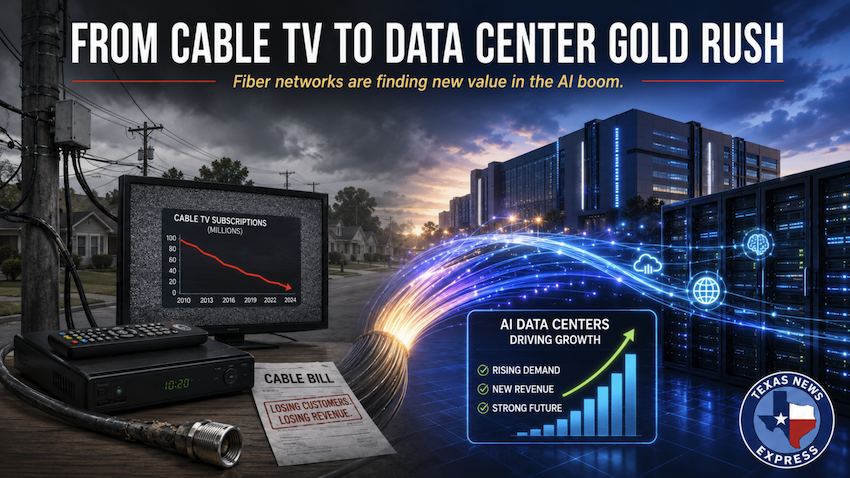
Verizon’s billion-dollar agreement with Google shows how older telecom networks are gaining new value from the rapid growth of artificial intelligence.
For decades, residential cable television was one of the most dependable businesses in America. Customers paid monthly bills for large channel packages, while cable and phone companies used that steady income to expand, buy competitors and take on debt. Streaming services and cord-cutting have since weakened that model, forcing providers to search for new sources of growth.
The decline is clear in company reports. Comcast ended 2025 with about 11.3 million domestic video customers, down roughly 1.3 million in one year. The company said video revenue fell because fewer people subscribed, although higher prices partly made up for the loss. Charter Communications ended the year with about 12.6 million video customers and $94.6 billion in debt. By the second quarter of 2026, Charter’s video total had fallen to about 12.5 million.
Cable television’s decline did not create all that debt. Much of it came from mergers, network construction, stock buybacks and other business decisions. Comcast and Charter also remain large companies that earn money from broadband, wireless service, media and other operations. Still, the loss of millions of television customers has weakened a business that once produced steady growth and dependable cash.
When I asked both AT&T and Comcast what their plan was to improve revenue other than enhancing existing internet services and add-on’s to that, both said they are actively pursuing fiber deals with data centers and AI companies. Both declined to give specific information.
Now, some network providers may have found an unexpected replacement: connecting the huge data centers being built for artificial intelligence. Verizon announced that it signed an agreement worth more than $1 billion to provide fiber connections for Google’s data centers. The deal was highlighted in the PhoneArena report and later confirmed by Verizon’s chief executive and Reuters.
Verizon will provide what is known as “dark fiber”. These are fiber-optic strands that have been installed but do not yet carry an active signal. Google can add its own electronic equipment to “light” the fiber and use it as a private, high-capacity network between data centers and major internet connection points.
Data centers need these connections because artificial-intelligence systems move enormous amounts of information. A data center may store information in one location, process it in another and send results to users across the country. Fiber can carry large amounts of data over long distances with low delays, making it a basic part of the AI system.
Verizon CEO Dan Schulman said the company expects to announce more agreements before the end of 2026. Together, those deals could bring Verizon several billion dollars in revenue over the next several years. Verizon has not released the length, location or construction schedule for the Google agreement.
Verizon is not alone. Fiber-network company Zayo said it completed more than $1 billion in AI-related agreements during 2024 and had another $3 billion in possible business. The company plans to build more than 5,000 miles of new long-distance fiber routes to connect growing data-center markets.
AT&T is also expanding its high-capacity fiber services. In June, the company said its 400-gigabit connections were available in more than 40 metropolitan areas. The network reaches major data-center locations in cities including Dallas, Atlanta, Chicago, New York, Seattle and Northern Virginia.
The new opportunity is different from residential cable television. Instead of collecting smaller monthly payments from millions of households, network companies can sign large, multiyear contracts with a few powerful technology companies. Those agreements may provide stable revenue, but they also carry risks. Building new routes is expensive, and providers could become too dependent on a small number of major customers.
Residential cable television is unlikely to return to its earlier strength. Americans have become used to choosing individual streaming services rather than buying large cable packages. However, the physical networks built during the cable and telephone era are not becoming useless.
The same fiber routes once valued mainly for home television, phone and internet service may now become major highways for artificial intelligence. For companies such as Verizon, the AI data-center boom offers a chance to turn existing infrastructure into billions of dollars in new business—and to replace part of the revenue lost as traditional television continues to fade.