A series of deaths and disappearances involving people connected to U.S. science, aerospace, nuclear research and defense-related institutions has drawn public attention and questions from federal officials about whether any of the cases may have a national security connection.
The cases involve people who worked for or were connected to NASA, Los Alamos National Laboratory, the U.S. Air Force, MIT, Caltech, the Kansas City National Security Campus, Novartis, the University of Alabama in Huntsville and other research-related organizations.
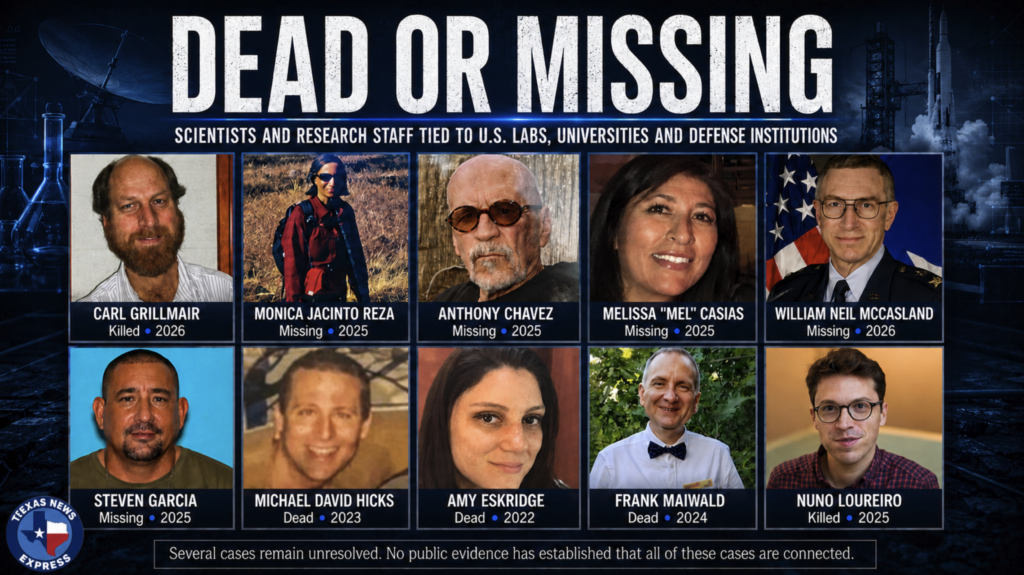
Federal officials have not publicly confirmed that the cases are connected. NASA has said that, at this time, nothing related to the agency indicates a national security threat. Fact-checkers have also found that not all of the people named in online discussions were scientists, and there is no public evidence that all or most of them worked together.
Still, the cases have gained attention because some of the people had ties to sensitive scientific, military, aerospace or nuclear-related institutions.
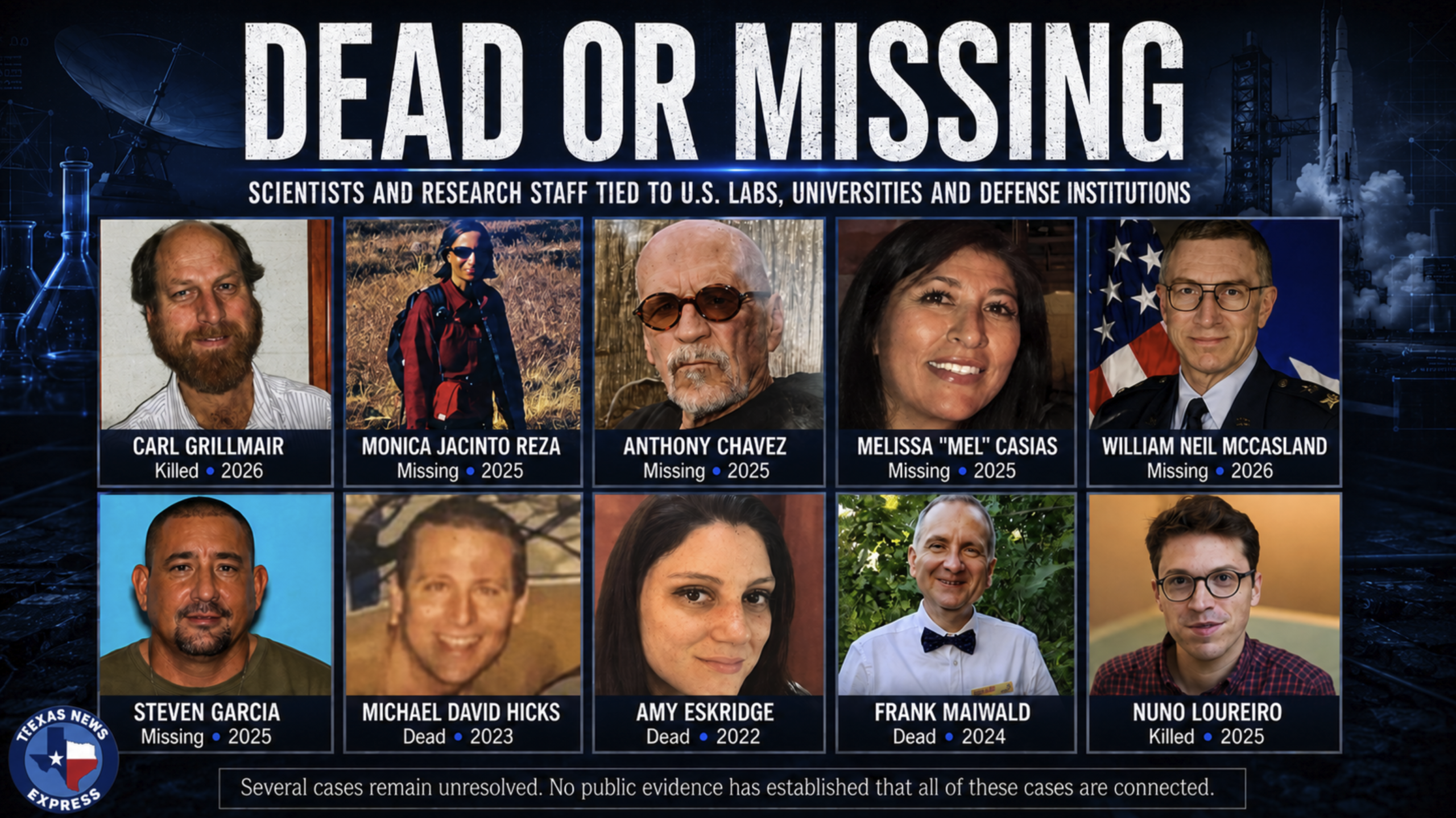
Among those named in public reporting are Michael David Hicks, Frank Maiwald, Monica Reza and Joshua LeBlanc, who were connected to NASA. Hicks died in July 2023. Maiwald died in July 2024. Reza disappeared in June 2025. LeBlanc died in July 2025.
Public reporting has described Hicks as having studied comets and asteroids, Maiwald as having worked on microwave radiometry and Earth science missions, Reza as a specialist in rocket materials, and LeBlanc as an electrical engineer.
Two of the names are connected to Los Alamos National Laboratory in New Mexico: Anthony Chavez and Melissa Casias. Chavez disappeared in May 2025, and Casias disappeared in June 2025. Casias’ remains were found in May 2026 in New Mexico’s Carson National Forest. Authorities said a handgun was found near the remains, but her cause and manner of death had not been publicly determined at the time of reporting.
Los Alamos is one of the most important nuclear research institutions in the United States, but public reports say Chavez and Casias did not appear to hold scientific research roles. Chavez was described as a construction foreman, and Casias was described as an administrative assistant.
Other cases involve people connected to the U.S. Air Force. Retired Maj. Gen. William Neil McCasland disappeared from his Albuquerque, New Mexico, home in February 2026. McCasland had worked in aerospace research and at military laboratories during his career, but he had been retired for about 13 years. Matthew Sullivan, also connected to the Air Force, died in 2024.
In another New Mexico case, Steven Garcia disappeared in August 2025. He worked at the Kansas City National Security Campus, a facility involved in nonnuclear components for the U.S. nuclear weapons complex. Axios reported that Garcia’s job did not involve scientific research.
Several deaths involved people with more direct scientific backgrounds. Carl Grillmair, an astrophysicist at the California Institute of Technology who collaborated with NASA, was shot and killed in February 2026 at his home in Los Angeles County. A suspect was arrested and charged with murder, carjacking and burglary.
Nuno Loureiro, a professor of nuclear science and engineering and physics at the Massachusetts Institute of Technology, was killed in December 2025 in Brookline, Massachusetts. Authorities said the man accused of killing him was also responsible for a shooting at Brown University and had a personal connection to Loureiro through a university in Portugal.
Jason Thomas, a pharmaceutical scientist who worked at Novartis, disappeared in December 2025 and was later found dead in March 2026.
Two earlier cases are also often included in public discussions. Amy Eskridge, who founded the Institute for Exotic Science in Huntsville, Alabama, died in June 2022. Ning Li, a former University of Alabama in Huntsville researcher who founded AC Gravity, died in 2021.
The national security concern is tied to a broader reality: U.S. officials have repeatedly warned that foreign governments seek access to American scientific and technological information. Sensitive areas include aerospace, nuclear science, artificial intelligence, quantum computing, semiconductors, biotechnology, advanced materials and military technology.
That context makes deaths or disappearances involving people connected to scientific or defense-related institutions more sensitive than ordinary missing-person cases. Even people who are not lead scientists may have access to facility information, internal contacts, schedules, procurement systems or other details that could be valuable to a foreign intelligence service.
However, public evidence remains limited. Several cases appear to have individual explanations or known suspects. Others remain unresolved or have not had causes of death publicly released. Federal officials and members of Congress have said the cases deserve review, but no agency has publicly confirmed a coordinated foreign plot.
The verified facts show that several people connected in some way to American science, aerospace, nuclear research or defense-related institutions have died or disappeared in recent years. The facts also show that U.S. scientific and defense information is a target for foreign intelligence services.
What has not been proven is whether these cases are connected, whether any foreign government was involved, or whether any of the people were targeted because of classified or sensitive work.
For now, the issue remains a serious but unresolved question. The cases warrant careful investigation, especially where sensitive research or national defense facilities are involved. But based on the public record, claims of a coordinated national security plot remain unproven.