
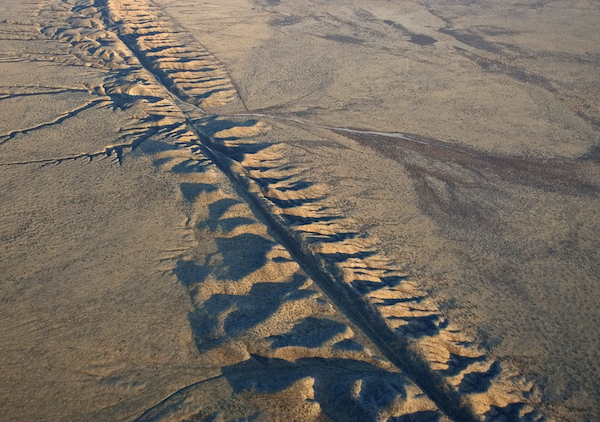
A new scientific study has renewed attention on Southern California’s San Andreas and San Jacinto fault systems, finding that portions of the region may be carrying their highest levels of tectonic stress in roughly 1,000 years.
The research does not predict that a major earthquake is imminent, and scientists cannot determine the exact date or time of a future rupture. But the findings suggest that the fault network is unusually loaded and may be capable of producing a major earthquake involving more than one fault system.
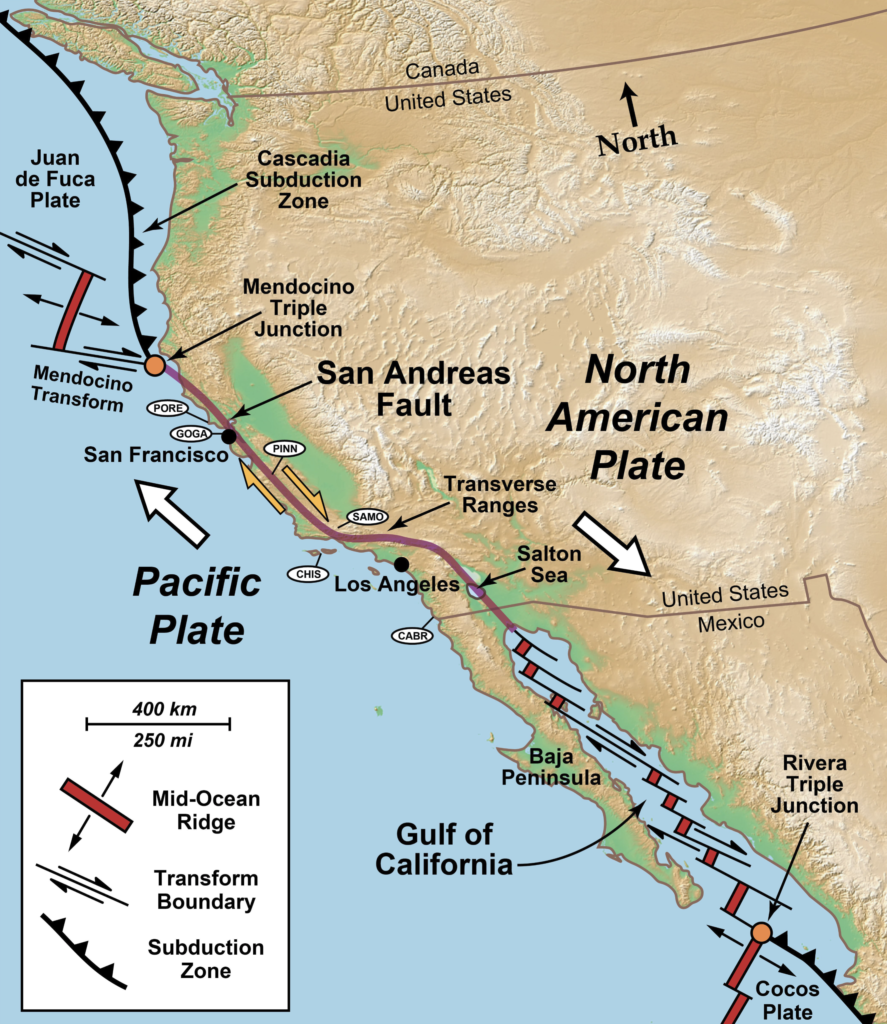
The study, led by geophysicist Liliane Burkhard, focused on the interaction between the southern San Andreas and San Jacinto faults near Cajon Pass, north of San Bernardino. That area is especially important because the two fault systems approach one another there, creating what researchers describe as an “earthquake gate.”
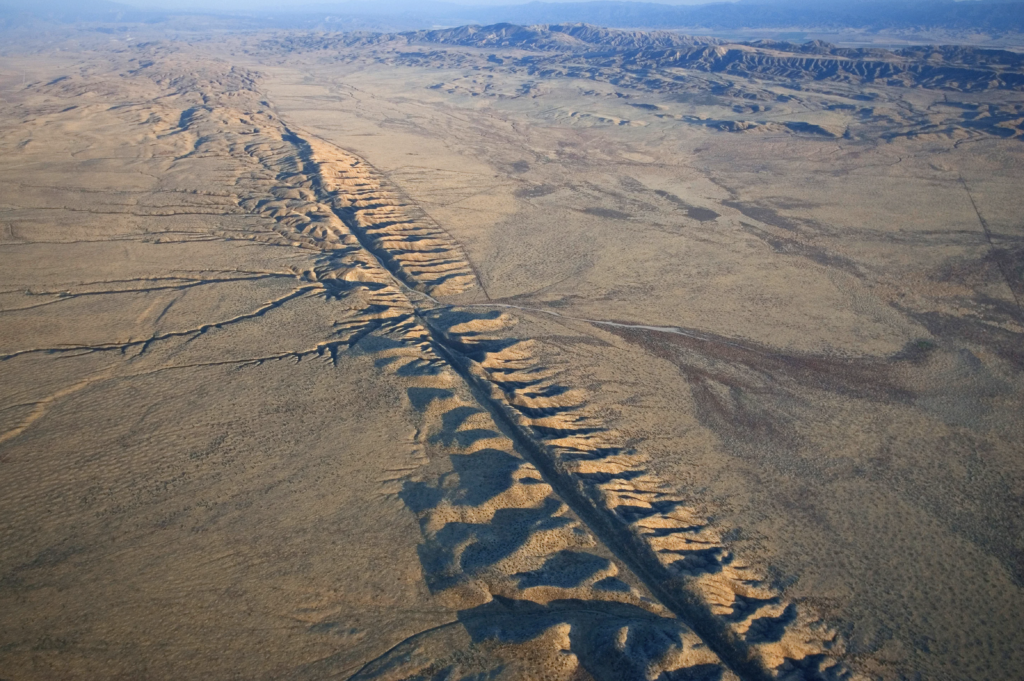
Depending on stress conditions at the time of an earthquake, Cajon Pass could stop a rupture from moving between the fault systems—or allow a rupture to continue across both.
“Our findings suggest the system is currently more loaded than at any point in the past 1,000 years,” Burkhard said in an email interview with Reuven Givati of Texas News Express.
Burkhard, who has is affiliated with the Hawaii Institute of Geophysics and Planetology at the University of Hawaii at Mānoa and the University of Bern in Switzerland, said the research indicates that the risk is real, even though scientists cannot translate the findings into a precise five-year prediction.
The study used a physics-based computer model combined with approximately 1,000 years of estimated earthquake history to examine how stress accumulated and was released on different fault segments.
Researchers found that stress levels on parts of the San Andreas and San Jacinto systems are unusually high and closely aligned. That alignment is important because it could make it easier for a rupture to cross the Cajon Pass junction rather than stopping there.
A rupture involving both systems could affect a wide area of Southern California, potentially including portions of Los Angeles, San Bernardino, Riverside, the Inland Empire and the Coachella Valley.
The Study Is a Warning, Not a Date-Specific Prediction
Despite the attention surrounding the findings, the study does not say that a major earthquake will occur within days, months or even five years.
Earthquake scientists generally issue long-term probability forecasts rather than short-term predictions because the statistical uncertainty becomes much greater over narrower periods.
Asked to rate the risk of a major Southern California earthquake during the next five years, Burkhard said official forecasts are normally calculated over 30-year periods.
“Converting that to a five-year probability is not straightforward,” she said. “But the underlying message is clear: the risk is real.”
Published U.S. Geological Survey figures estimate that the Los Angeles region has a 60% chance of experiencing a magnitude 6.7 earthquake within a 30-year period, a 46% chance of a magnitude 7 and a 31% chance of a magnitude 7.5.
Those figures are regional estimates and are not limited to the San Andreas Fault. They include earthquakes on known major faults, smaller faults and potentially unidentified fault structures.
California as a whole has a greater than 99% chance of experiencing at least one magnitude 6.7 or larger earthquake during a 30-year period, according to longstanding statewide modeling.
That does not mean every part of California faces the same risk, nor does it mean the next major earthquake will occur on the San Andreas.
Why Cajon Pass Matters
The southern San Andreas Fault last produced a major rupture in 1857, when an estimated magnitude 7.9 earthquake broke along a long section of the fault from Central California toward Southern California.
That rupture did not continue through the Cajon Pass region into the San Jacinto system.
An earlier earthquake in 1812 appears to have behaved differently, with evidence suggesting that the rupture may have crossed or interacted with the junction near Cajon Pass.
Researchers are studying why one earthquake passed through the junction while another stopped. The answer may depend partly on whether stress levels across the two fault systems were sufficiently similar at the time.
The new modeling suggests present conditions may be more favorable for a connected rupture than they have been during much of the past millennium.
That possibility matters because a rupture involving multiple fault segments could be longer, more complex and potentially more damaging than an earthquake confined to one section.
It could also disrupt critical infrastructure crossing Cajon Pass, including Interstate 15, rail lines, power transmission systems, pipelines and communications routes connecting Southern California with Las Vegas and other interior regions.
California’s Other Major Fault Threats
The San Andreas is California’s most famous fault, but it is only one part of a large and complicated seismic network.
Burkhard identified the San Jacinto Fault as one of the most important Southern California systems. It runs through parts of the Inland Empire and toward the Salton Sea and is capable of producing a major earthquake.
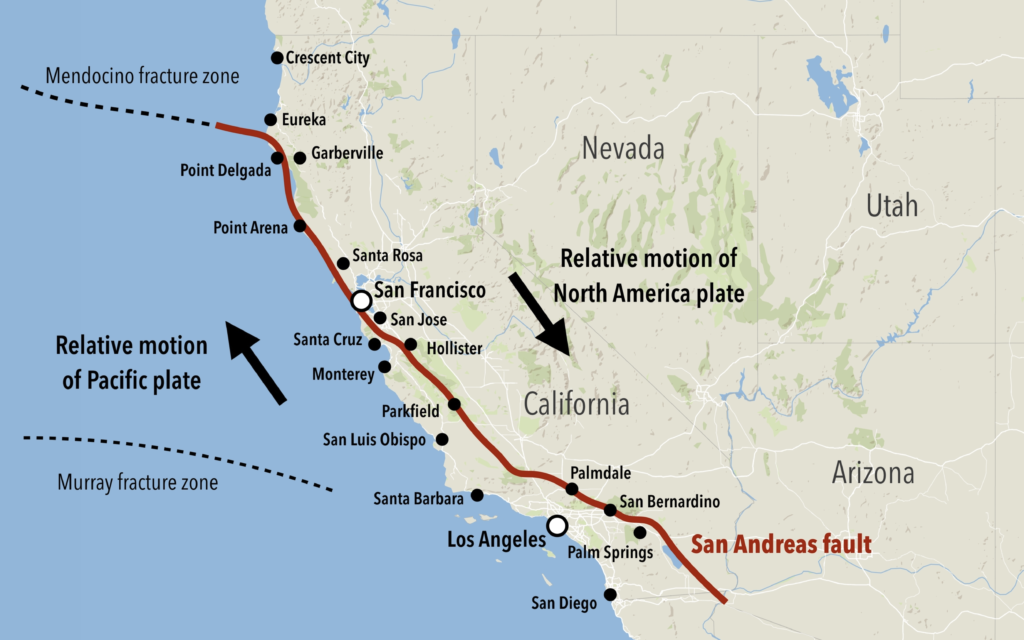
The Elsinore Fault, located farther west, is also active and runs through portions of Riverside, San Diego and Orange counties. The Garlock Fault stretches along the northern edge of the Mojave Desert and can interact with other major California fault systems.
In Northern California, the Hayward Fault is considered among the most dangerous urban faults in the United States. It runs beneath densely populated East Bay communities, including areas near Oakland, Berkeley, Hayward and Fremont.
The Hayward Fault last produced a major earthquake in 1868. Current federal estimates assign the combined Hayward-Rodgers Creek fault system roughly a one-in-three chance of producing a magnitude 6.7 or larger earthquake within the 30-year forecast period used by the USGS.
Unlike the more remote portions of the San Andreas, the Hayward Fault passes directly through highly developed communities and near major transportation, water, utility and communications infrastructure.
Cascadia Could Produce a Magnitude 9 Earthquake
Farther north, another major threat lies offshore.
The Cascadia Subduction Zone extends from Northern California through Oregon and Washington to Vancouver Island, Canada. It is capable of producing a magnitude 9-class megathrust earthquake and a large tsunami.
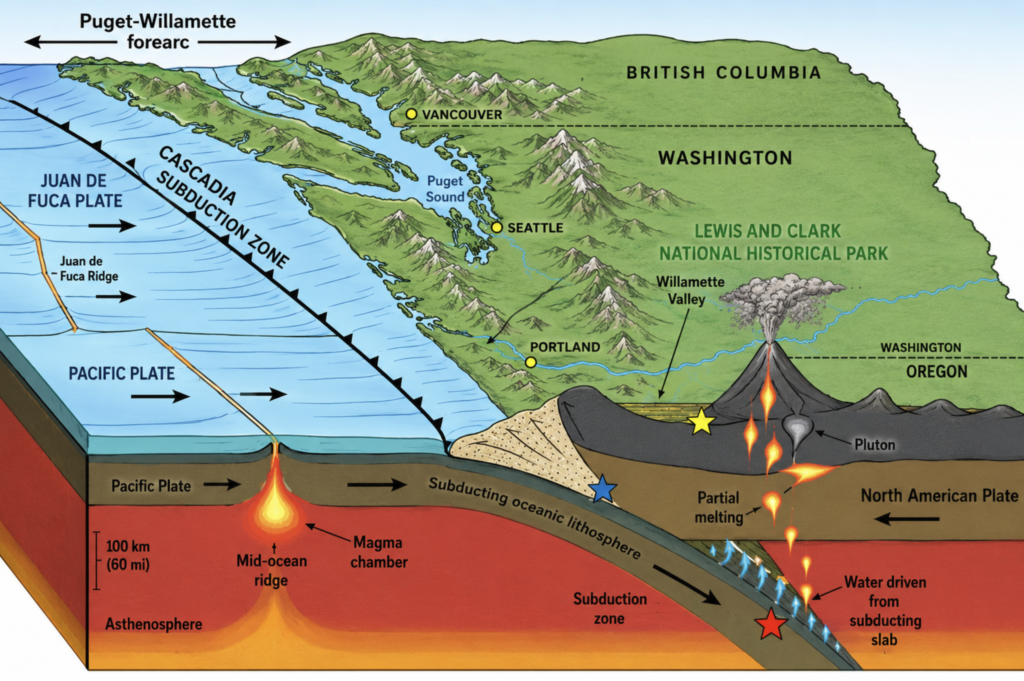
The last full-margin Cascadia earthquake occurred in January 1700.
Recent USGS assessments estimate a roughly 10% to 15% chance of another magnitude 9 earthquake along the full Cascadia Subduction Zone during the next 50 years. For southern Cascadia, which includes the offshore region near Northern California and southern Oregon, the probability of a magnitude 8 or larger partial or full rupture may be closer to 30%.
A major Cascadia event could produce several minutes of severe shaking, coastal subsidence, landslides, liquefaction and tsunami waves reaching nearby communities within minutes.
New Madrid Remains a Central U.S. Threat
Earthquake risk is not limited to the West Coast.
The New Madrid Seismic Zone extends through portions of Missouri, Arkansas, Tennessee and Kentucky. It produced a sequence of extremely large earthquakes during the winter of 1811 and 1812.
Those earthquakes were felt across much of the eastern United States and caused major ground deformation along the Mississippi River.
Burkhard declined to estimate the five-year risk for New Madrid because it lies outside her area of specialization. She recommended relying on scientists who study the central and eastern United States.
The USGS estimates a 25% to 40% chance of a magnitude 6 or larger earthquake in the New Madrid region during the next 50 years. It estimates roughly a 7% to 10% chance of a repeat of an 1811–1812-scale earthquake sequence during that period.
Because seismic waves generally travel farther through the older and denser crust of the central and eastern United States, a large New Madrid earthquake could affect an area much larger than a comparable California event.
Cities including Memphis and St. Louis contain older buildings and infrastructure that were not necessarily designed for severe earthquake shaking.
West Texas and Oklahoma Are Experiencing More Earthquakes
West Texas has experienced a sharp increase in earthquakes, particularly in the Permian Basin. Oklahoma also experienced a major increase in earthquake activity during the expansion of oil and gas production and wastewater disposal.
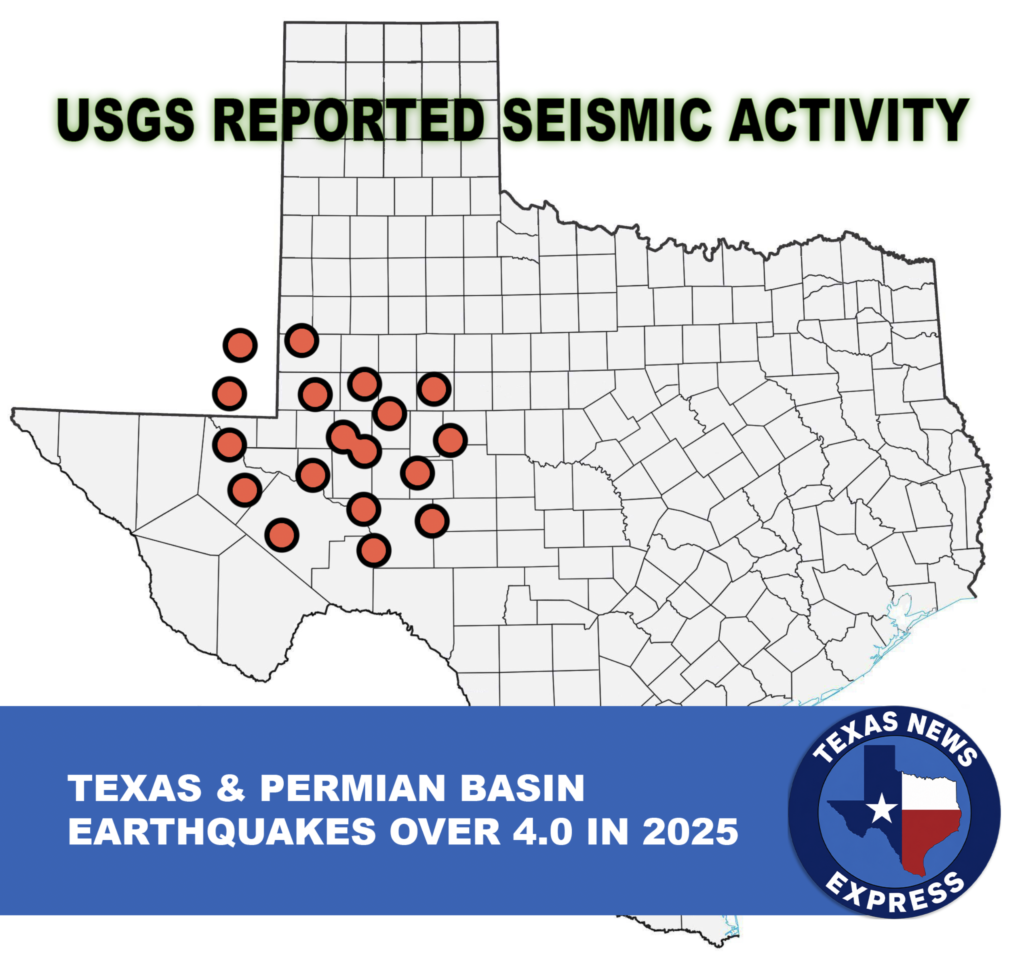
Unlike California’s plate-boundary earthquakes, much of the increase in West Texas is associated with oil and gas activity, especially the underground disposal of wastewater produced during drilling and extraction.
“Induced seismicity from wastewater injection associated with oil and gas operations is a well-documented phenomenon,” Burkhard said. “The increase in earthquake activity in the Permian Basin is a serious and actively studied issue.”
USGS geologist Mark Gordon offered a similar but measured assessment in his comments.
“Overall, there has been an increase in earthquakes across West Texas and even Oklahoma, but that does not mean an old fault system is becoming active again,” Gordon said. “Rather, there are other local issues, and it is unlikely that major earthquakes will happen, but not impossible.”
Researchers have linked many earthquakes in the region to wastewater injection, which can increase underground fluid pressure and reduce friction along faults that already exist beneath the surface.
Hydraulic fracturing itself can produce earthquakes, but deep wastewater disposal has been associated with many of the larger induced events.
Asked whether West Texas earthquakes could develop into a new fault system, Burkhard said induced earthquakes typically reactivate faults that already exist underground.
“In a sense, the fault structures already exist,” she said.
The more important question is whether continued injection could activate larger fault areas or produce stronger earthquakes. Scientists continue to monitor that possibility, but the recent activity does not mean West Texas is developing a San Andreas-style plate boundary.
Gordon’s comments also underscore an important distinction between an increase in earthquake frequency and the reawakening of a large regional fault system. More earthquakes do not automatically mean that a catastrophic event is approaching.
Preparedness Matters More Than Prediction
Scientists cannot say exactly when the next major U.S. earthquake will occur. That makes preparedness more useful than trying to interpret every small tremor as a warning.
Both Burkhard and Gordon emphasized that communities should focus on reducing risk rather than attempting to predict a precise date.
“Preparedness is far more important than prediction right now,” Gordon said. “Developing better earthquake-resistant buildings, having individual and family emergency supplies and a plan, and improving infrastructure to better handle earthquakes is what we can do right now.”
Burkhard recommended that households maintain at least 72 hours of water, food and essential medication. Families should have a communication and reunification plan because mobile networks may fail or become overloaded after a disaster.
Heavy furniture, bookshelves and water heaters should be secured to walls. Residents should also understand whether they live or work in an older, unreinforced building and know how to shut off the gas supply if authorities recommend doing so or a leak is suspected.
During shaking, emergency officials recommend “Drop, Cover and Hold On.” People should get beneath a sturdy desk or table, protect their head and neck and remain away from windows.
Running outside during strong shaking can expose people to falling glass, bricks, signs and other debris.
After an earthquake, residents should expect aftershocks, check for injuries and avoid visibly damaged buildings and downed power lines. Anyone who smells gas should leave the area and contact emergency services from outside.
Government preparedness extends beyond household emergency kits. Engineers and public officials can strengthen bridges, water systems, hospitals, schools, utility networks and older buildings so that they are better able to withstand severe shaking.
The new San Andreas and San Jacinto study does not establish a countdown to California’s next major earthquake.
It does, however, show that important portions of Southern California’s fault system may be carrying historically high stress—and that a junction capable of connecting two major faults deserves close attention.
For millions of people living near active earthquake zones, the message from both researchers is not that disaster will occur tomorrow. It is that the hazard is permanent, the timing remains uncertain and preparation is the most practical defense available.