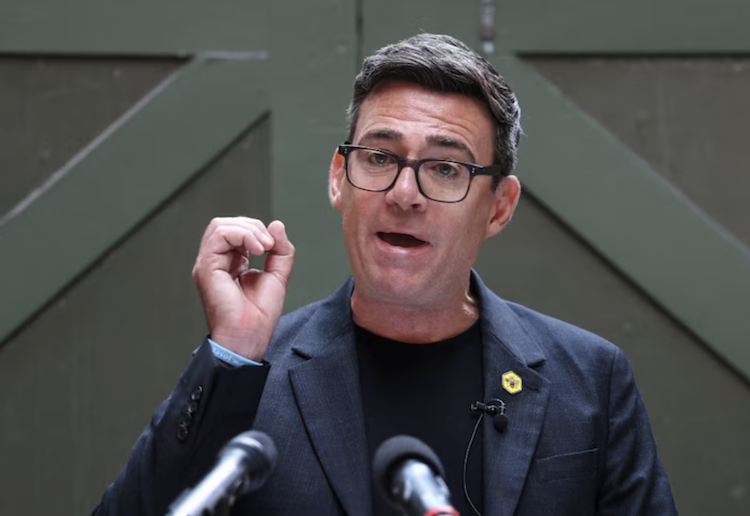
Andy Burnham was officially declared leader of Britain’s governing Labour Party on Friday, clearing the way for him to become the United Kingdom’s next prime minister.
Burnham, the former mayor of Greater Manchester, replaces outgoing Prime Minister Keir Starmer as Labour leader after a leadership contest in which he was the only candidate. According to the Associated Press, Burnham secured nominations from 379 of Labour’s 403 lawmakers in the House of Commons, making Friday’s announcement largely procedural.
Starmer is expected to remain prime minister until Monday, when he is scheduled to formally submit his resignation to King Charles III. The king is then expected to ask Burnham to form a government. Under Britain’s parliamentary system, a change in party leadership can lead to a change in prime minister without a general election, as long as the governing party continues to command a majority in the House of Commons.
In his first speech as Labour leader, Burnham promised to restore hope and give the country a renewed sense of purpose. He told party lawmakers, activists and union leaders that he was ready for the role and said his government would focus on shifting power away from Westminster and toward local communities.
“We will take power back from Westminster and Whitehall and give it to the place you live,” Burnham said, according to AP. He said his approach would include giving cities and regions more control over what he described as “life’s essentials,” including services that affect everyday living standards.
Burnham takes over after a turbulent period for Labour. Starmer led the party to a landslide election victory in 2024, but his government later faced declining popularity, internal party pressure, poor local election results and public frustration over the economy, the cost of living and public services.
Labour has also faced rising pressure from Reform UK, the anti-immigration party led by Nigel Farage. AP and Reuters have reported that Reform has been polling strongly, adding pressure on Labour to reconnect with voters who have grown dissatisfied with the government.
Burnham’s political rise has been unusual. He previously served as a Labour Cabinet minister under Prime Ministers Tony Blair and Gordon Brown, including as health secretary. After twice losing bids for Labour leader, he left Parliament in 2017 to become mayor of Greater Manchester.
As mayor, Burnham built a national profile by promoting regional devolution, public transport reform and what supporters have called a more locally focused model of government. His time in Greater Manchester helped reshape his political identity and made him one of Labour’s best-known figures outside London.
A month before being confirmed as Labour leader, Burnham returned to Parliament by winning a special election in Makerfield. That victory made him eligible to seek the Labour leadership after Starmer announced he would step down.
Reuters reported that Burnham has not yet decided who will serve in his Cabinet, but he said his senior team would reflect different parts of the Labour Party and the country. “I haven’t made any decisions yet about who will be in that top team,” Burnham said. “But I will soon, and when I have, you will see it reflects all parts of our party, all communities.”
Burnham has outlined broad priorities, including regional empowerment, economic renewal, social care reform, public control of some essential services and efforts to create industrial jobs. However, he has provided limited detail on how some of those policies would be funded or implemented.
His government will inherit many of the same issues that affected Starmer’s administration, including slow economic growth, pressure on household budgets, strained public services and questions about Britain’s relationship with Europe, the United States and other allies.
Burnham will become Britain’s seventh prime minister since 2016, continuing a period of frequent leadership change in British politics. The next national election does not have to be held until 2029.