British Prime Minister Keir Starmer announced Monday that he will resign, ending a premiership that began with one of Labour’s largest election victories but unraveled in less than two years amid weak public support, internal rebellion and repeated questions about the government’s direction.
Starmer said he had listened to members of his Cabinet and governing Labour Party and concluded that an orderly leadership transition was in the country’s best interest. He is expected to remain in office temporarily while Labour selects a new leader, who would then be appointed prime minister by King Charles III.
His departure places Britain on course to receive its seventh prime minister in approximately 10 years, an unusually rapid rate of leadership turnover for a country once associated with political stability.
The six people who have served as prime minister since 2016 are David Cameron, Theresa May, Boris Johnson, Liz Truss, Rishi Sunak and Starmer. The person replacing Starmer will become the seventh leader during the decade that began with Britain’s vote to leave the European Union.
Cameron resigned after losing the 2016 Brexit referendum. May stepped down after repeatedly failing to win parliamentary support for her Brexit agreement. Johnson left following ethics scandals and a collapse of support within the Conservative Party. Truss resigned after only 49 days when her economic plan destabilized financial markets. Sunak departed after the Conservatives suffered a historic defeat in the 2024 general election.
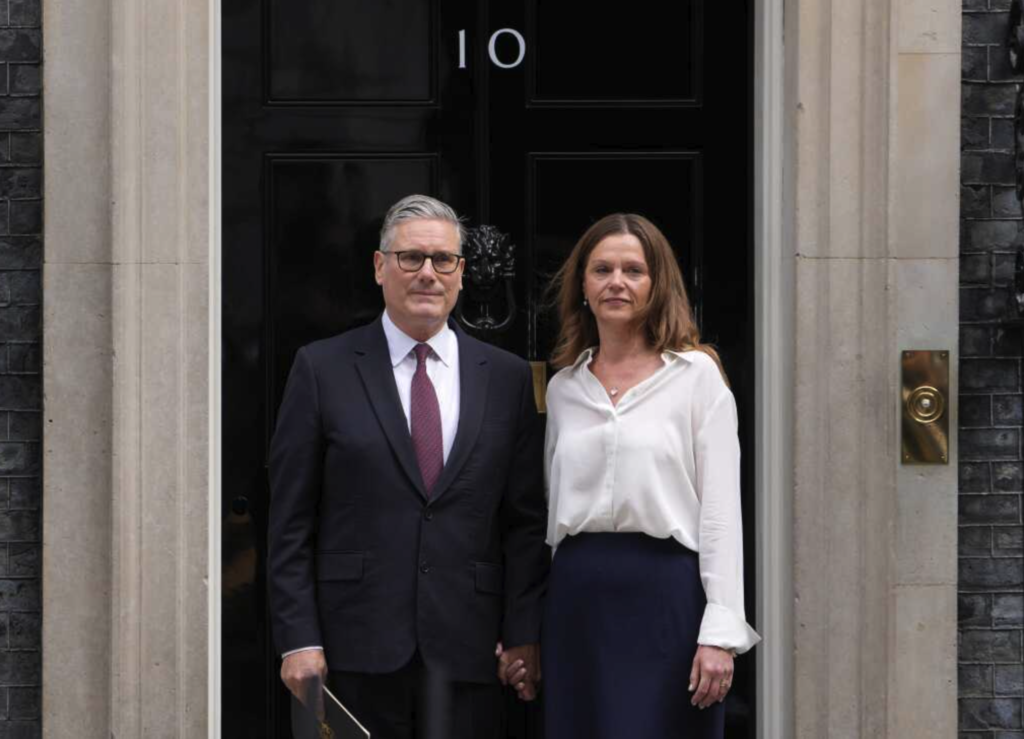
UK Prime Minister Keir Starmer appears with his wife outside of Number 10 Downing Street and announces his resignation.

Starmer was supposed to end that instability.
Labour won a commanding parliamentary majority in July 2024 after Starmer promised competent government, economic growth and an end to the turmoil that had characterized the final years of Conservative rule. Instead, his administration became associated with policy reversals, weak economic performance and uncertainty over what the government ultimately stood for.
Falling Public and Party Support
By May 2026, Starmer’s net favorability rating had fallen to minus 46 in polling by YouGov. An Opinium survey during the same period found that nearly half of the public believed he should resign rather than contest another Labour leadership election.
The pressure increased after Labour suffered heavy losses in local and regional elections. Nigel Farage’s Reform UK gained support in areas that Labour needed to retain, while Labour lawmakers became increasingly concerned that Starmer could lead the party to defeat at the next general election.
The return of Andy Burnham to Parliament intensified those concerns. Burnham, the former mayor of Greater Manchester and a previous Labour leadership candidate, won a parliamentary by-election and quickly emerged as the most likely challenger to Starmer.
Several ministers resigned or withdrew their support from the prime minister. When senior Cabinet members concluded that Starmer could no longer unite the party, his position became increasingly difficult to maintain.
Policy Reversals Damaged Credibility
Starmer’s government repeatedly changed course on major policies, reinforcing criticism that it lacked a consistent political identity.
One of the most damaging decisions involved restricting winter fuel payments for many pensioners. The government initially defended the measure as necessary to control spending, but later softened or reversed parts of the policy after strong opposition from Labour lawmakers and the public.
The government also retreated or adjusted plans involving welfare reductions, inheritance tax changes affecting farms, foreign-aid spending, employment reforms and an inquiry into organized child sexual exploitation.
Changing a policy after receiving new information is not necessarily evidence of weak leadership. Governments routinely revise proposals during negotiations. However, the number and visibility of the reversals allowed opponents to portray Starmer as indecisive.
A Resolution Foundation assessment said the government’s early record had become characterized by policy U-turns, abandoned tax proposals and hesitation on major reforms involving housing, employment and trade.
Starmer also faced criticism over the appointment of veteran Labour politician Peter Mandelson as Britain’s ambassador to the United States. Questions about the appointment and the government’s handling of concerns surrounding Mandelson weakened Starmer’s claims that Labour had restored ethical standards and careful decision-making.
Disagreement Over Relations With the United States
Foreign policy became another source of controversy, particularly over Britain’s response to the conflict involving the United States, Israel and Iran.
Starmer defended his decision not to support the initial American and Israeli strikes against Iran. He argued that Britain should focus on protecting its citizens, supporting allies when required and preventing the conflict from expanding.
President Donald Trump publicly criticized the British position, while some Conservative politicians and defense advocates argued that Starmer should have offered stronger support to the United States, Britain’s closest military ally.
Supporters of Starmer’s decision said refusing to join the strikes reduced the risk of pulling Britain into a wider Middle Eastern war without a clear parliamentary mandate or defined objective.
The disagreement did not by itself cause Starmer’s resignation. His political difficulties began well before the Iran conflict. However, the dispute added to the perception among critics that Britain was becoming an uncertain partner at a time of international instability.
Starmer later spoke with Trump about diplomatic efforts to end the conflict, and his government continued working with the United States on security, intelligence and efforts to protect regional shipping.
Economic Problems Proved Difficult to Solve
Starmer entered office promising to make economic growth the government’s central mission. Britain’s economy, however, remained constrained by weak productivity, high public debt, costly public services and continuing pressure on household finances.
Labour inherited many of those problems, and international events—including higher energy prices and renewed instability in the Middle East—made them more difficult to address.
Still, voters generally judge governments on results rather than explanations. Starmer’s promise of stability became harder to defend when growth remained limited, taxes increased and the government repeatedly adjusted its spending plans.
His administration introduced stronger employment protections, increased the national living wage, expanded some family programs and moved Britain toward closer cooperation with the European Union. It also continued strong support for Ukraine.
Those achievements were not enough to overcome the belief among many Labour lawmakers that Starmer had failed to present a clear explanation of what his government was trying to accomplish.
Britain Heads Toward Another Unelected Transition
A change in prime minister does not automatically require a general election under Britain’s parliamentary system.
Labour holds a majority in the House of Commons, and its next leader can become prime minister if that person can maintain the confidence of Parliament. The next nationwide election is not legally required until 2029.
Opposition parties are nevertheless expected to demand an early election, arguing that voters elected a government led by Starmer rather than his successor.
Andy Burnham is widely viewed as the favorite to replace him. Other possible candidates could still emerge, although senior Labour figures have already begun rallying around Burnham in an effort to avoid a prolonged and divisive leadership contest.
Reports that Burnham could take office without serious opposition remain political expectations rather than a confirmed outcome. Labour must first establish its leadership timetable and determine whether other candidates qualify to run.
A Decade of Political Instability
Starmer’s resignation extends a period of remarkable turnover at the top of British government.
From Margaret Thatcher’s arrival in 1979 through Cameron’s resignation in 2016, Britain had six prime ministers over approximately 37 years. The country has now had six more in the 10 years since the Brexit referendum, with a seventh expected shortly.
The reasons for their departures have varied, but Brexit, party division, economic pressure, ethical controversies and collapsing public confidence have repeatedly destabilized the government.
Starmer came to office presenting himself as the steady administrator who would return Britain to predictable government. His departure after less than two years demonstrates how difficult that promise proved to deliver.
His successor will inherit the same problems that weakened his government: a slow-growing economy, strained public services, divisions over immigration, pressure from Reform UK, disputes over Britain’s international role and a public increasingly skeptical of political leadership.
Changing the prime minister may give Labour an opportunity to reset its government. Whether it restores public confidence will depend less on the identity of the new leader than on whether that leader can offer a consistent direction—and produce results.