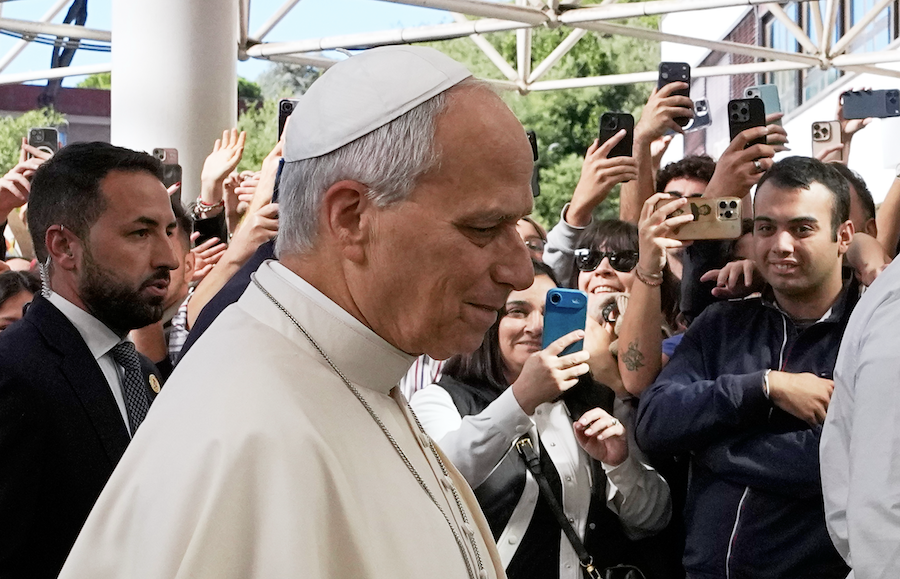
ROME, Italy – Pope Leo XIV is recovering at Rome’s Gemelli Hospital after surgery for lung cancer, with doctors reporting Thursday that his operated lung is healing well and that the 71-year-old pontiff has already returned to some of his normal work. The Vatican confirmed that Leo underwent surgery Tuesday to remove the lower lobe of his right lung after doctors discovered a cancerous tumor identified as pulmonary adenocarcinoma.
The latest update from the Vatican on Thursday, Oct. 15, said routine medical tests were within normal ranges. A chest X-ray showed what doctors described as “good recovery” of the lung that underwent surgery.
Leo was also able to carry out his normal daily activities independently and completed a physical therapy session that included full movement exercises.
“Overall, his postoperative recovery is progressing normally,” his doctors said in the Vatican statement.
The update came two days after doctors at Gemelli Hospital removed the lower lobe of the pope’s right lung using video-assisted surgery.
The Vatican said Leo spent about three hours in the operating room, although the operation itself lasted approximately 90 minutes. Doctors reported no complications during the procedure.
Testing of tissue during the surgery confirmed that the growth was pulmonary adenocarcinoma, one of the most common forms of lung cancer.
The cancer had been suspected before surgery. Leo publicly disclosed Sunday that doctors had discovered what he described as a small and localized nodule during routine medical examinations.
Doctors decided to remove an entire lobe of the lung rather than only the nodule. A procedure of this type is known as a lobectomy and is commonly used when doctors believe lung cancer is limited enough to be removed surgically.
The Vatican has not released the exact size of the tumor or said whether cancer cells were found in nearby lymph nodes.
Those details are important because they will help doctors determine the cancer’s final stage and whether Leo will need treatment beyond surgery.
Further testing is also being done to study the molecular characteristics of the cancer, according to The Associated Press. Those results could help doctors decide whether medication or another form of treatment would be useful.
Medical experts who are not treating the pope have generally described the early information as encouraging, while cautioning that it is too soon to know his full prognosis.
Dr. Ross Camidge, a lung cancer specialist at the University of Colorado Cancer Center, said the decision to remove the tumor surgically and reports that it was detected early are positive signs.
Other cancer specialists have made similar observations but say the final pathology results will be important. UCHealth
Dr. Luis Ráez, an oncologist who is not involved in Leo’s care, said treatment decisions usually depend heavily on the size of a tumor and whether the cancer has moved beyond the lung.
Surgery is most commonly used for earlier-stage lung cancer. Patients with more advanced disease are often treated with chemotherapy, radiation or newer drug therapies instead of surgery alone.
Ráez said early-stage lung cancers that can be completely removed can have a strong chance of successful treatment, but continued monitoring is normally required because cancer can return.
The Vatican has not announced that Leo is cancer-free.
Doctors are still reviewing information from the removed tissue, and no decision has been announced about whether the pope will need chemotherapy, immunotherapy or another treatment.
Adenocarcinoma is a form of non-small cell lung cancer that develops in gland-like cells in the lung. It accounts for about 40 percent of lung cancers and can occur in people who have never smoked.
Leo is not known to have been a smoker.
Doctors say lung cancer in nonsmokers can be associated with several factors, including environmental exposures or genetic changes, although there has been no public information identifying what may have caused the pope’s cancer.
The Vatican has not suggested that any particular environmental or genetic factor was responsible.
Leo’s physical recovery began quickly after the operation.
By Wednesday, doctors said he had begun walking around his hospital room, was eating normally and had started respiratory physiotherapy designed to help his remaining lung tissue work effectively after surgery.
He also celebrated Mass Wednesday from a room prepared for worship on the hospital’s 10th floor.
On Thursday, the pope celebrated Mass again and began handling Vatican business from his hospital room.
He met with Archbishop Paolo Rudelli, a senior Vatican official who serves as chief of staff and handles much of the Holy See’s daily administrative work.
The return to work came only two days after surgery, but the Vatican has not indicated that Leo will leave the hospital earlier than originally planned.
He is expected to remain at Gemelli until at least Oct. 20.
All public audiences and appearances have been canceled through that date. Vatican News
The pope’s planned November trip to South America also remains on the Vatican schedule for now.
Leo is scheduled to travel from Nov. 6 through Nov. 17, with stops planned in Peru, Uruguay and Argentina. Vatican officials have not announced any changes to the trip following his diagnosis and surgery. AP News
The trip would require considerable travel only a few weeks after part of his lung was removed, raising questions about whether doctors will recommend changes as his recovery continues.
Peruvian officials have acknowledged that the schedule could change depending on Leo’s health, while the Vatican has so far kept the planned dates in place.
The diagnosis has also brought messages of support from political and religious leaders around the world.
President Donald Trump said Wednesday that he hoped Leo would “get better fast.” Other leaders have sent similar messages, while Catholic communities in several countries have organized prayers for the pope’s recovery.
At Gemelli Hospital, Catholics have gathered outside and left candles and religious items near a statue of St. John Paul II.
The hospital has treated several popes over the past four decades. John Paul II received extensive medical care there following the 1981 assassination attempt, and Pope Francis was also treated at Gemelli during his papacy. Reuters
Leo’s diagnosis has drawn particular attention because he had maintained an active travel and public schedule since becoming pope in May 2025 and had not previously disclosed a serious illness.
His doctors said Thursday that the immediate recovery from surgery remains on schedule.
What has not yet been announced is the cancer’s complete stage, whether lymph nodes were affected and whether surgery will be the only cancer treatment Leo needs.
For now, the Vatican says he will continue physical and respiratory therapy at Gemelli while his doctors review the remaining test results and monitor how his lung heals.