
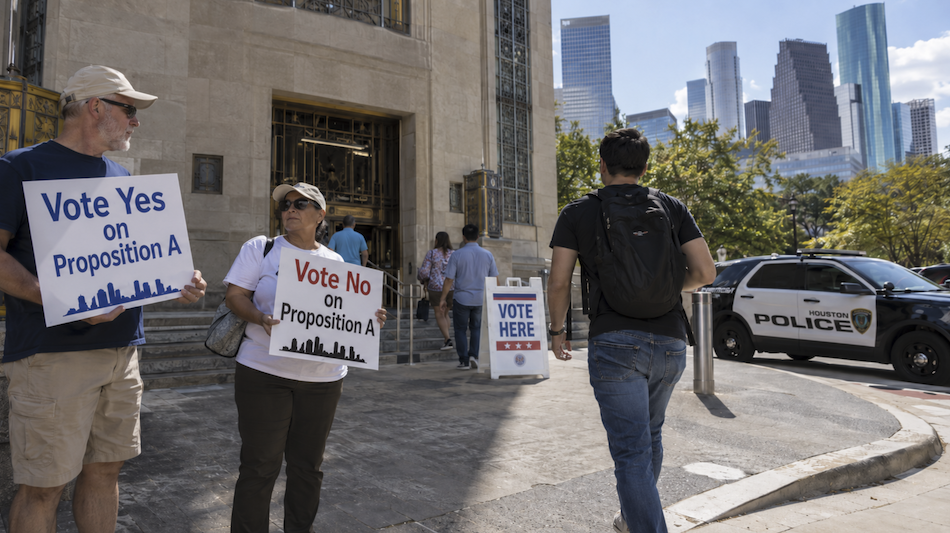
HOUSTON, Texas – Houston voters will decide on November 3 whether the city should change how its police department handles misdemeanor marijuana possession and place a ban on no-knock search warrants into the city charter.
Proposition A, called the Houston Freedom Act by its supporters, would require the Houston Police Department to make enforcement of Class A and Class B misdemeanor marijuana possession its lowest law-enforcement priority. It would also prohibit Houston police officers from requesting or executing no-knock search warrants and require additional reporting on marijuana enforcement.
The proposal would not legalize marijuana in Houston.
Marijuana possession would remain illegal under Texas law. Possession of two ounces or less is generally a Class B misdemeanor, while possession of more than two ounces but no more than four ounces is a Class A misdemeanor.
The measure would instead tell HPD where misdemeanor marijuana possession should fall among the department’s enforcement priorities. Other agencies, including the Texas Department of Public Safety and county law enforcement agencies, would not be bound by Houston’s charter amendment.
Supporters gathered roughly 40,000 petition signatures to place the proposal before voters. Houston City Council placed the measure on the November ballot in August.
Ground Game Texas, the group leading the campaign, argues that police officers should spend more time on serious crimes rather than arresting people for possessing small amounts of marijuana.
Supporters also say the measure could have an important effect on young people and first-time offenders who make a mistake but otherwise have little or no criminal history.
An arrest or drug charge can create problems long after the original case is over. Employers and landlords commonly use background checks, and supporters argue that a young person should not have future opportunities limited because of one low-level marijuana case. Ground Game Texas Executive Director Catina Voellinger has said the costs of an arrest can include lost work and legal expenses, while a criminal history can also create problems when someone applies for employment or housing.
For an 18- or 19-year-old caught with a small amount of marijuana for the first time, supporters say avoiding the criminal justice system could give that person an opportunity to learn from the mistake without carrying a drug conviction into adulthood.
Harris County already has a program designed to accomplish some of that goal.
The Harris County District Attorney’s Office operates a Misdemeanor Marijuana Diversion Program for qualifying people accused of Class A or Class B marijuana possession. The program is open to adults age 17 and older who meet eligibility requirements.
Instead of going through the traditional criminal court process, eligible participants complete an education program. According to the district attorney’s office, someone who successfully completes the program will not have a record of an arrest or charge for marijuana possession.
That program provides an important protection for many first-time offenders, but supporters of Proposition A say it does not eliminate the possibility of being detained or arrested in the first place.
They argue that making marijuana possession HPD’s lowest priority could prevent some young people from entering the system at all, rather than relying on a diversion program after police have already taken action.
Recent arrest numbers have become part of the debate.
Houston Public Media reported that HPD misdemeanor marijuana arrests increased from about 70 in 2023 to about 540 in 2024, Mayor John Whitmire’s first year in office. HPD made 426 misdemeanor marijuana arrests in 2025, according to the same reporting.
Whitmire has said personal marijuana use is not a priority for HPD and has questioned whether Proposition A would make much difference.
“Houstonians will get to speak, but even before the ballot initiative, it is not a priority of HPD,” Whitmire said in September.
The Houston Police Officers’ Union has also questioned the need for the measure.
Union President Douglas Griffith said many marijuana cases already involve another alleged offense. He said HPD made about 400 marijuana possession arrests last year and estimated that about 90 percent were connected to another charge.
Griffith also said officers who discover marijuana still have responsibilities involving evidence and reports, even if marijuana possession becomes the department’s lowest priority.
“We still have to do all the paperwork the same,” Griffith told KPRC.
He has also raised concerns about creating different marijuana enforcement policies within the Houston area.
Houston extends into Harris County as well as portions of Fort Bend and Montgomery counties. Sheriff’s deputies, constables and state troopers would still enforce Texas law according to their own policies.
Griffith argues that the result could be different treatment depending on which law-enforcement agency encounters someone carrying marijuana.
Harris County District Attorney Sean Teare has taken a position somewhere between the two sides.
Teare has said he does not believe prosecutors should be spending significant resources on marijuana possession cases and has expanded access to the county’s diversion program. At the same time, his office has said the larger confusion surrounding marijuana laws should ultimately be addressed by the Texas Legislature.
The second major part of Proposition A involves no-knock search warrants.
A no-knock warrant allows police to enter a property without first knocking and announcing their presence. Houston’s use of the tactic received national attention following the January 2019 Harding Street raid.
Homeowners Dennis Tuttle and Rhogena Nicholas were killed during that raid, while several Houston police officers were wounded. The investigation later found that information used to obtain the search warrant had been fabricated.
Since Harding Street, Houston has placed strict limits on no-knock warrants.
Griffith says HPD has already largely stopped using them and that the rare cases require approval from the police chief and are handled by specialized officers.
“Since Harding Street, we pretty much did away with no-knock warrants,” Griffith said.
Whitmire has made a similar argument, saying no-knock warrants are already effectively prohibited in Houston.
Supporters of Proposition A respond that current police policies can be changed by a future mayor or police chief. Putting the restriction into the city charter would make it more difficult for a future administration to reverse the policy without another vote.
There is also a major legal question surrounding the marijuana portion of Proposition A.
Texas law says local governments may not adopt a policy that prevents the full enforcement of state drug laws. Attorney General Ken Paxton has previously sued Texas cities that adopted local marijuana decriminalization measures.
In 2025, the Texas Fifteenth Court of Appeals ruled that marijuana ordinances adopted in Austin and San Marcos conflicted with state law. The Austin ordinance had prohibited police from making arrests or issuing citations for most misdemeanor marijuana possession cases.
The Houston proposal is worded differently by making marijuana possession the “lowest” enforcement priority rather than declaring marijuana legal. Ground Game Texas says the Houston language was written with those earlier court fights in mind.
Whether that difference would be enough to survive a legal challenge remains uncertain.
Opponents argue that marijuana law should be decided by the Texas Legislature instead of individual cities. Supporters argue that cities have a right to decide how limited police resources should be used, even when the underlying state law remains unchanged.
The election will therefore involve more than the question of marijuana itself.
Voters will also be deciding how much discretion Houston should have over local policing, whether current protections against no-knock warrants should become permanent parts of the city charter and how the justice system should handle people accused of low-level marijuana offenses.
For young first-time offenders, the debate is especially important. Supporters see Proposition A as another way to keep a single mistake from becoming a lasting criminal record. Opponents say Houston’s existing diversion program already provides that second chance while allowing officers to continue enforcing state law when circumstances require it.
Houston voters will make that decision on November 3.