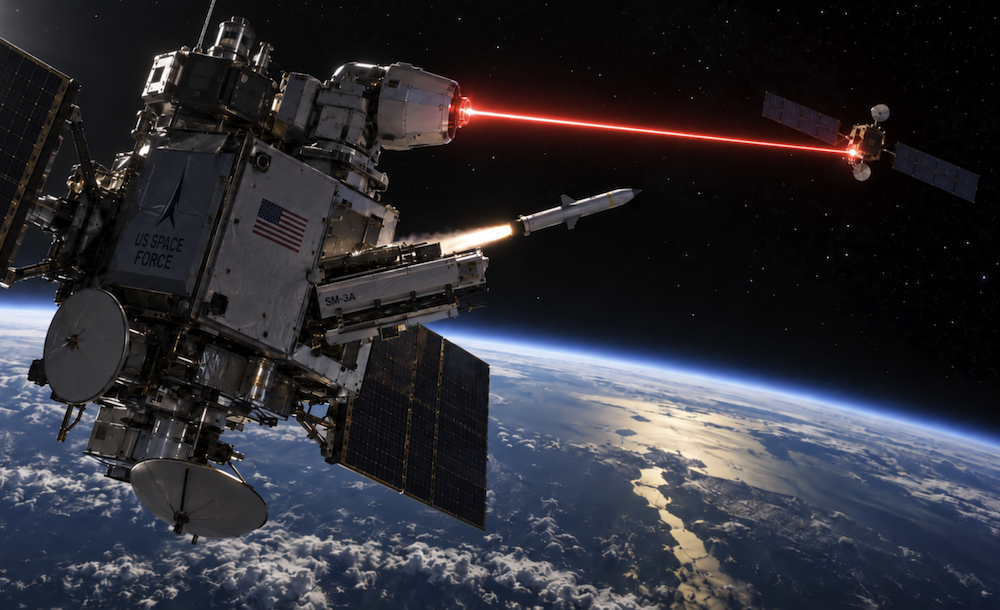
WASHINGTON, D.C. The United States has publicly confirmed for the first time that it has weapons operating in Earth’s orbit, marking a major change in how openly the Pentagon talks about military activity in space.
Air Force Secretary Troy Meink made the announcement Monday during the Air, Space and Cyber Conference in Maryland. He said the U.S. Space Force now has “on-orbit space control weapons” that can defend American forces against attacks from space. He did not say what the weapons are, how many have been deployed or exactly what they can do.
Meink later told reporters that the wording was intentional. He said the United States needs to be able to protect itself in space as other countries develop systems that could threaten American satellites.
“It is critically important that we maintain our dominance, not only in the air but in space,” Meink said. He added that the Pentagon does not plan to release details about the weapons because doing so could reduce their value as a deterrent.
The announcement does not necessarily mean the United States has placed traditional missiles or guns in orbit. The military uses the term “space control” broadly. Space Force doctrine includes systems that can interfere with an opponent’s satellites or communications, along with technology that could physically disable an object in space. The Pentagon has not said whether the newly acknowledged weapons are designed to destroy satellites or disable them without causing physical damage.
The next day, Space Force Chief of Space Operations Gen. Douglas Schiess confirmed that U.S. military personnel are already operating these systems.
“Today, Guardians operate on-orbit weapons that can defend the Joint Force against space-enabled attacks,” Schiess said during a speech Tuesday. He described space as both a battlefield and an important part of nearly every modern U.S. military operation.
American military leaders say the change is being driven in large part by China and Russia.
The Space Force says both countries have been developing ways to interfere with or destroy satellites. China previously demonstrated a ground-launched anti-satellite missile by destroying one of its own weather satellites in 2007. U.S. officials also say China has developed satellites capable of approaching and moving other objects in orbit.
Russia has also developed electronic systems designed to jam satellite communications. U.S. officials have previously warned that Moscow was working on a nuclear anti-satellite system that could damage many satellites at once if it were ever used. Russia has disputed some American accusations about its space programs.
The reason this matters goes far beyond the military.
Satellites help provide GPS navigation and communications around the world. They are also used for weather forecasting, financial systems and emergency services. The military depends on satellites to track missiles, communicate with forces and guide some weapons.
Schiess warned that a serious conflict in orbit would not stay isolated in space. “A bad day in space is felt by everyone,” he said, pointing to the military and the U.S. economy as areas that could be affected.
The announcement has already drawn criticism from China.
Chinese Foreign Ministry spokesperson Guo Jiakun said Wednesday that Beijing opposes turning space into a battlefield. He called on the United States to stop expanding its military presence in orbit. Chinese officials warned that the American announcement could lead other countries to build more space weapons of their own.
Russia also criticized the move. Deputy Foreign Minister Sergei Ryabkov said Moscow wants countries to negotiate a legally binding agreement that would prevent offensive weapons from being placed in space. He said Russia was not surprised by the American announcement and had been watching U.S. military developments closely.
The United States argues that China and Russia have already changed the security situation by developing their own counterspace systems. American officials say openly admitting that the U.S. has defensive and potentially offensive capabilities could discourage an enemy from attacking American satellites in the first place.
There are also questions about international law.
The 1967 Outer Space Treaty prohibits countries from placing nuclear weapons or other weapons of mass destruction in orbit. It also bans military bases and weapons testing on the Moon and other celestial bodies. However, the treaty does not create a complete ban on conventional weapons operating in Earth orbit. Countries are still required to follow international law when conducting activities in space.
The new weapons are separate from another major U.S. military space project known as Golden Dome.
Golden Dome is a planned missile defense system that could eventually include interceptors stationed in space. Those systems would be designed to detect and stop missiles headed toward the United States. Meink said some hardware for the space-based interceptor program has already reached the flight-ready stage, although the system remains under development.
The Congressional Budget Office has estimated that the space-based parts of a large missile defense system could cost hundreds of billions of dollars over the next two decades, depending on how large the system becomes.
For years, much of the discussion surrounding American space weapons took place behind closed doors. The Pentagon openly talked about defending satellites, but officials usually avoided confirming that weapons were already operating in orbit.
That changed this week.
The United States still is not saying what its orbital weapons look like or how they work. But for the first time, the Pentagon is openly acknowledging that American military weapons are already operating above Earth.
That admission may be intended to warn potential enemies. It could also increase pressure on China, Russia and other countries to expand their own military programs in space.
What happens next could help determine whether space remains mainly a place for communications and exploration, or becomes a much more active military battlefield.