
Crew-13 was scheduled to launch Sept. 12, but NASA says engineers need more time to inspect and test the spacecraft before four astronauts can safely fly to the International Space Station.
CAPE CANAVERAL, Fla. NASA and SpaceX have delayed their next astronaut mission to the International Space Station after engineers discovered an oxidizer leak in the propulsion system of the Crew Dragon spacecraft. The Crew-13 mission had been scheduled to launch Sept. 12 from Cape Canaveral Space Force Station in Florida. NASA has not announced a new launch date.
NASA said the leak was discovered during normal work on the spacecraft before launch. Engineers from NASA and SpaceX are now performing more tests and reviewing data. The teams will make any repairs that are needed before the spacecraft is cleared to carry astronauts. NASA has not publicly said how large the leak was or identified the exact part that caused it.
An oxidizer is a chemical that allows rocket fuel to burn. Dragon’s propulsion system uses nitrogen tetroxide as an oxidizer with monomethylhydrazine as fuel. These chemicals can be stored for long periods, which makes them useful for spacecraft that may need to fire their engines many times while in orbit. They are also hazardous, which is why leaks are taken seriously before a crewed flight.
The four-person Crew-13 mission will be commanded by NASA astronaut Jessica Watkins. NASA astronaut Luke Delaney will serve as pilot. Canadian Space Agency astronaut Joshua Kutryk and Russian cosmonaut Sergey Teteryatnikov will also fly as mission specialists. The crew is expected to spend about seven months aboard the space station and become part of Expedition 75.
Watkins has said the mission will include a busy schedule of scientific research and station maintenance. The crew is also expected to prepare for spacewalks and work with visiting spacecraft during its stay. Crew-13 will continue the regular rotation of astronauts that keeps the space station staffed throughout the year.
SpaceX’s Dragon spacecraft has become a major part of NASA’s human spaceflight program. Crew-13 will be SpaceX’s 13th regular astronaut rotation mission for NASA. The company also flew the Demo-2 test mission in 2020, which restored the ability to launch NASA astronauts to orbit from the United States after the Space Shuttle program ended.
The delay does not mean NASA has found a problem with every Crew Dragon spacecraft. NASA’s announcement applies to the Dragon being prepared for Crew-13. The agency has also not announced any emergency involving astronauts already aboard the International Space Station. Crew-12 astronauts Jessica Meir, Jack Hathaway, Sophie Adenot and Andrey Fedyaev have been aboard the station since February.
Crew Dragon has several propulsion systems that help it maneuver in space and provide emergency protection for astronauts. Its smaller Draco thrusters are used to control the spacecraft in orbit, including during operations near the space station. The much more powerful SuperDraco engines are designed to pull the capsule away from the rocket if a serious emergency occurs during launch.
NASA has delayed crewed launches before when engineers found technical concerns. The agency and SpaceX use flight-readiness reviews and ground testing to decide whether equipment is safe enough for astronauts. In March 2025, for example, NASA required additional testing of Dragon thrusters before approving the Crew-10 mission for launch.
The latest delay comes as SpaceX continues a very busy launch schedule. On Sunday, the company successfully launched NASA’s $4 billion Nancy Grace Roman Space Telescope aboard a Falcon Heavy rocket from Florida. That mission was separate from Crew-13 and was not affected by the Dragon leak.
For now, Crew-13 will remain on the ground while engineers determine why the oxidizer leaked and whether repairs are needed. NASA said a new launch date will be announced after the testing and review are complete. The delay may change the space station’s crew rotation schedule, but NASA has not announced any major changes to station operations.
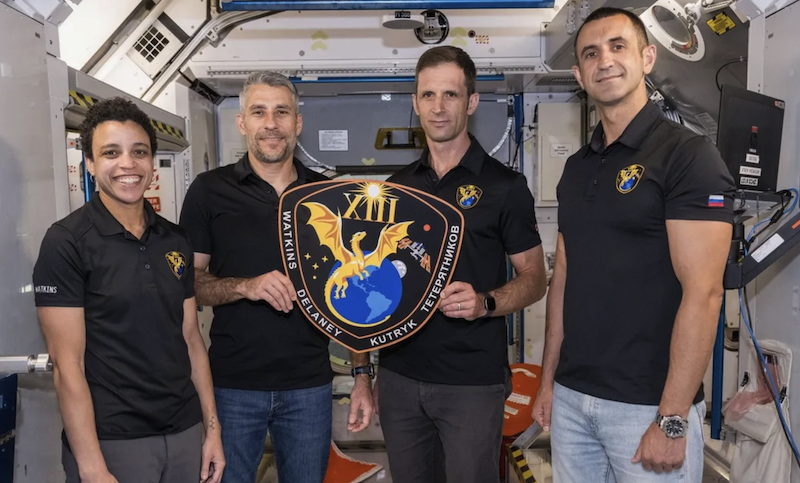
From left: Commander Jessica Watkins and Pilot Luke Delaney, both from NASA, and Mission Specialists Joshua Kutryk of the Canadian Space Agency and Sergey Teteryatnikov of Roscosmos. (Image credit: NASA/Morgan Gridley)