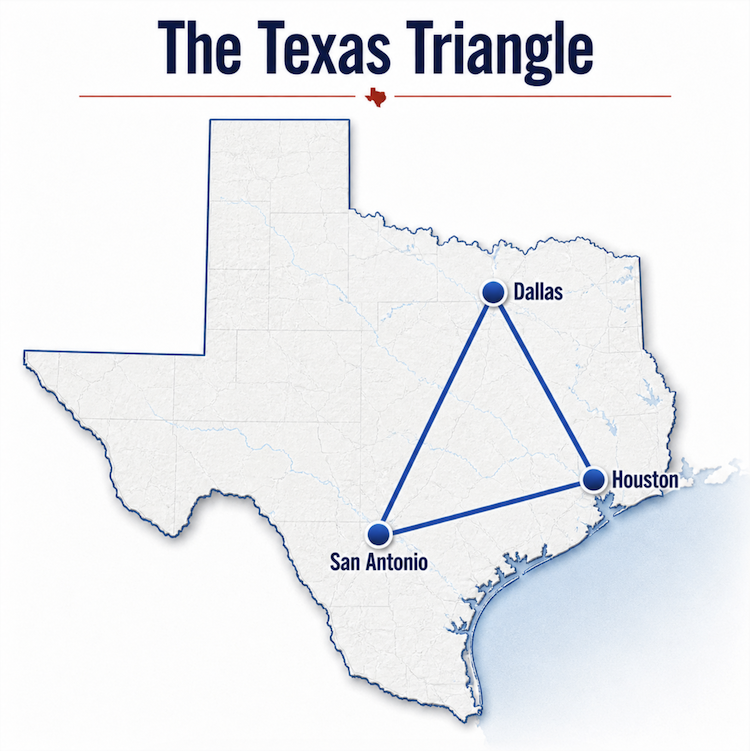
The Texas Triangle has become the center of gravity for Texas growth, linking Dallas-Fort Worth, Houston, Austin and San Antonio into one of the most powerful megaregions in the United States. The region is no longer just a collection of separate metropolitan areas. It is increasingly functioning as a connected economic corridor where people, freight, jobs, housing markets, airports, universities, ports and highway systems overlap. TxDOT now describes the Texas Triangle as home to more than 22 million residents and responsible for nearly 80% of the state’s gross domestic product, making it central to the future of Texas mobility and economic competitiveness.
The newest Census estimates show why the issue is urgent. In 2025, all four major Texas Triangle metros ranked among the nation’s top 10 for numeric population growth. Houston-Pasadena-The Woodlands added 126,720 residents, Dallas-Fort Worth-Arlington added 123,557, Austin-Round Rock-San Marcos added 53,796, and San Antonio-New Braunfels added 38,402. Together, those four metro areas added more than 342,000 people in one year, a population gain larger than many mid-sized American cities.
That growth brings opportunity, but it also exposes the limits of infrastructure built for an earlier Texas. Highways that once connected separate cities now carry daily commuter traffic, long-distance freight, airport access, regional logistics, construction vehicles and local trips all at the same time. TxDOT’s long-range transportation planning says Texas is growing rapidly, with the state’s population projected to exceed 40 million and freight tonnage expected to exceed 8 billion tons per year by 2050. That means the Texas Triangle is not only adding residents; it is also adding movement, deliveries, warehousing demand and pressure on roads that already serve some of the state’s busiest corridors.
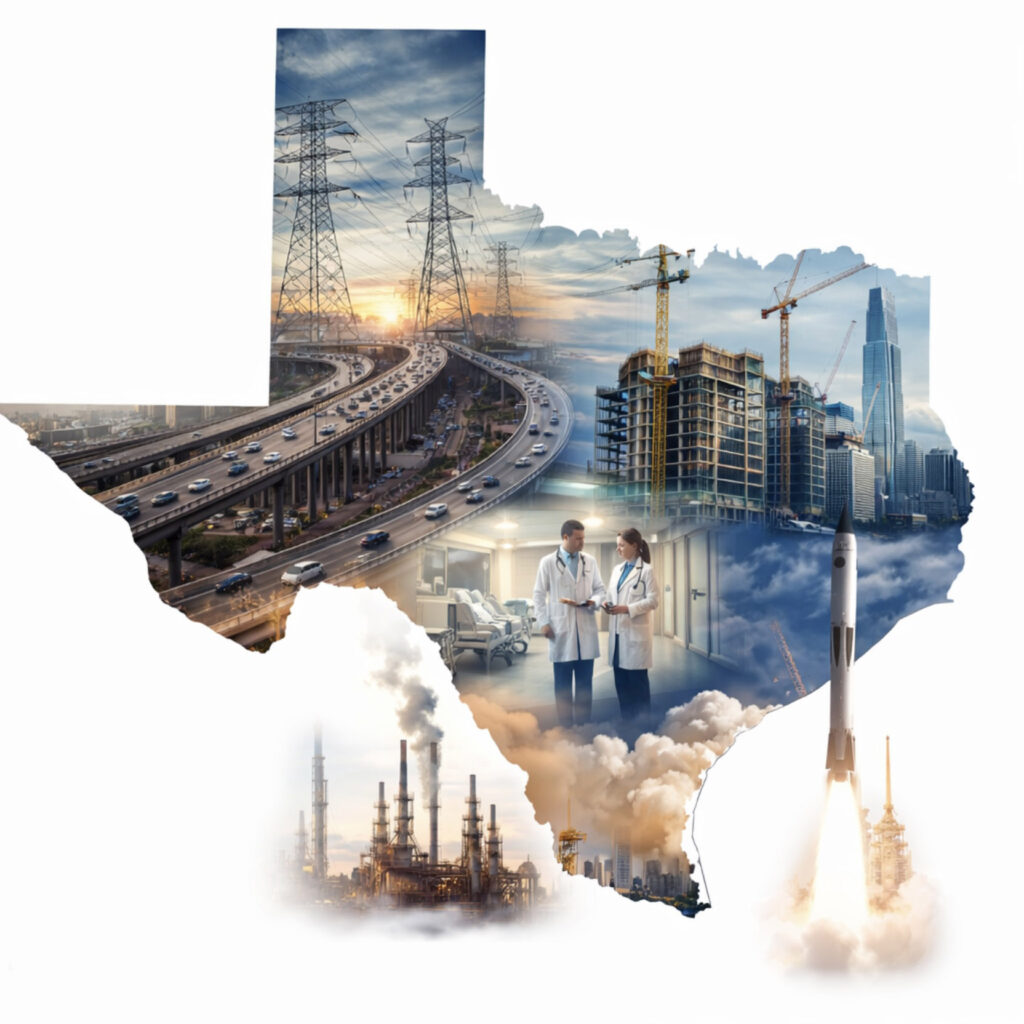
The challenge is not limited to freeways. The same growth is increasing demand for housing, water, drainage, power, schools, emergency services, local streets, sidewalks and public transportation. Texas 2036 reported that from 2010 to 2023, the Texas Triangle captured nearly 87% of the state’s population growth, and that more than 90% of Texas’ growth through 2060 is expected to be located in the Triangle. That level of concentration means planning decisions made in this region will shape the state’s future, whether those decisions involve new subdivisions, toll roads, rail corridors, utility lines or flood-control projects.
Water may become one of the hardest tests. The Texas Water Development Board’s 2027 State Water Plan process is built around population and water-demand projections through 2070, and recent reporting on the draft plan says Texas’ population is expected to grow sharply over the coming decades while existing water supplies decline. Spectrum News reported that the draft plan projects Texas’ population will increase 53% from 2030 to 2080, while annual water availability is expected to decline by 9% and existing water supply by 10%. Those numbers make clear that growth planning cannot be separated from water planning.
Transportation officials are beginning to treat the Texas Triangle as a megaregion rather than a set of disconnected metro areas. TxDOT’s Texas Triangle Multimodal Strategic Plan is designed to evaluate the movement of both people and goods across the corridor, including freight movement and workforce access. Separately, TxDOT’s Statewide Multimodal Transit Plan 2050 identifies transit needs, gaps, challenges and strategies for improving mobility and connectivity options across Texas through 2050. Those planning efforts acknowledge a basic reality: road expansion alone cannot solve every problem created by population growth, freight demand and long-distance regional commuting.
The Texas Triangle’s growth is not a crisis by itself. It is evidence that people and businesses continue to see Texas as a place of opportunity. But unmanaged growth can turn opportunity into congestion, higher infrastructure costs, water stress, longer commutes and uneven development. The practical question for Texas is whether the state can build the roads, transit systems, water projects, housing supply and regional planning framework needed for the population it is already attracting. The Texas Triangle is growing into a true megaregion; the infrastructure conversation now has to catch up.
For this article, we sourced data from the US Census Bureau, TXDOT, Texas Urban Planning Agency, Texas Water Board.