
The 2026 Congressional Forecast: A Democratic House, a Republican Senate, and a Country Still Split Down the Middle
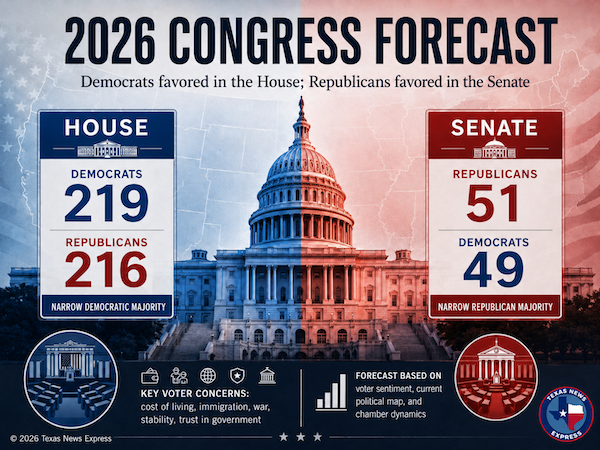
The 2026 midterm elections are beginning to look less like a clean national wave and more like a test of competing political realities. Democrats appear to have the stronger national environment. Republicans, however, still benefit from geography, redistricting, incumbency and a Senate map that is difficult for Democrats to overcome. If the election were held under current conditions, the most likely outcome would be divided congressional control: Democrats narrowly winning the House of Representatives while Republicans narrowly retain the Senate.
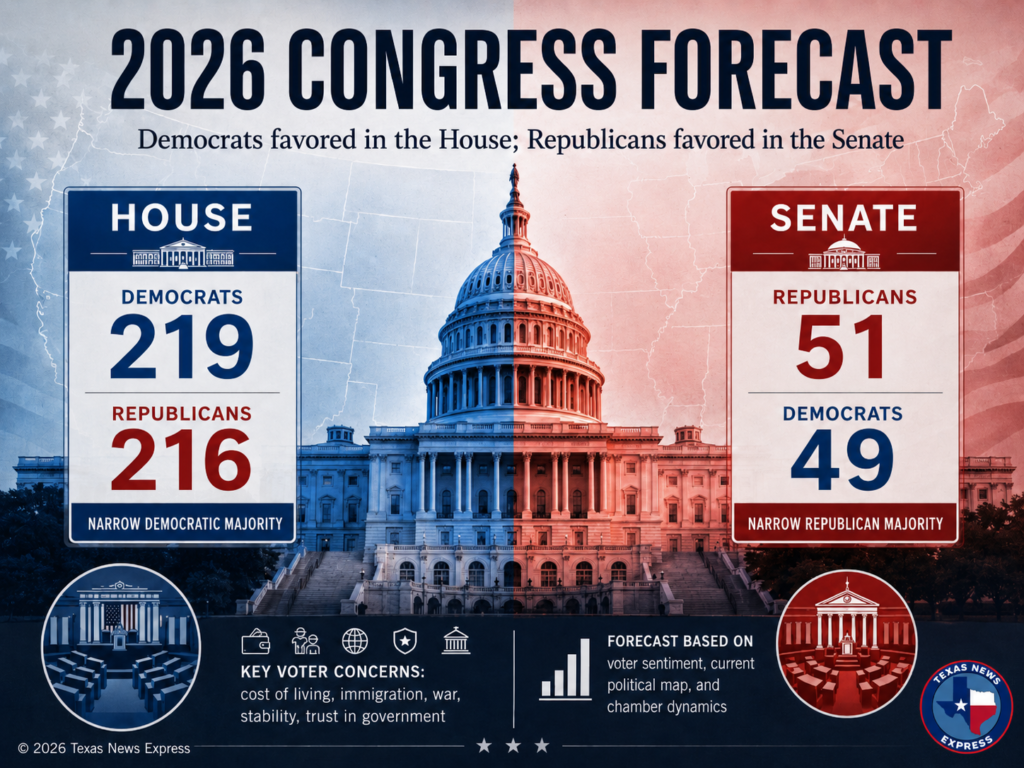
My current projection is 219 Democrats and 216 Republicans in the House, giving Democrats the thinnest possible working majority. In the Senate, I project 51 Republicans and 49 Democrats or Democratic-caucusing independents, enough for the GOP to maintain control but not enough to govern comfortably. That forecast leaves both chambers close enough that a modest shift in public opinion, turnout, candidate quality or late-breaking events could change the outcome.
The House is the more vulnerable chamber for Republicans because the majority is already narrow. In modern midterm politics, a president’s party often loses ground, especially when voters are uneasy about the economy or dissatisfied with the direction of the country. Democrats are hoping to turn the election into a referendum on Republican control in Washington, with a campaign centered on affordability, institutional stability, health care, education, abortion rights, and fatigue with political chaos.
Republicans are trying to make the election about different concerns: immigration, crime, energy prices, cultural issues, national security and distrust of Democratic governance in major cities and blue states. Their argument is not simply that voters should reward the GOP, but that divided or Democratic control would weaken border enforcement, increase spending and return Washington to policies voters rejected in the previous presidential cycle.
That is the central tension of the 2026 House campaign. Democrats have the better national mood, but Republicans have a durable map. The House is no longer a simple reflection of national vote totals. District boundaries, geographic sorting and redistricting battles can allow one party to remain competitive for control even while losing the national House vote. That structural advantage is why Democrats may need a meaningful popular-vote edge just to win a small majority.
The most important House battlegrounds are likely to be in the suburbs and outer suburbs of states such as California, New York, Pennsylvania, Michigan, Arizona, Nevada, Virginia and New Jersey. These are places where voters may lean moderate, dislike political extremes and respond strongly to cost-of-living concerns. They are also places where college-educated voters, independents and disaffected Republicans could determine whether Democrats gain enough seats to flip control.
Texas and Florida will also matter, though in a different way. Republicans are likely to retain large advantages in both delegations, but Democrats do not need to dominate those states to affect the national balance. A small number of competitive districts in fast-growing metro areas could help determine whether the House ends up with a Republican majority of a few seats or a Democratic majority of a few seats. In a chamber this closely divided, even one or two districts in Houston, Dallas, Austin, Tampa, Orlando or Miami could matter.
The Senate is a much harder climb for Democrats. Unlike the House, where every seat is on the ballot, only a portion of the Senate is up in any given cycle. That gives the Senate map its own political logic. Democrats can have a decent national year and still fail to win the chamber if the competitive races are mostly in states that lean Republican.
That is why the Senate forecast favors Republicans despite the broader environment. Democrats have plausible opportunities in places such as North Carolina and Ohio, and they must defend key seats in states such as Georgia and Michigan. But to win the Senate outright, they would likely need to win several difficult races at once while also avoiding any unexpected losses. That is possible, but it is not the most likely outcome under current conditions.
North Carolina may be Democrats’ best pickup opportunity. The state has been politically competitive for years, but Republicans have repeatedly found ways to win statewide federal races there. A strong Democratic candidate, favorable turnout and a national environment tilted against Republicans could put the seat in play. Ohio is also competitive, but Democrats face a state that has moved rightward over the past decade, especially outside the major metro areas.
Texas remains the tempting but difficult prize for Democrats. The state’s growing suburbs, younger electorate and large urban population continue to generate Democratic hopes. But Texas has remained Republican in statewide federal races, and GOP strength in rural areas, smaller cities and exurban counties remains formidable. Democrats can make Texas more competitive, but winning a Senate seat there still requires a near-perfect campaign and a political environment worse for Republicans than the one visible today.
The broader mood of the electorate is likely to be shaped by anxiety more than enthusiasm. Voters are worried about prices, housing, immigration, war, public safety and the general feeling that the country is difficult to govern. Democrats will try to channel that anxiety into a demand for accountability and a check on Republican power. Republicans will try to channel it into a demand for order, border control, national strength and resistance to progressive policy priorities.
Both parties will also be campaigning to voters who are tired. The electorate is polarized, but it is not uniformly energized. Many swing voters are not looking for ideological purity. They are looking for competence, predictability and some evidence that government can still address ordinary problems. That gives both parties an opening, but it also creates risk: candidates who sound too ideological, too performative or too disconnected from daily economic pressure may struggle with the voters who decide close races.
The likely result is not a sweeping mandate for either side. A Democratic House and a Republican Senate would produce a divided Congress that mirrors the country’s own division. Democrats would gain subpoena power, committee control and the ability to block much of the Republican legislative agenda in the House. Republicans, by holding the Senate, would retain influence over nominations, foreign policy debates, judicial confirmations and any major legislative bargain.
Such an outcome would likely increase confrontation in Washington. A Democratic House would almost certainly pursue aggressive oversight of the administration. A Republican Senate would act as a firewall against Democratic legislative priorities. Major bills would become harder to pass, while budget fights, investigations and messaging votes would become more common.
The 2026 election, then, may not settle the country’s political argument. It may simply move that argument into a new institutional arrangement. Voters appear open to checking Republican power, especially in the House. But the Senate map gives Republicans enough protection to survive a difficult environment. That combination points toward a narrow Democratic House majority, a narrow Republican Senate majority and another two years of divided, combative government.